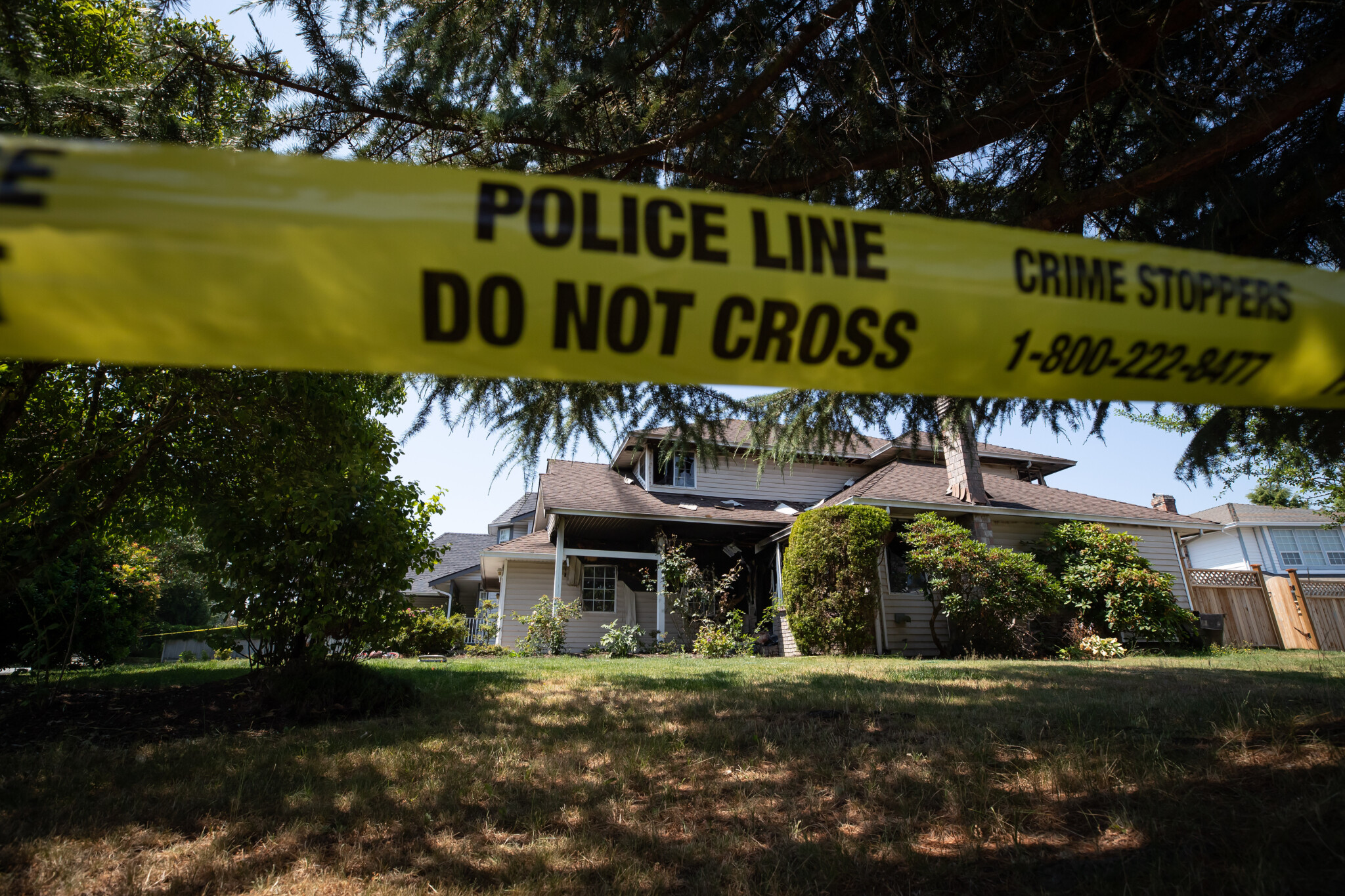
When Abdul Aleem Farooqi was gunned down over Labour Day weekend in front of his family in a brutal home invasion in Kleinburg, Ont., York Regional Police Chief Jim MacSween took to a podium to urge residents: “Don’t take matters into your own hands.”
His comment, made days after one of Farooqi’s daughters was held at gunpoint and her father was shot, landed with a thud. Citizens erupted on social media at the cognitive dissonance: how could the state really direct victims to stand down in the face of armed marauders in their own homes?
MacSween has since walked it back, clarifying that “A citizen should do what they deem necessary to preserve their own safety, and the safety of their loved ones.” But the damage was done. The instinctive backlash revealed something fundamental if obvious. When violent strangers invade the sanctuary of our homes, telling people to hide or wait for police runs headlong against the most primal human reflex of all: to defend one’s self and family.
Conservative Leader Pierre Poilevre has responded with a proposed legal change that, while imperfect, reflects this common-sense instinct.
The maxim that “A man’s home is his castle” has echoed through centuries of law and philosophy. Cicero asked: “What is more sacred, what more inviolable, than the house of every citizen?” The early moderns built on this. Thomas Hobbes argued that the right of self-defence is inalienable. No person can be expected to surrender the right to protect their life. In Leviathan (1651), Hobbes wrote that any covenant to “not…defend myself from force, by force” is void, for no one can give up the right to save themselves from death or injury. John Locke emphasized that entering another’s property by force initiates a “state of war,” a condition in which the victim may respond with lethal force. He famously argued it is lawful to kill a thief who uses force to rob you, even if the thief has not yet harmed you. And William Blackstone, the great 18th-century expositor of the common law, confirmed that when violent burglary invades the home, “the law leaves [a man] the natural right of killing the aggressor.”
Ask The Hub
This makes obvious intuitive sense, and explains the collective recoil upon a second recent case, that of Jeremy McDonald of Lindsay, Ont., who acted non-lethally against an armed intruder with a crossbow and nonetheless found himself facing charges. There is a widespread feeling that our law should not merely tolerate such instinctive acts as concessions to human frailty, but should affirm them as morally rightful. To engineer away this primal instinct by criminal law seems like an illegitimate overreach. Still, critics warn that if this instinct is given unqualified legal sanction, it risks encouraging excessive or even pre-emptive violence under the banner of self-defence. When society’s rules press against our deepest instincts to protect our families from danger, the mammalian drive to defend our own resists. This is why for Hobbes, Locke, and the common-law tradition, any law that unduly limits the right to self-defence was contrary to natural law, and void by its nature. Into this heady brew we come to Poilievre’s proposed “Stand on Guard” principle. His amendment would align Canada somewhat closer to U.S. “castle doctrine” laws, though it stops well short of America’s broad “Stand Your Ground” statutes, which are law in Texas, Florida, and many other mostly red states. Poilievre’s proposal would insert a presumption of reasonableness for force used against someone unlawfully entering a home and threatening those inside. While we have yet to see the exact language he would use in the Criminal Code, he told reporters that “the use of force, including lethal force,” would be “presumed reasonable against an individual who unlawfully enters a house and poses a threat to the safety of anyone inside.” In effect, the law would start from the side of the homeowner, not the intruder. If the scenario constitutes a violent break-in, the law would default to treating the defender’s split-second decision as justified. Police and prosecutors would be directed to presume self-defence, unless clear evidence shows otherwise. Supporters say this would “end the legal limbo” that currently leaves homeowners second-guessed for months or years, and shift the spotlight to the criminal actions of the intruder. The proposal is modest. It applies only to home invasions, not general public confrontations, as in the case of some “Stand Your Ground’ laws, and still requires that the intruder pose a threat, preserving proportionality. It is less a radical rewrite than a statutory nudge, making explicit what many believe the law already ought to assume. Still, ambiguities remain. As law professor Michael Plaxton has noted, questions of reasonableness and proportionality do not vanish. What counts as an “intruder”? Does trespassing on a yard or porch qualify? Toronto residents once complained of drunk 20-somethings using their lawns as impromptu latrines during the pandemic summers when Trinity-Bellwoods Park turned into a de facto bar scene—would that count? More generally: Does appearing uninvited on another’s property always imply intent to harm? These inquiries cannot be eliminated; they are baked into any law that distinguishes justified from excessive force. But we should also be mindful of the externalities of how self-defence laws are framed. If a law is perceived as allowing unlimited right to use lethal force, with no duty to retreat and little scrutiny of proportionality, it can shape citizens’ ex ante expectations in ways with bloody consequences. The most notorious example is the Trayvon Martin case in Florida, where “stand your ground” reasoning was invoked to treat the mere sight of a Black teenager in a hoodie as sufficient suspicion to justify lethal force. A 2020 analysis by the RAND Corporation found “supportive evidence that stand-your-ground laws are associated with increases in firearm homicides.” The implication is clear: removing the retreat requirement may, in some circumstances, produce more deadly encounters. The law must never be read as carte blanche for vigilantism. That’s not the case with Poilievre’s Stand on Guard law. At best, the proposal slightly tilts the presumption toward the homeowner, perhaps discouraging premature charges and giving defenders confidence that the law is on their side. But in cases with some gray areas, courts will still need to assess whether the homeowner’s perception of threat was reasonable and whether the force used was proportionate. That inquiry is inescapable, and as Plaxton points out, if the concern is that a homeowner would need to be subjected to the indignities of investigation and possible court hearings, the proposal comes well short of guaranteeing against that. The Lindsay case has made clear where the public’s instincts lie. Poilievre’s “Stand on Guard” principle is an attempt, however imperfect, to realign the law with those instincts.
Joanna Baron is Executive Director of the Canadian Constitution Foundation, a legal charity that protects constitutional freedoms in courts of law and public opinion. Previously, she was the founding National Director of the Runnymede Society and a criminal defence litigator in Toronto. She studied Classics at St John’s College in MD and NM and law at McGill University.