
Alberta’s geography has always shaped its destiny. When Imperial Oil struck Leduc No. 1 in 1947, it set the province on a new economic course.
Today, some of the same natural advantages—plus a concentration of brain power—are positioning Alberta to play a leading role in the next great boom in artificial intelligence.
But whether the province can turn those assets into lasting gains will depend on the right policies, investments, and a shift in mindset.
On The Hub’s latest Alberta Edge podcast, three leaders in the field—Cam Linke, CEO of Alberta Machine Intelligence Institute, also known as Amii; Nicole Janssen, co-founder of AltaML; and Danielle Gifford, managing director of AI at PwC—laid out what it will take for the province and country to seize the moment.
Geographical advantages
The province checks all the boxes for the energy-hungry data centres AI depends on. It has a cold climate, plenty of land with few earthquakes, and access to water.
But the biggest, most important advantage is the abundance of energy.
“Essentially, [it’s what] data centres come down to—they are an energy problem,” said Linke. “And you need to power them. It’s a power problem almost more than anything else.”
In late 2024, the Alberta government unveiled its formal AI data centre strategy, laying out a vision to make the province the destination of choice for investment in this sector.
Despite challenges around grid capacity and community consent, industry leaders point to Alberta’s deep expertise in managing large-scale infrastructure—from oilsands to natural gas—as a strength.

“We know actually how to hook up and connect the different energy sources that are actually needed,” Gifford said.
Making it work requires aligning all the elements in a steady, abundant, and reliable way.
“Think about if you’re running an AI robot that is doing an operation on a human being, and it’s leveraging compute through a data centre,” Janssen explained. “[If] it’s hit by an earthquake, that’s a problem.”
Alberta has begun exploring nuclear power as a key part of its strategy to meet surging demand for reliable, low-carbon energy. It joins a growing number of jurisdictions around the globe turning to small modular reactors as a possible solution.
Research foundation in Edmonton
One of the best-kept secrets in Alberta is that Edmonton is a world leader in AI development.
Richard Sutton, University of Alberta computing science professor who also serves as the senior scientific advisor to Amii, is widely recognized as one of the founders of modern computational reinforcement learning.
In March, he was awarded the prestigious Turing Award, the highest honour in computer science that is often described as the field’s Nobel Prize.
Janssen attributes the lack of public awareness around this news as part of a “disease many Edmontonians suffer from,” which is humility.
“We have the world-class team—like the best team in the world in Edmonton—and it will be the next big advance in AI,” she added. “That’s in Edmonton! That’s insane! I think that’s something that every Canadian needs to know about!”

A University of Alberta flag in Edmonton on Wednesday, Jan. 8, 2020. Codie McLachlan/The Canadian Press.
From cancer care to regulatory applications to space
The applications are already showing up across Alberta’s economy.
In health care, predictive models are being used to personalize treatment for individual patients. That shift has already shown promise in reducing wait times for oncology care. Elsewhere, AI is showing potential to improve diagnostic imaging, predict opioid overdoses, and simplify triage.
In the energy sector, AI is being applied to methane detection, maintenance planning, and even enhancing security.
AI is also reshaping how large infrastructure and utility projects get built—streamlining regulatory processes, assessing feasibility, and surfacing risks earlier so projects can move faster and more efficiently.
“Maybe one that’s surprising—we’re doing some stuff in space,” Linke said.
“We just hired an awesome new researcher, Abby [Azari], who works at the intersection of AI and space,” he said. “She has some cool projects she’s working on. Things like routing communications through satellites for NASA.”
For Janssen, the bigger point is that AI is not a siloed sector.
“I almost say AI is not even its own industry,” she explained. “The true impact comes from it being adopted by all industries.”
The policy bottleneck
Still, Alberta’s promise won’t materialize without tackling Canada’s commercialization gap.
Linke has distilled the problem down to three main C’s that he says are “killing us.”
“Customers, capital, compute,” he stated plainly.
The customer problem is especially acute in the public sector. From paperclips to power plants, government procurement represents a massive untapped opportunity.
In fact, that kind of purchasing typically accounts for 13 and 20 per cent of a country’s GDP.
In Canada, that makes the government the single biggest potential customer for homegrown AI.
Yet too often, Linke argued, governments buy from foreign suppliers, which means fewer contracts for Canadian firms, less intellectual property developed here, and fewer dollars circulating back into the domestic innovation economy.
The Liberal government under Prime Minister Mark Carney has pledged to shift procurement rules to favour “made-in-Canada” solutions, but that also means picking winners and losers.
“I don’t think anyone wants to see Canada buy the Canadian version of Microsoft Word. We probably should buy Microsoft Word,” Linke mused.
“But there’s a ton of Canadian technology. Talk to a start-up entrepreneur or investor in Canada, and they’ll have 10 horror stories about this,” he said, citing examples such as rules that only allow companies with previous government contracts to qualify as unfair to start-ups.
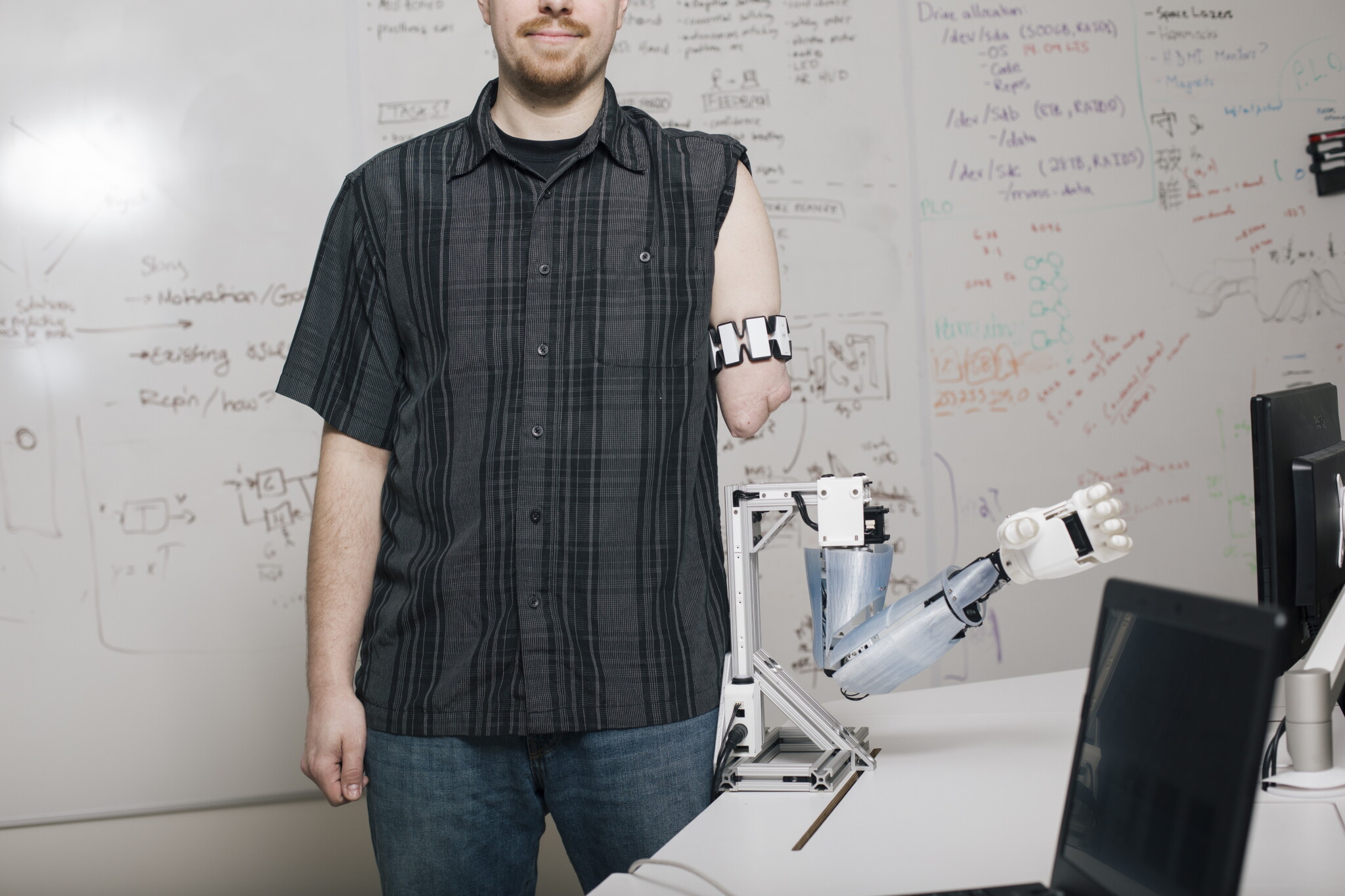
Chris Neilson poses with the Bento Arm at the University of Alberta’s BLINC lab in Edmonton on Thursday March 14, 2019. Amber Bracken/The Canadian Press.
Cultural and attitude shift
Janssen argued there’s also a cultural hurdle. Too often, when Canadian companies look to grow, they instinctively look south.
“We have so much great research that’s here in Canada that literally just sits on a shelf,” she said, adding that Canadians are generally more risk-averse and tend to equate success with being able to sell to Americans.
“When did that become what winning looked like? Why can’t winning be building a big company here?” she asked. “So it’s very much around mindset and entrepreneurship.”
In comparing the Canadian tech sector with Silicon Valley, Gifford pointed to a general difference in attitude when it comes to connecting scientific research with commercialization and, ultimately, profit.
“If you commercialize your idea, you’re almost a sellout, right?” she said about the Canadian mindset. “And if we look south of the border, that’s not at all the case.
“We’re really risk aware,” she continued. “We are not willing to take a leap before we look. That’s something I think that’s fundamentally hard to change.”
Linke pointed to a larger problem beyond tech. If Canadian companies are slow to adopt and continue to gravitate toward U.S. markets, then at what point does it become futile to grow a business here?
“Well, now our C-suites down there,” he said hypothetically. “Why am I even a Canadian company anymore? Why do I stay up there?”

“Generational opportunity”
In its data centre strategy, the Alberta government described the current moment in AI development as one that presents a “generational opportunity.”
Linke and Janssen, who both sit on the national advisory council on artificial intelligence, echoed that sentiment. The latter co-founder of AltaML is so concerned about Canada “squandering” the moment, she has stepped aside from the operational side of her business as co-CEO since June to devote herself entirely to winning hearts and minds, and helping government officials make informed decisions around AI.
“It’s early days—the advisory council has met once. The minister is getting up to speed,” she said about Evan Solomon, the broadcaster-turned-MP who in May became Canada’s first minister of artificial intelligence and digital innovation.
“There’s a lot of good things being said that are exciting for me to hear,” she said. “And now I am going to be there to support how we actually make this happen.”
A good place to start, she joked, would be to stop making movies about AI killer robots.

Falice Chin is The Hub’s Alberta Bureau Chief. She has worked as a reporter, editor, podcast producer, and newsroom leader across Canada…