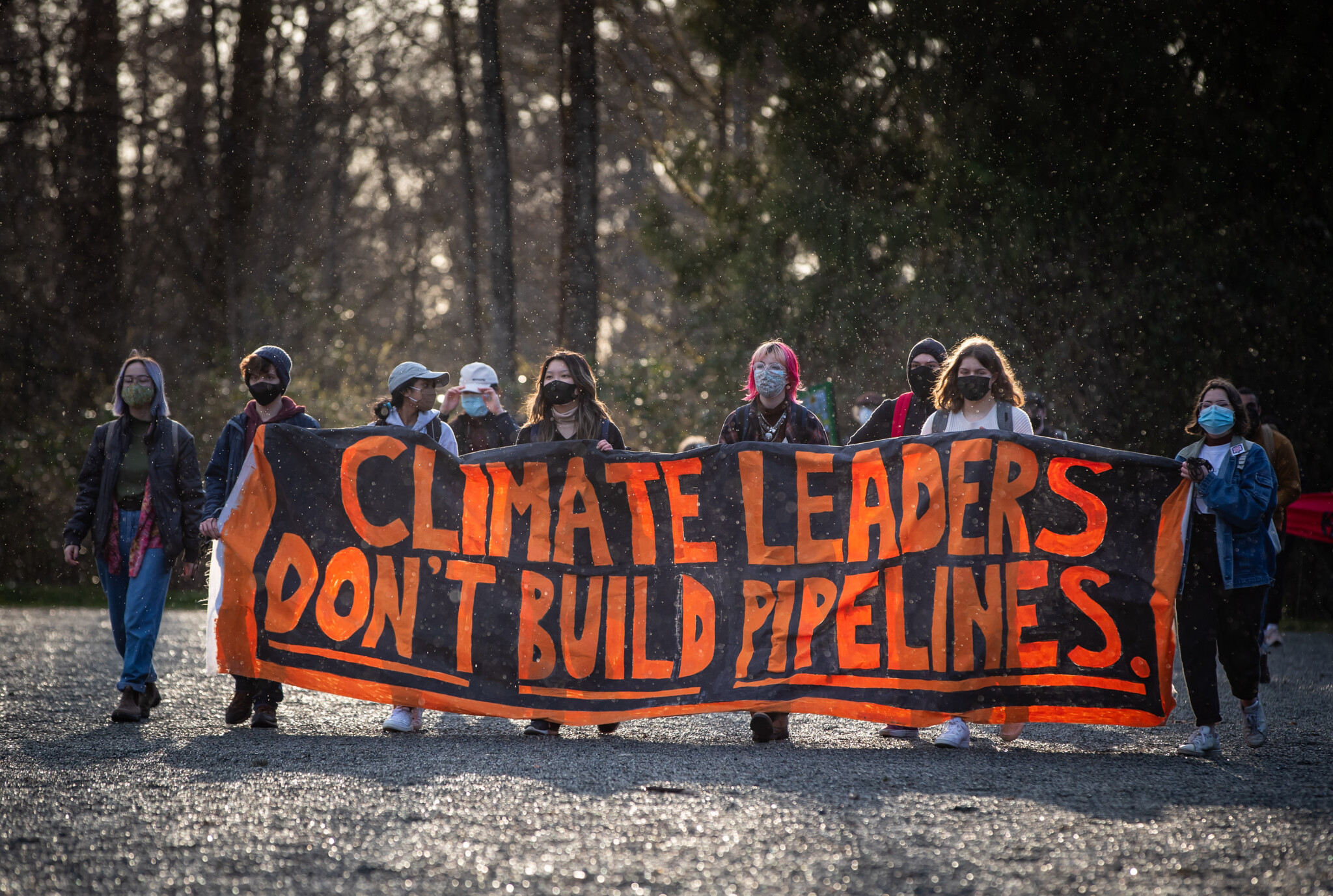
Long before Alberta Premier Danielle Smith announced her government’s intention to submit a bitumen pipeline proposal to the federal government’s new Major Projects Office, the battle lines had already been drawn.
Through the summer and fall of 2025, the federal government’s consultations on Bill C-5—the part known as the Building Canada Act—triggered a flood of communiqués from environmental groups and First Nations organizations across the country.
Their message was remarkably consistent.
The new “nation-building” framework, meant to fast-track major infrastructure, risked becoming a backdoor for oil and gas expansion, according to documents filed in Canada’s national lobby registry.
The records, which The Hub has analyzed alongside the various organizations’ own press releases and emails, as well as interviews, offer an early preview of the intense opposition any future Alberta pipeline will face.
It’s also a reminder that resistance to such projects is increasingly preemptive rather than reactive.

“Absolutely, I think you would see broad-scale opposition to any kind of bitumen pipeline going to the north coast of British Columbia from multiple sources—the government of British Columbia, First Nations, and Canadians broadly,” Tim Gray, executive director of Environmental Defence Canada, told The Hub.
Months before he learned of Smith’s plan, Gray said his group had urged Ottawa to prioritize projects that reflect “the world we’re entering into.”
“So that would be in recognition of the pivot of Canada towards Europe, towards Asia because of what’s going on with the U.S., but also in recognition with the very rapid transition towards a cleaner economy—the adoption of renewable energy, the electrification of everything.”
Three days after the House of Commons passed Bill C-5 at third reading, lobby records show Environmental Defence met with Alberta independent senator Karen Sorensen to present its concerns around the legislation.
Gray said at the time, he and others were more focused on making sure no project, whether expanding the Port of Churchill or building a new high-speed rail in central Canada, would bypass environmental regulations.
Should the Alberta government submit a pipeline proposal in the near future, Gray said his group will ramp up its lobbying efforts and, “of course, the conversation will continue.”

Other environmental groups framed it more forcefully.
“Alberta’s proposal for a new pipeline to B.C.’s coast is a fossil fuel fantasy that takes us further away from true reconciliation,” said Janelle Lapointe, a senior advisor at the David Suzuki Foundation.
“Real reconciliation means land restitution, renewable energy and community power,” the statement continued. “We call on the federal government to respect Indigenous jurisdiction and reject this proposal outright.”
Records show the Vancouver-based non-profit met with officials from National Resources Canada and the Privy Council Office to discuss “protecting the environment and respecting Indigenous and human rights obligations in the implementation” of Bill C-5.
First Nations groups that have preemptively met with government ahead of the creation of the Major Projects Office in Calgary included the Sturgeon Lake Cree Nation, the Mushkegowuk Council, the Kee Tas Kee Now Tribal Council, the Treaty 8 First Nations of Alberta, and the Epekwitk Assembly of Councils.
Not all meetings were about oil and gas, however.
The Mushkeqowuk council, which represents seven First Nations in northern Ontario, for example, is concerned about mineral extractions in the Ring of Fire—a sprawling, undeveloped mining region in the James Bay Lowlands.
This, too, provides a glimpse into the scope of opposition taking shape against the goals of C-5.
In mid-July, the seven chiefs passed a resolution calling on Ottawa to repeal the bill.
In Alberta, the chiefs of Treaty 8 First Nations, including Sturgeon Lake Cree Nation, have been clear about their position since day one.
“This is not a failure of process; it is a deliberate act,” a press release from June 16 read. “This is neither honourable nor constitutional.”

British Columbia takes the stage
If there was ever any doubt about how swiftly Alberta’s pipeline ambitions would ignite interprovincial drama, the Premier of B.C. David Eby dispelled it.
Within days of Smith signalling her intention, Eby delivered one of the bluntest rebukes yet of Alberta’s resource agenda, prompting Smith to call his actions “un-Canadian.”
The exchange quickly became a flashpoint, reviving the same interprovincial tension that defined the Northern Gateway and Trans Mountain (TMX) eras.
Eby may provide a convenient punching bag for pipeline proponents now, but if the past few months of lobbying are any indication, the well runs much deeper.
Beyond the two environmental groups listed earlier, the Canadian Parks and Wilderness Society (CPAWS), Ecojustice Canada, Stand Environmental Society, and the Quebec Environmental Law Centre have all submitted communication reports with the lobby registry.
Canada’s energy minister Tim Hodgson told the Senate last week that Alberta will need B.C. and Indigenous support to build a new West Coast pipeline, which contradicts the Supreme Court’s previous ruling on TMX being a federal responsibility.
What is clear is that the next fight over pipelines will unfold not only between premiers, but also in legislatures, boardrooms, courtrooms, and cabinet meetings—shaped in part by groups that have spent the past months defining the limits of what “nation-building” can mean in a net-zero world.

Falice Chin is The Hub’s Alberta Bureau Chief. She has worked as a reporter, editor, podcast producer, and newsroom leader across Canada…






Comments (14)
I fear Canada will once again fall victim to “The Groups”, unelected, unaccountable, well financed, whose agendas bear no resemblance to the concerns of the majority of Canadians.