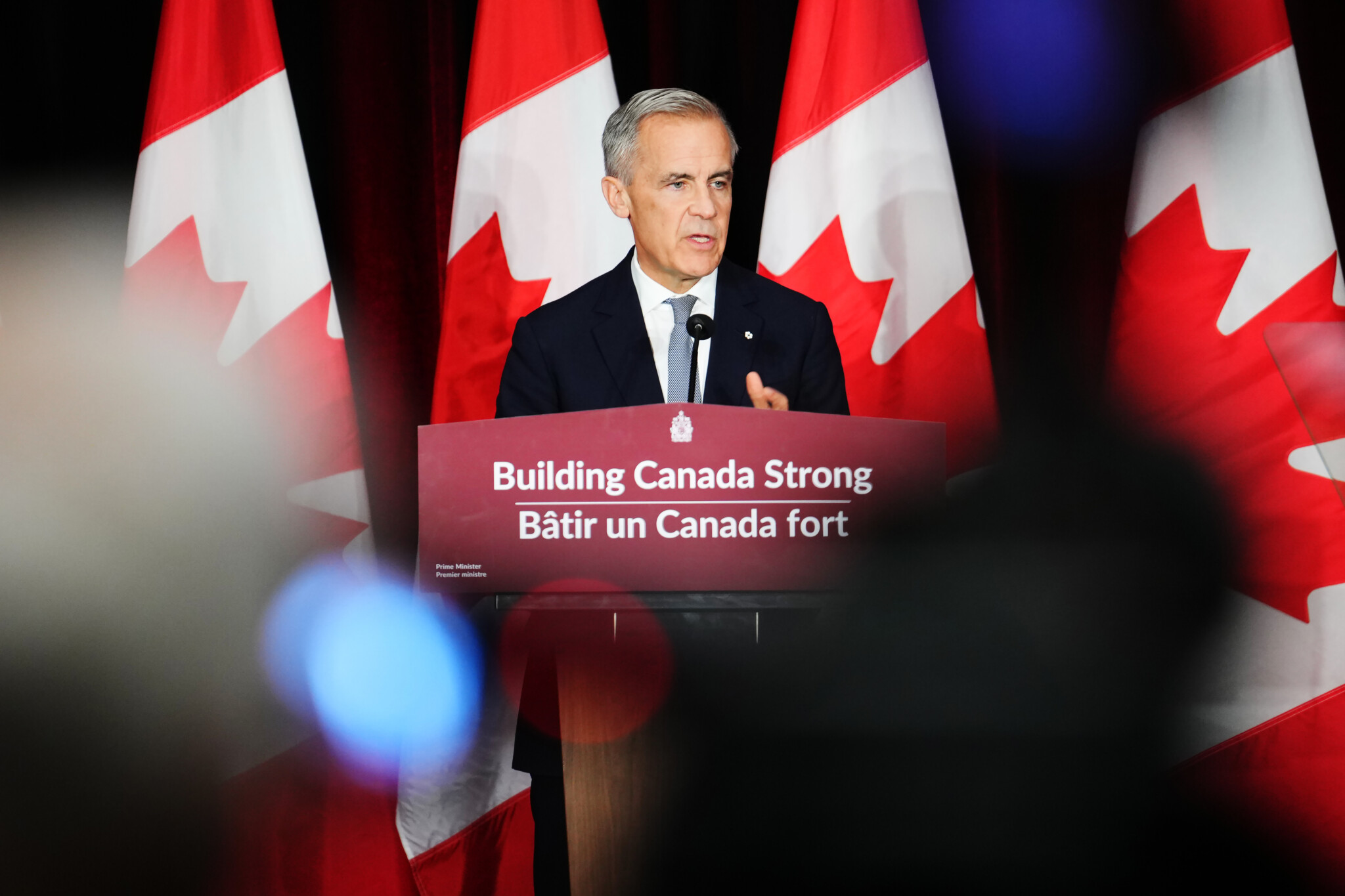
Finance Minister François-Philippe Champagne unveiled the Liberal government’s federal budget yesterday, which he insisted will respond to a new chaotic world not seen since the fall of the Berlin Wall.
“This is a generational shift. This is not just an ordinary transition,” Champagne told reporters alongside Prime Minister Mark Carney. “We’re going to build this country like never before. We’re gonna protect our sovereignty.”
The budget includes a $78.3 billion deficit, projected to fall to $56.6 billion by the end of the decade. In the next five years, the Liberals plan to spend $115 billion on infrastructure, $81.1 billion on defence, and $25 billion on housing. They will invest in bringing down emissions through the industrial carbon tax, oil and gas methane regulations, and carbon capture, making way for the potential elimination of the emissions cap. They also plan to cut from Canada’s ballooning federal civil service, shedding 40,000 jobs by 2029.
The Hub has collected insights from some of our wise contributors to get their take on the budget that was.

There’s a big gap between rhetoric and reality
By Trevor Tombe, professor of economics at the University of Calgary
It was, to quote the finance minister as he entered the House of Commons, an “investment budget.” It aims to address Canada’s dismal productivity performance and, it said, reversing the “history of weak private sector investment” requires a “sea change.”
The government is absolutely right: Moving the needle on investment is indeed key to boosting productivity growth.
But did the budget succeed? The government is setting the bar high, saying that it will “enable $1 trillion in total investment over the next five years.” Unfortunately, the reality is—at best—mixed, and it falls well short of the rhetoric around making “generational investments.”
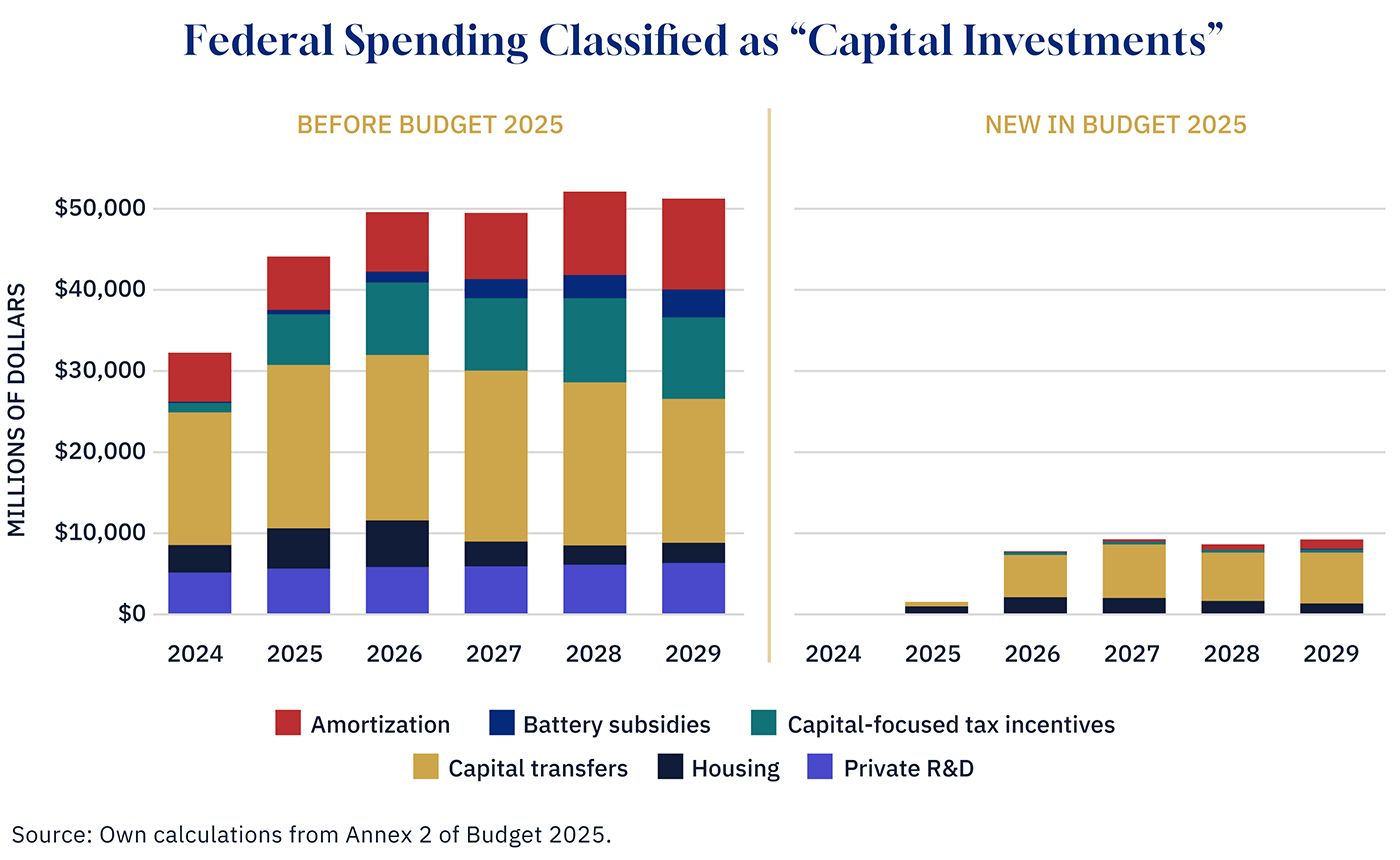
First, the government highlights rising capital spending—from $32.2 billion last year to nearly $59.6 billion by 2029—but only about $8.3 billion of the $27 billion increase is actually new (details are in the budget’s “Annex 2”), and it’s mostly spending on transfers to others, like provinces. That’s roughly 0.2 percent of GDP and in line with commitments seen in many previous budgets. So, for all the hype, this budget does little that’s “generational.”
Graphic credit: Janice Nelson
To be fair, there are measures that could move the needle on private investment. Scrapping the oil and gas emissions cap is long overdue and removes a major drag on one of Canada’s most capital-intensive sectors.
Another bright spot is the so-called “productivity super-deduction.” Silly name aside, it could meaningfully improve business investment incentives by allowing immediate expensing of a wide range of capital investments—from machinery and equipment to computers—the measure effectively lowers the marginal effective tax rate on new manufacturing investments to zero, from around 8.6 percent today. Other sectors see smaller benefits, averaging a two-point tax reduction. Unfortunately, while a real step to encourage private investment, potentially boosting GDP by 0.2 percent (the government reckons), it’s a temporary measure, so its long-term impact is muted.
On the broader fiscal front, deficits remain large, at $78.3 billion in 2025–26, falling to $56.5 billion by 2029–30. This can matter for overall investment since public borrowing can potentially “crowd out” private investment if interest rates are higher than they otherwise would be.
And as anticipated since the election campaign earlier this year, the government has effectively moved away from its fiscal anchor of a declining debt-to-GDP ratio, now planning to miss that previous goal for several years to come.” These projections also hinge on a “Comprehensive Expenditure Review” and other measures to “optimize productivity in government,” with roughly 80 percent of the planned deficit reduction by 2029 relying on these efforts.
The targeted savings are substantial—comparable to the post-financial-crisis review under the previous Conservative government and about one-third the scale of Budget 1995. That requires a level of multi-year discipline and consistency not seen in many years. The budget does have a lot of detail around where those savings will be, so perhaps this time will be different.
In short, it was billed as an investment budget—and in its framing, it’s right about the problem. But on the numbers, it offers more continuity than change.

Prepare to be disappointed if you had high hopes for housing
By Mike Moffatt, founding director of the Missing Middle Initiative
Yesterday’s budget sent a clear signal to Canadians that the federal government’s plan to address the housing crisis is to reduce the demand for homes by cutting immigration, rather than increasing homebuilding.
There is a chasm-sized disconnect between the housing section of the budget and the Liberal Party’s housing platform from earlier this year. During the election campaign, the Liberals made four significant housing policy commitments. Today’s budget delivered on one, substantially watered down two, and ignored the fourth altogether.
The commitment to introduce a GST rebate for first-time homebuyers appears in the budget, as it is included in Bill C-4. What is being implemented is what was promised in the campaign; however, given the crash in new home sales, there was hope that this would be expanded upon.
The Build Canada Homes (BCH) initiative and the promise to reduce development charges have both been watered down relative to the platform. The government has committed to investing $6.8 billion, on an accrual basis, in BCH over the next four years, a 40 percent reduction from the platform’s $11.2 billion commitment. The platform contained an annual commitment to spend $1.5 billion to halve development charges. The budget revises this plan, now only requiring development charges to be “substantially reduced,” and allocating only $1.2 billion annually to the measure.
The final major platform commitment to reintroduce the 1970s-era MURB (Multiple Unit Residential Building) tax provision, which incentivizes the construction of rental apartments, is nowhere to be found in the budget. In place of this supply-side measure on housing, there were demand-side measures through immigration policy changes.
I was surprised to see that the budget repeatedly established an explicit link between high home prices and rents resulting from housing shortages, as well as population growth driven by immigration and non-permanent residents. The budget credits lower population growth as a primary driver of the 3.2 percent reduction in rents nationwide, and promises further cuts to non-permanent resident programs. The federal government is quietly laying the groundwork to reduce housing supply targets, citing slower population growth as the reason.
The rhetoric used in describing immigration policy changes is unlike anything we have seen in recent Canadian history. The budget promises that, in their words, the federal government would be “taking back control over the immigration system,” adopting the “take back control” slogan made famous by the Leave campaign during the Brexit referendum. U.K. Prime Minister Keir Starmer made a similar statement earlier this year, prompting Nigel Farage to note how the Labour government had come around to his way of thinking. In both Canada and the U.K., the immigration consensus is over.

Prime Minister Mark Carney announces funding for houses during a visit to Edmonton, Thursday, March 20, 2025. Jason Franson/The Canadian Press.
The continuing credibility crisis of federal fiscal policy
By William Robson, president and CEO, C.D. Howe Institute
Slogging through the 493 pages of the federal government’s November 4th, 2025, budget reveals the pre-release hype about transformational change to have been just that: hype. Start with the bloated page count. Like its predecessors, the budget buries the key numbers in hundreds of pages of repetition, reannouncements, and condescending political messaging. And the numbers themselves—the projections of revenue and expense, deficit and debt (on page 249!)—suggest that this budget is scarcely more credible than its predecessors were.
We still do not have the federal public accounts for the 2024-25 fiscal year, even though it ended more than seven months ago—another sign that the government does not take stewardship of public funds seriously. In their absence, a crucial number was the total for federal spending the budget showed for 2024-25. That number has a troubling history. The first projections for 2024-25 were in the 2019 Fall Economic Statement, which put it at $421 billion. The budget now pegs 2024-25 spending at $547 billion—more than $126 billion higher in just six years.
Even if that number accurately prefigures what the public accounts will show—and the delay in their release raises suspicions on that score—the government’s spending estimates have been leaping more than $20 billion every year. And notwithstanding pre-release talk of restraint and even austerity, comparing the budget’s projections for 2025-26 and beyond with its earlier budgets and fall statements reveals that the spending projections have risen yet again. Nothing has changed.
If the spending projections are not serious, the fiscal plan is not serious. The 2024 fall statement showed the deficit for 2025-26 at $42 billion. Now the budget says it will be $78 billion. Past fiscal projections claimed the ratio of debt to GDP would fall. The budget now shows it rising. We have no more reason to believe the federal government’s latest plan than we had to believe the earlier ones. The government’s fiscal credibility crisis continues.

Finally, some relief: Energy and resources in the Budget
By Heather Exner-Pirot, a special advisor at the Business Council of Canada, and Michael Gullo, vice president of policy at the Business Council of Canada
It’s been a long time since the energy sector got good news in a federal budget. During the Trudeau era, new investment-killing policies were conceived and announced constantly. Since Prime Minister Carney was elected in April, it could at least be said that bad things were no longer being layered on.
With Budget 2025, some of the bad things could be taken away soon, and what’s more, some good things have been announced. There is a glimmer of hope that we are moving from an era of sticks to an era of carrots.
At the top of the list of bad things was the much-reviled emissions cap. Budget 2025 identifies a series of climate actions that “would create the circumstances whereby the oil and gas emissions cap would no longer be required.”
That doesn’t say the emissions cap is scrapped! Some may quibble. But as the cap is not yet enacted, all the federal government has to do is nothing, and they are signaling they will do just that. At any rate, the limited political space they’ve left to revive it, the bait and switch that would represent to the markets, and the howls it would elicit from the West, make us confident the oil and gas emissions cap is dead.
The elimination of the greenwashing amendment, which made improperly substantiated climate goals punishable with heavy fines, is the icing on the cake.
And then there are the carrots. Calls to amend the investment tax credit regime were heard; the mining exploration tax credit was renewed; there are accelerated capital cost allowances for LNG facilities; and meaningful funding for defence-related critical minerals projects. Further, the federal government has created space for a collaborative conversation with the provinces about the competitiveness of Canada’s industrial carbon pricing regime.
Expectations for the Major Projects Office have gotten higher. It remains to be seen if billions in new infrastructure funding will crowd in private capital for energy projects and trade corridors.
Directionally, the budget is positive. If you’re an energy or mining investor, Canada looks more attractive today than it did yesterday. But there are ways to make it more attractive yet. The budget made some steps, but there is still a way to go yet.

Alberta searches for clarity in Carney’s new climate competitiveness strategy
By Falice Chin, The Hub’s Alberta bureau chief
Mark Carney’s first budget acknowledges Alberta’s central role in Canada’s economic future, and in doing so, shifts away from the current 2030 emissions targets and toward the longer path to net zero by 2050.
It is, in some sense, an implicit admission that the earlier timelines were politically unrealistic. But even with a longer runway, the budget still falls short of providing all of the regulatory clarity and investment certainty Alberta has been asking for.
The budget does not outright eliminate the much-criticized emissions cap or industrial carbon pricing. Instead, it recasts the first as conditional and positions the latter as the centrepiece of Canada’s new climate competitiveness strategy.
If carbon capture, methane reduction, and a more liquid carbon market can reduce emissions at scale, then oil and gas production can still grow. Gone, too, will be the so-called “greenwashing” provisions.
“When conditions are met, we won’t need the cap anymore,” said Finance Minister François-Philippe Champagne.
In other words, technology and carbon markets, rather than output cuts, are expected to carry the burden of decarbonization.
This framing mirrors some of what Alberta Premier Danielle Smith has been advancing.
But how, exactly, we get there remains vague.
Does the budget truly represent a 'generational shift' or more 'continuity than change'?
How effectively does the budget address Canada's productivity growth challenges?
What is the budget's approach to the housing crisis, and is it effective?






Comments (9)
Come on we’re getting Eurovision! No need to worry about labour productivity and fiscal discipline now!