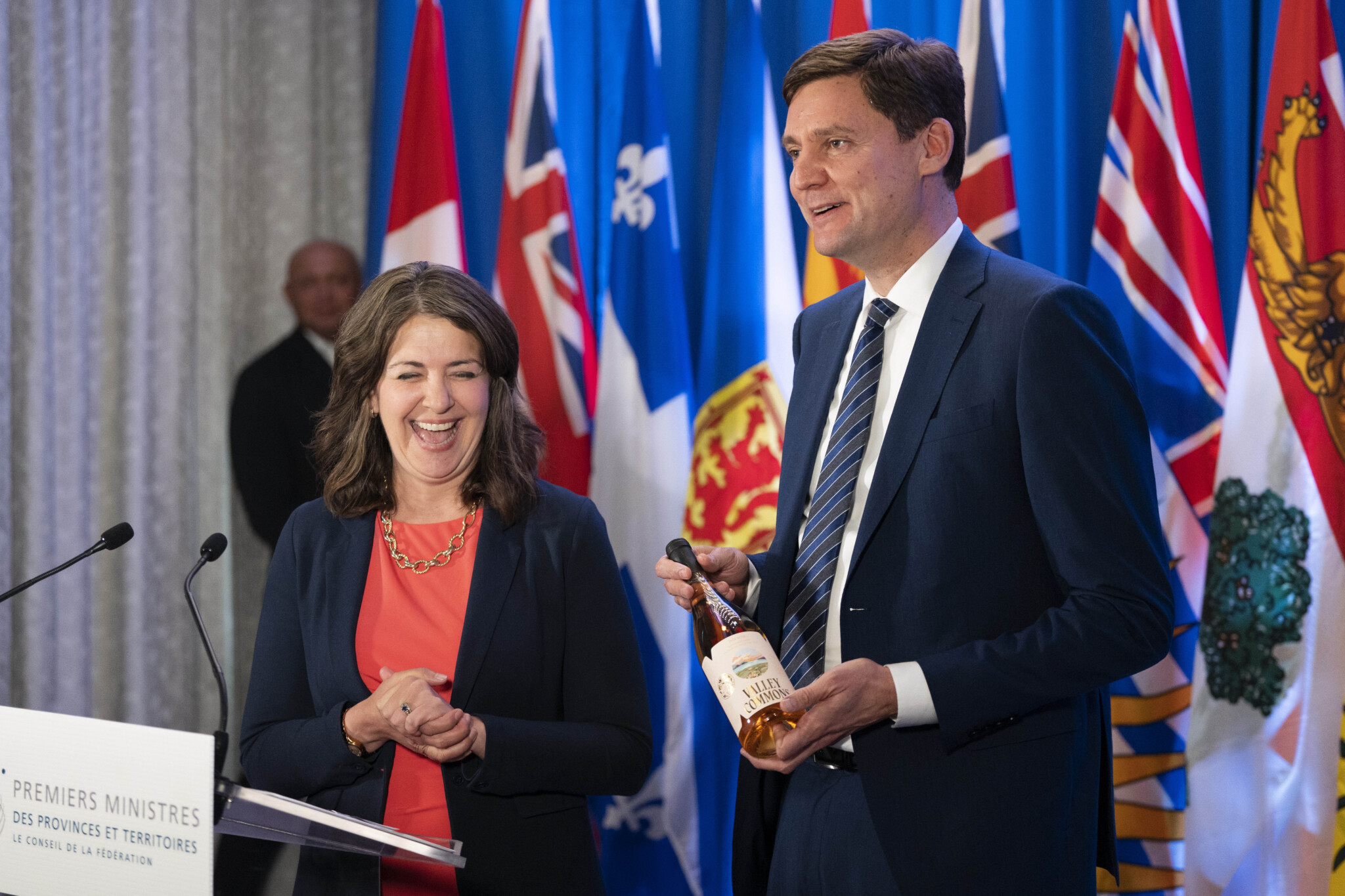
For weeks, political watchers have been bracing for the long-rumoured energy accord between Alberta and Ottawa—a memorandum of understanding (MOU) that would align the two levels of government on a conditional pathway for a new oil pipeline to the B.C. coast.
The fact that it didn’t come in the budget, during the second tranche of major projects announcement, and blew past Premier Danielle Smith and Prime Minister Mark Carney’s half-promised, self-imposed Grey Cup deadline, frustrated a lot of people.
But that delay may have been more necessary than meets the eye.
It all starts to make sense when folding in a third character in this drama of national importance: David Eby.
Assuming what the Globe and Mail and CBC reported this week on the vague sketches of the deal, which again is apparently incrementally imminent, are true—it’s fair to imagine there’s also an element of what one former Alberta NDP staffer calls “managed opposition” going on here.
“I don’t see any realistic path where David Eby becomes the premier who sells an Alberta bitumen pipeline to the B.C. coast,” Keith McLaughlin, who worked under former Alberta NDP premier Rachel Notley, said on The Hub’s Alberta Edge podcast this week.
“The best you might ever get is some kind of managed opposition while Ottawa and the prime minister kind of take on more of the heat here,” he said.
Not that the B.C. premier has the power to veto. But there does appear to be a way forward that makes everyone satisfied politically.
And the timing just happens to work out for Eby, Carney, and Smith.
Why the MOU couldn’t drop during LNG announcement
This theory begins with the most overlooked part of the equation: Eby needed his win first.
The second wave of nation-building referrals—delivered by Carney on the Prince Rupert waterfront—were designed to shine light on B.C.’s LNG projects, transmission corridor, and conservation commitments. That press conference was meant to be B.C.’s moment.
Dropping an oil-pipeline carve-out that same week would have detonated the whole thing.
Coastal First Nations that have signed onto LNG revenue-sharing agreements with the B.C. government have been clear about their position about a hypothetical oil pipeline since the start.
“Premier Smith’s continued talk of oil pipelines and tankers, and the risk of a catastrophic oil spill in B.C.’s coastal waters, is not nation-building,” Marilyn Slett, elected chief of the Heiltsuk Nation and president of Coastal First Nations-Great Bear Initiative, stated last month.
“In fact, it risks the goodwill and support of First Nations for more realistic and economically valuable nation-building projects in B.C. and beyond,” she said.
McLaughlin doesn’t see a scenario where dropping a pipeline announcement, however premature, would jeopardize existing agreements between those communities and the B.C. government on the LNG front.
However, the optics would be terrible.
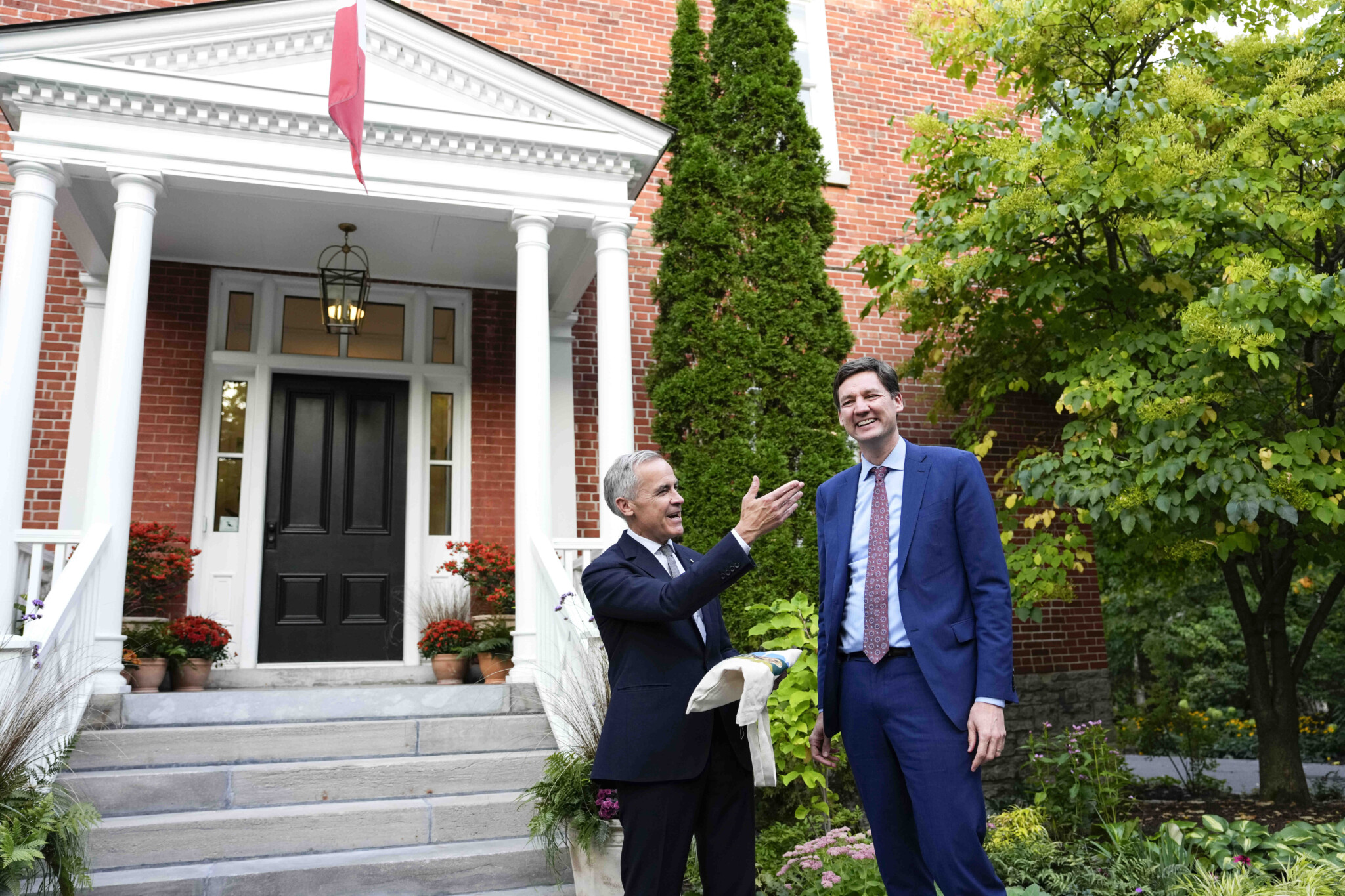
Prime Minister Mark Carney jokes with B.C. Premier David Eby as they make their way to a working dinner at his residence at Rideau Cottage in Ottawa, on Wednesday, Sept. 17, 2025. Justin Tang/The Canadian Press.
The cancelled Northern Gateway project proved that while a majority of Indigenous groups along the route supported the right-of-way, those on the West Coast were overwhelmingly against it.
Reanimating that division now would unnecessarily spark new drama when last week’s focus was all about LNG, said Shannon Greer, another former NDP staffer who has worked in both the B.C. and Alberta governments.
“Is it worth it to have this fight?” Greer said about the prospect of a pipeline proposal with no private proponent. “We know that First Nations in B.C… have strong support from other environmentalists along the coast. So I think it would be very difficult.”
Announcing the MOU just days ahead of the BC NDP convention would’ve also created problems for Eby politically as party leader.
Greer says that although recent polling shows 56 percent of British Columbians support a pipeline, the limited overlap with Eby’s base makes the issue far more fraught.
“What that poll doesn’t show is where that 56 percent live in B.C.,” Greer said on the Alberta Edge podcast. “When you look at the results of the 2024 election, it’s pretty easy to see where the NDP support is concentrated, and how those regions likely feel about the environment versus how folks in Northern or interior B.C. feel about a pipeline.”
Indeed, Eby easily sailed out of his party’s convention days after the second tranche announcement, winning 82 percent support from members.
But there are also parallels for the federal Liberal Party.
Heading into his budget vote this week, the last thing Carney needed was grumbling from his own party, especially from B.C. MPs, in a razor-thin minority government.
“It may well be that some members of his own caucus are not fully on board that new vision,” Premier Smith said this week. “But I will know in the matter of days whether they’re influential enough to change the direction that I think the prime minister and I want to go.”

Smith may get her day in the sun next
If the first act was all about Eby, then the next one could belong to Smith.
The Globe’s reporting suggests the MOU is close enough to touch—with insiders in both the federal and Alberta governments feeling “optimistic” it could land in time for the UCP’s annual general meeting at the end of November.
That timing mirrors the logic that shaped the Prince Rupert announcement, which is to give each premier the room to get what they need, when they need it, without blowing up each other’s coalitions.
Like Eby, Smith’s wishlist is well known.
There’s even a shorthand for it—the so-called “nine bad laws,” which include changes or carve-outs for the tanker ban, the industrial carbon pricing regime, and the emissions cap.
All three are potentially on the table in this ever-imminent MOU.
Dropping those details after the budget, after Eby’s NDP convention, and after the federal Liberal caucus has had its chance to vent—but before Smith’s UCP AGM—gives her maximum lift with minimum risk to the other two parties.
If the stars do in fact align, she’ll get to present a giant win just like Eby did to her base, proving that her steady, conciliatory tone, normally the opposite of red meat for the UCP base, has paid off.
Any First Nation backlash from the West Coast would still be real, but it wouldn’t dominate the national stage as it would have if the photo ops from that very same region had come during the week earlier.
“I think it remains good politics for [Eby] to oppose this project… And it’s been good politics for Premier Smith as well,” Greer said. “Both of them have benefited from this conversation.”
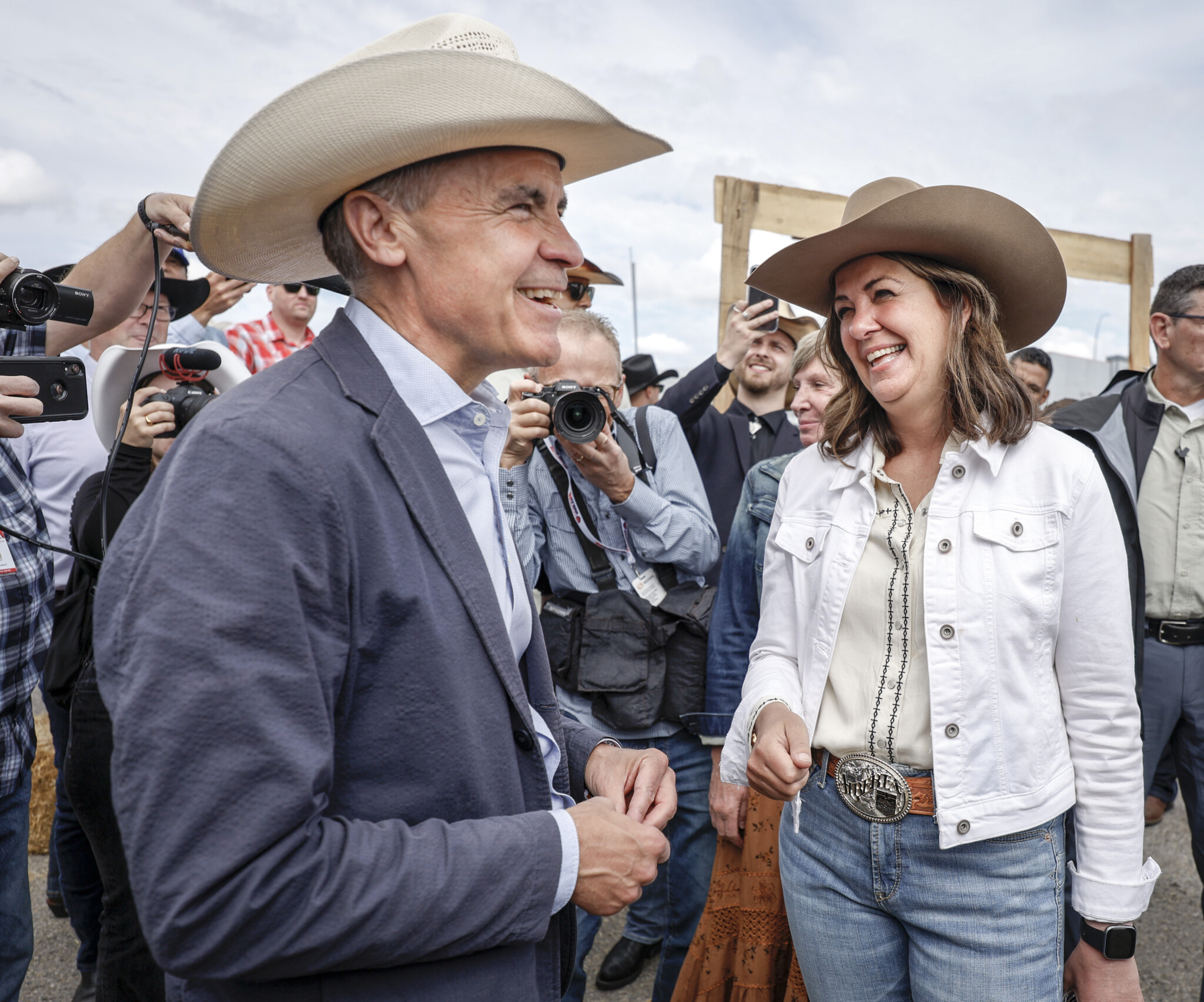
Prime Minister Mark Carney, left, meets with Alberta Premier Danielle Smith as the pair attend a Stampede breakfast in Calgary, Alta., Saturday, July 5, 2025. Jeff McIntosh/The Canadian Press.
Is the MOU just a plan for a plan?
Politics aside, any MOU is just the beginning. Both McLaughlin and Greer acknowledged that many tough challenges still lie ahead.
For starters, someone still needs to step forward as a proponent.
“Alberta is spending $14 million to map out that route—to also establish some parameters around who the proponents or consortium would be,” said McLaughlin. “I’m hoping that there’s a lot of that going into supporting conversations with the [First Nations] because so far Alberta hasn’t really, at least to my knowledge, done enough there to engage folks.”
Interior B.C. Nations may view the project differently than coastal Nations, but equity is no longer optional, he said.
The tanker ban is likely to be the main flashpoint.
“Another thing I think we don’t think about is the tourism impacts,” said Greer. “There’s so much tourism in B.C. Do you really want to go and see a tanker a day coming through? So there is a lot evolving and there’s a lot of different interests.”
View reader comments (7)
Critics of that argument often point to Alaska as an example where a robust energy export regime involving tankers can coexist with a world-class tourism industry. Even so, both NDP observers said Alberta needs to do a better sell job.
“Alberta has a lot of work to do here on the First Nations aspect of this to build at least some support along the route,” McLaughlin said.
Then there is the Alberta side of the bargain.
In exchange for movement on the pipeline corridor, Smith is being asked to engage constructively on the carbon capture front. The Pathways Plus project still has many unanswered questions, including onboarding Alberta’s own First Nations.
Interestingly, a group of chiefs from the Confederacy of Treaty Six First Nations in Alberta met with Smith this week to discuss a host of issues, including the creation of a resource revenue sharing agreement. The group did not respond to The Hub’s follow-up questions about that meeting.

Time to haul everyone into the “principal’s office”
All roads ultimately lead to the federal government, which, both the B.C. Court of Appeal and the Supreme Court of Canada affirmed, has jurisdiction over interprovincial infrastructure.
The last great pipeline fight was the TransMountain expansion, back when Kinder Morgan was still the proponent and when the BC NDP under John Horgan did everything possible to stall the project.
That conflict escalated from a war of words to real trade retaliation in 2018, with Notley’s government temporarily banning wine imports from B.C. and threatening to “turn off the taps” by restricting fuel exports westward.
That spat landed in the courts and in the prime minister’s office, ultimately resulting in a multi-billion-dollar government bailout.
“I’m actually reading John Horgan’s memoir, and he talks about being called into the ‘principal’s office,’ with Rachel Notley, where they both end up in Justin Trudeau’s office to hash out [a truce],” Greer said.
“I think we’re probably going to see this,” she said. “But the difference is that Mark Carney is a very different kind of principal.”
McLaughlin doubts Eby would be able to drag his feet the way his predecessor did this time around.
“I think the context we’re in is actually so different now—to really torture the metaphor— because the school board weighed in after, right? And it’s a new policy and it’s a settled sort of school board policy,” McLaughlin said in reference to the Supreme Court.
By invoking that federal power, he said, “principal Mark Carney is going to have to sort of negotiate a détente of some significance.”
And it’s possible that that “détente” allows room for Eby to continue to project dismay. In other words, a more advanced version of the “managed opposition” referenced earlier.
Money, of course, has a way of smoothing things over.
Carney has already signalled his government won’t buy another pipeline. But to assuage Eby and British Columbians who are against any such project, McLaughlin entertained the possibility that the federal government could re-tweak transfers or financial incentives for the province.
For the record, no one has proposed this. It came up as a thought experiment during the podcast episode.
“Could there be sort of, you know, a couple of billion dollars a year that get funnelled through the British Columbia government for something like this? You could see a scenario where that gets on the table,” he said. “I don’t think we’ve heard the last of this discussion.”
At the end of the day, any MOU—real or imagined—is not an actual pipeline.
At best, it’s the start of a long and difficult business, bureaucratic, and political journey that could drag on for years. The real fights—legal challenges, First Nations negotiations, political recalibrations, and back-and-forth over economics and risks—haven’t even begun.

Falice Chin is The Hub’s Alberta Bureau Chief. She has worked as a reporter, editor, podcast producer, and newsroom leader across Canada…
How does the political timing of the pipeline MOU benefit BC Premier David Eby?
What is the 'managed opposition' strategy mentioned regarding BC's stance on the pipeline?
How might the pipeline MOU timing benefit Alberta Premier Danielle Smith?





Comments (7)
Almost half of the benefits of the AB oil industry is in the rest of canada.
There is your benefit.
We’ve seen this show before, Horgan strutted and posed and vented against the TMX expansion to gain “social license” for his LNG dreams and it failed utterly, the same climate/insane that opposed TMX fought LNG Canada and the coastal gas link pipeline but in the end both were built after endless delays and added costs that now scare investors away.
TMX expansion was not a success, the govt was forced to take it over and proceeded to be government, driving costs to 6x overrun, unheard of in canadian mega projects, sending a clear message to out side investors.
Coastal gaslink was 2x over budget even though it was physically attacked by terrorists and TC Energy had the decency to appear upset at that but this is standard for mega projects.
I have zero faith in carney as his inticts are all wrong. He should pull back c5 and instead announce they are going to systematically fix all the Trudeau era blockages.
And get out of the way.