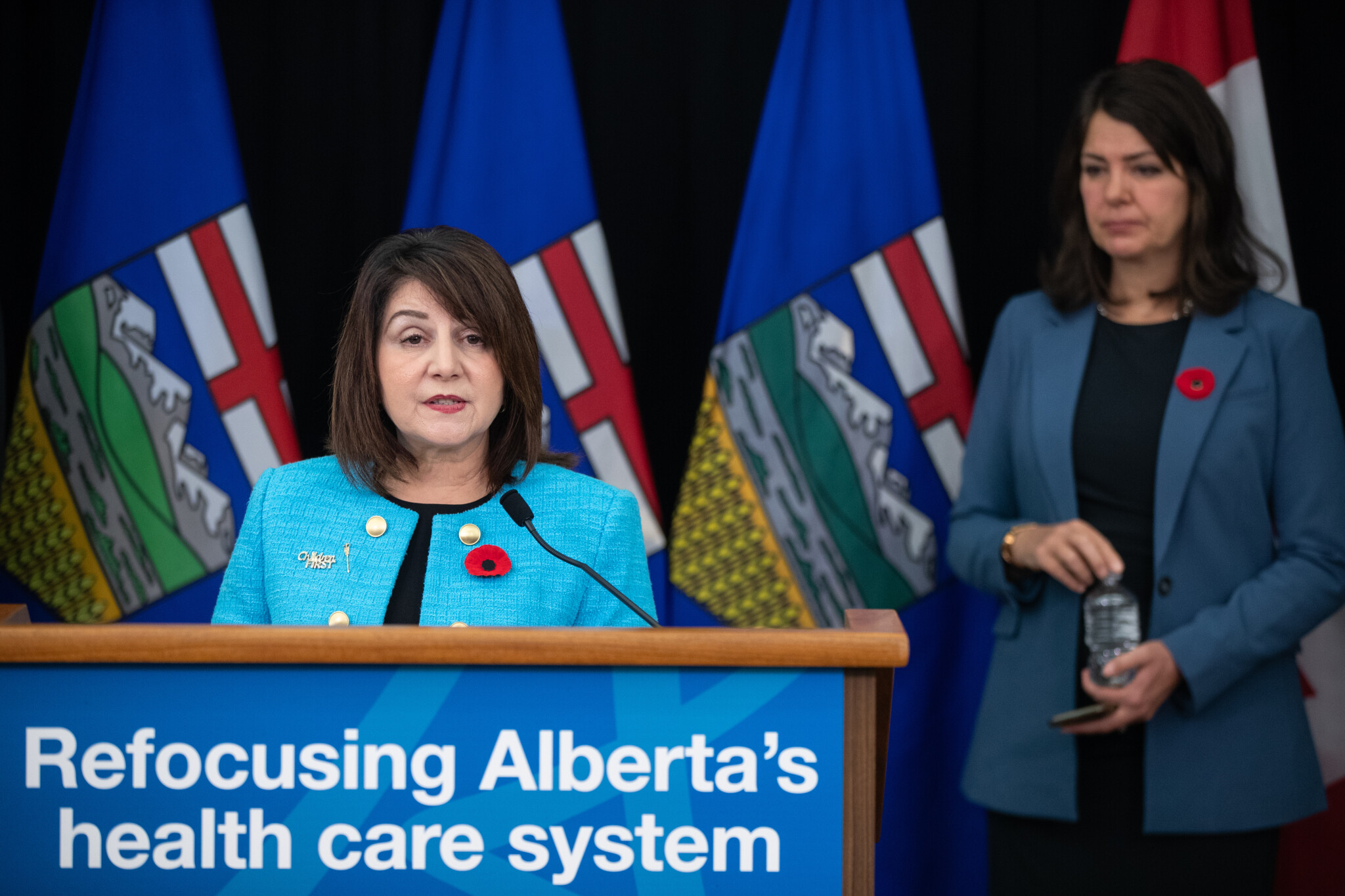
Alberta’s Minister of Primary and Preventative Health Services, Adriana LaGrange, spoke to The Hub in an interview about newly unveiled legislation that would allow physicians to practice in both the public and private health-care systems simultaneously within the province, marking what she calls a fundamental shift in how Alberta delivers medical services.
The proposed changes would create a new category of “flexibly participating physicians” who could toggle between publicly funded and private practice on a case-by-case basis, a model LaGrange insists is common in European health-care systems.
The Hub co-founder Sean Speer spoke with Minister LaGrange to better understand the rationale behind the reforms and how the province plans to protect public health-care access.
Here are four key takeaways from the conversation:
1. Alberta will introduce a “flexibly participating” physician category: Currently, doctors must choose between being fully “opted in” to the public system or “opted out” and working entirely privately—a transition that takes 12 to 18 months. The new system would allow physicians to work in both simultaneously.
2. The reforms aim to reduce surgical wait times by expanding capacity: Alberta currently performs surgeries within clinically approved times only 70 percent of the time, according to LaGrange, up from 40-45 percent two years ago. The province plans to add 50,000 surgeries this year to last year’s record of 318,000.
3. Certain medical services will be excluded from private practice: Emergency surgeries, cancer surgeries, and family medicine will remain exclusively in the public system, said the minister, as the province prioritizes attaching every Albertan to a primary care provider.
4. The government aims to impose guardrails to protect the public system: Proposed safeguards include requiring physicians to work a minimum number of hours in the public system and restricting opt-outs in medical specialties facing shortages.

Alberta will introduce a “flexibly participating” physician category
Under the current system, Alberta physicians face a binary choice: work entirely within the publicly funded Alberta Health Care Insurance Plan or opt out completely and charge private rates. Only 14 physicians in the province have opted out, partly because the transition takes 12 to 18 months.
“The way it will work [now] is you can be a participating physician, which would be you’re opted-in. You can be a non-participating physician, which would be your opted-out. But you can also be a flexibly participating physician, which means you can toggle between the opted-in and opted-out, public and private,” LaGrange explained. “That can be done on a case-by-case basis.”
Physicians would be required to inform patients of their options and provide full transparency about costs. The model mirrors systems already in place in Quebec and New Brunswick, as well as several European countries.
The reforms aim to reduce surgical wait times by expanding capacity
LaGrange pointed to persistent lengthy wait times as the primary driver of the reforms.
“Right now, a hip surgery I’m hearing could be up to 18 months, sometimes longer. And yet in [European] countries they can do it within weeks to months,” LaGrange said, referencing European jurisdictions with dual-practice systems. “I do not know any person that doesn’t know someone who’s left the province or left the country to get a much-needed surgery.”
The minister described hearing from an orthopedic surgeon who was allocated only one day per month for surgeries due to budget constraints, despite having a lengthy waitlist. Under the new system, that surgeon could perform additional procedures privately, theoretically reducing the public queue.
“[When] I first started, roughly about 40 to 45 percent of surgeries were being done in clinically approved times,” LaGrange said. “Now we’re nearing 70 percent in clinically approved times.”
Certain medical services will be excluded from private practice
The legislation includes explicit carve-outs for services the government considers essential to the public system. Emergency surgeries, cancer treatments, and family medicine will remain exclusively publicly funded.
“You cannot opt out if you are doing emergency surgery, if it’s cancer surgery, or if you are a family physician,” LaGrange stated. “Right now, our priority in the family physician realm is to make sure that every Albertan is attached to a primary care provider.”
These exclusions reflect the government’s stated priority of maintaining universal access to urgent and primary care while using private capacity to address elective surgical backlogs.
Alberta aims to impose guardrails to protect the public system
LaGrange acknowledged concerns that allowing private practice could drain resources from the public system. She outlined several proposed safeguards, though details, she explained, remain subject to consultation with the College of Physicians and Surgeons and the Alberta Medical Association.
Potential requirements include mandating that physicians work a minimum number of hours or days in the public system before performing private procedures, or possibly restricting private work to evenings and weekends.
“We have the authority within the legislation to, if we recognize that we have a shortage of a particular discipline, make sure that they are not able to opt out or to become flexibly participating physicians until such time as we have the numbers that we need within the public system,” LaGrange said.
The minister pointed to European models where dual practice has not diminished public access, although critics have noted those systems often have different funding structures and regulatory frameworks than Canada’s single-payer model.
“The status quo is not working,” she said. “Let’s do something different.”
This commentary draws on a Hub podcast. It was edited using AI. Full program here.
Will allowing doctors to work in both public and private systems truly reduce wait times, or could it exacerbate inequities in healthcare access?
What are the potential economic implications of Alberta's new 'flexibly participating physician' model for both doctors and the healthcare system?
How does Alberta's proposed legislation balance the need to address surgical wait times with the commitment to maintaining a strong public healthcare system?





Comments (1)
An excellent address, however a bit too much direct emphasis on the system and doctors. I only heard two references to patients and that’s what good health care is all about. The system has to be designed to put patients at the top of the priority list and allow everyone working to that end to focus on it. Having said that a well designed public, private, non profit system will do just that.