
Canadian governments hired an additional 950,000 employees in the last decade, making up 30 percent of all of Canada’s employment gains from 2015 to 2024, according to a new Fraser Institute study.
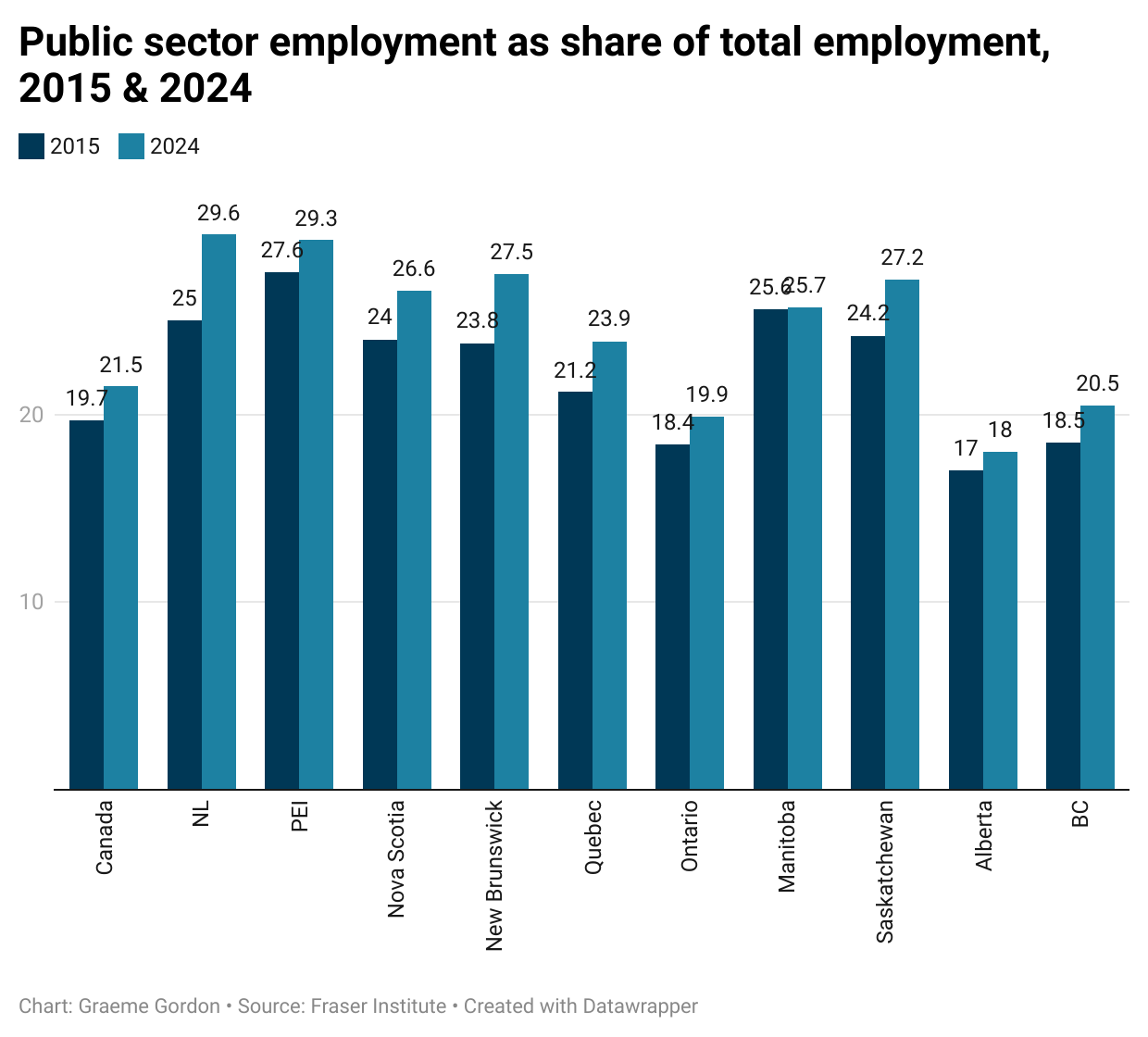
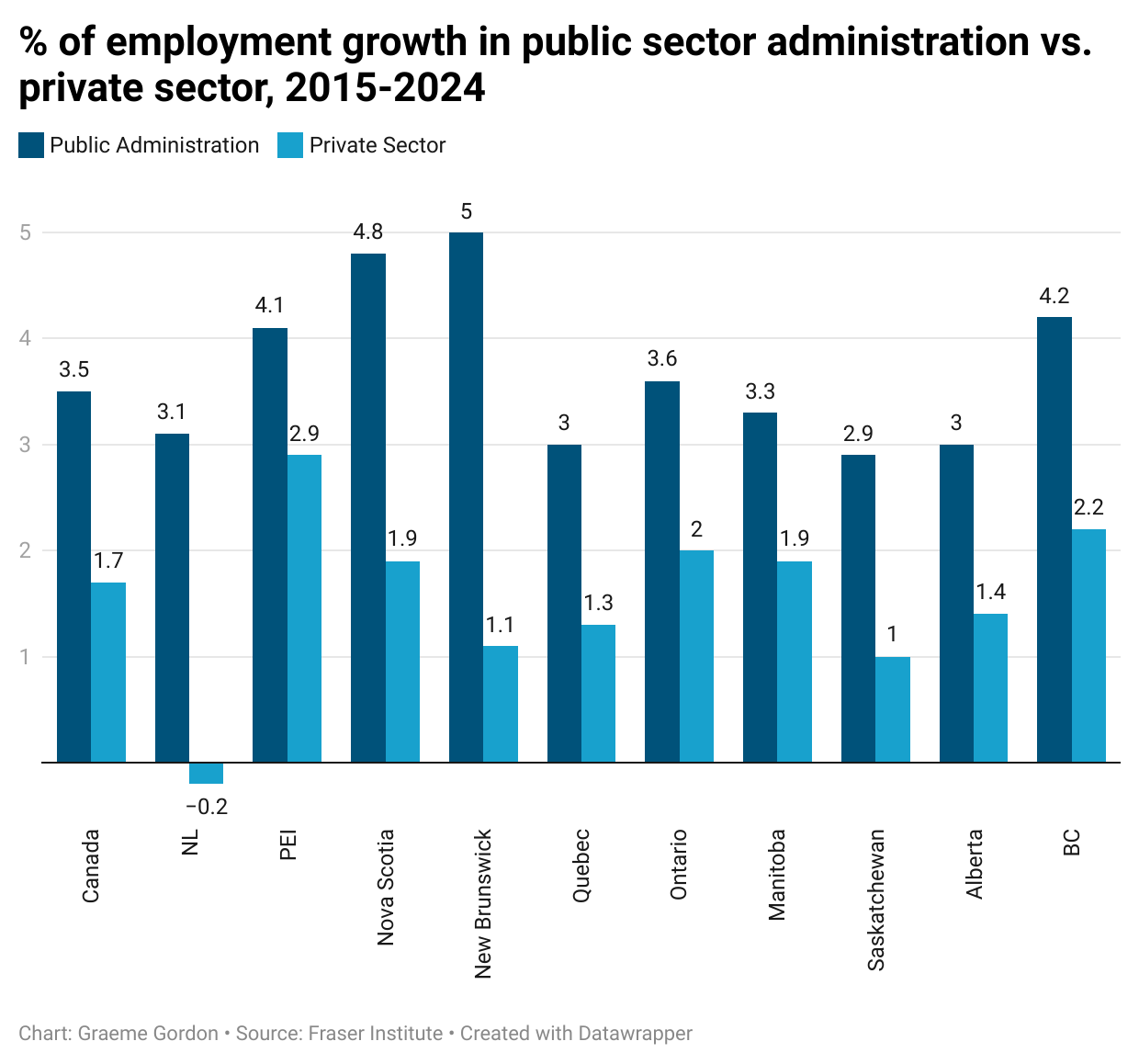
The proportion of government employees in Canada’s workforce crept up from 19.7 percent in 2015 to 21.5 percent by last year, comprising workers from all three tiers of government: municipal, provincial, and federal. Public sector jobs grew at an annual average rate of 2.7 percent in the past decade. Meanwhile, private sector employment grew at 1.7 percent per year.
“Overall, [it] shows that we’re moving away from anything that can be described as sustainable,” said Jason Childs, a University of Regina economics professor and author of the study. “You cannot have an economy with decent standards of living where the majority of what’s going on is government [growth]. The private sector is the one that ultimately pays for everything.”
The disparity in government job distribution across Canada varied greatly from province to province. In Alberta, government workers make up 18 percent of the workforce. Meanwhile, just under 30 percent of those employed in the Atlantic provinces work government jobs.
The report defines government employment as public sector employees according to the North American Industry Classification System (NAICS), which includes workers in health care, education, and social services.
Federally, the civil service shot up to a record high of 367,772 personnel in early 2024 from 257,034 back at the start of 2015—when the tenure of former prime minister Justin Trudeau began—a 43 percent increase. The Privy Council Office (PCO) nearly doubled from 727 PCO employees to 1,288 employees in 2024, a 77 percent increase.
During the same time period of 2015 to 2024, research from the Macdonald Laurier Institute found that Canadian public sector productivity declined by an average of 0.3 percent, costing the Canadian economy an estimated $32 billion in GDP.
In response to Canada’s productivity stagnation, Prime Minister Mark Carney has committed to reducing the federal civil workforce.
“We will spend less to invest more,” Carney said upon release of his first budget at the start of November, where his Liberal government laid out a plan to scale back the number of federal employees by roughly 40,000 or 10 percent through “attrition and voluntary departures.”
The federal government plans to cut back Ottawa’s employment payroll by enticing senior employees to retire early by offering generous early retirement packages which the Liberal government earmarked an estimated $1.5 billion over five years. The government has also implemented hiring freezes and are getting other employees to voluntarily leave.
Public sector unions called proposed cuts part of an “austerity” budget, claiming they will lead to the expanded use of private consultants, and hurt service delivery.
The latest Fraser Institute report also found that out of all the government jobs added, 328,200 of those were public administrator jobs, a subset of which are among the highest-paying. This represented just under a third of all new government jobs added from 2015 to 2024, and 10 percent of total jobs added to Canada’s overall workforce during that time.
Public administrator roles are defined as jobs that involve the judicial interpretation of laws, the administration of programs, legislative activities, taxation, national defence, public order and safety, immigration services, foreign affairs and international assistance.
That study was released last week, around the same time that the Treasury Board of Canada Secretariat showed that over 27,000 federal employees made at least $150,000 in the 2024 fiscal year.
Around 5,000 of those civil servants were paid between $200,000 and $249,999, while another 1,400 earned between $250,000 and $299,999. Another 654 federal employees made $300,000 and $399,999, while 42 others were paid within the range of $400,000 to $499,000. Six others surpassed half a million in salary.
Childs believes Canada is not “meaningfully different” from European countries with large bureaucracies like Greece and France.
“It’s really easy to slip into a negative spiral. You can even find yourself in a situation where you need to raise taxes to pay for the public services, but that scares away private sector investment, which then means you have to raise taxes again,” Childs explained.
“If [the growth of the public sector] is preventing meaningful economic growth from taking place, maybe due to regulatory overburden, red tape…then you’ve got two problems,” Childs added.
Another Fraser Institute research study from October compared compensation for public sector employees versus those in the private sector shows government employees retire approximately 2.2 years earlier, receive better pensions, take 6.4 more work days off for personal reasons, and earn 4.8 percent more than private sector employees, on average.
“The trend toward sustained strong public sector employment growth is worrisome given Canada’s weak productivity and persistent deficits by both provinces and the federal government,” Childs concluded in his research. “The size of the broad public sector workforce will have to shrink, both absolutely and relative to overall Canadian employment.”

Graeme Gordon is The Hub's Senior Editor and Podcast Producer. He has worked as a journalist contributing to a variety of publications, including CBC,…
Is the growth of government jobs a positive or negative for Canada's economy?
What is the government's plan to address the growth in federal employment?
How does public sector compensation and benefits compare to the private sector in Canada?







Comments (7)
It’s so easy spending other people’s money. Eventually the chickens come home to roost though. The steps the liberal government is planning on taking are tepid at best and will not make a dent in the out of control spending.
You can call it spending, you can call it investing, in the end, spending is spending and Canadian tax payers are tapped out. This government would rather see the country sink into insolvency rather than take the bold steps necessary to right the ship and reduce hurdles to facilitate investment. We need less pandering and more “getting out of the way” for this country to even have a shadow of a chance. We should be wealthy beyond compare, instead, we’re wallowing in insolvency and irrelevance, that’s not an accident, that pure incompetence.