In the Weekly Wrap, editor-at-large Sean Speer analyses, exclusively for Hub subscribers, the big stories shaping politics, policy, and the economy in the week that was.
Assessing Harper’s legacy, 20 years on
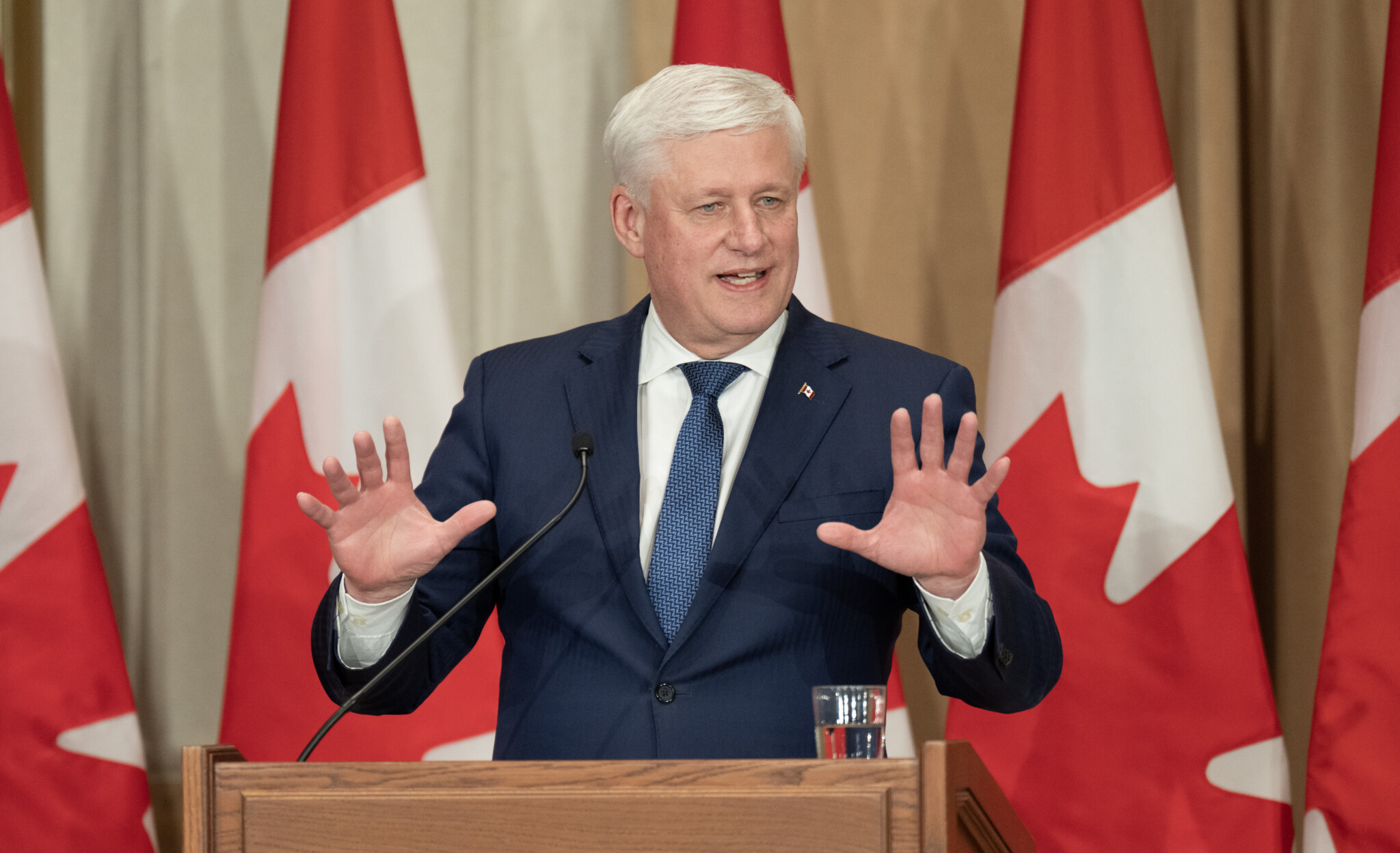
This week’s gathering in Ottawa to mark the 20th anniversary of the Harper government was a natural opportunity to assess its policy legacy.
There’s a tendency in some conservative circles to look back on those years with a bit of disappointment that the government wasn’t bolder and more ambitious. That it was too inclined to take a pass on major institutional reforms. That its incrementalism left too much of the Liberal state apparatus in place. That the Harper era should ultimately be understood as a missed opportunity.
One can partly understand this instinct. As a former aide to the prime minister, these are of course questions that I’ve subsequently asked myself.
In the moment, it’s admittedly easy to miscalculate the tradeoffs between political risks and policy reforms. A government can convince itself that the timing isn’t right or political conditions aren’t fertile or the public isn’t ready. These arguments can become self-rationalizations for putting off structural reforms—particularly for conservatives whose predisposition is to retrench the state and scale back entitlements.
It’s also fair to say that the government’s own experience showed that the politics of such reforms could in fact be managed. Its 2012 increase to the Old Age Security eligibility age, which many thought couldn’t be executed without serious political damage, was a sign that with proper foresight and planning, the government could implement big policy changes while minimizing its political exposure.
There are counterfactuals about whether this approach could have been extended to the Canada Health Act or the Canadian Broadcasting Corporation or other rightful targets of conservative criticism.
At this stage, though, there’s not much point indulging in such what-ifs. Especially since doing so detracts from seeing the benefits of a near-decade of steady and stable governance.
Sean Speer assesses Stephen Harper’s legacy 20 years on, arguing that while not marked by sweeping reforms, his government provided steady, stable governance on key issues like tax, fiscal policy, national unity, foreign policy, and Canadian culture. He also challenges the narrative of conservative radicalization driving political polarization, presenting research suggesting the Left has shifted more significantly. Finally, he highlights a proven “success sequence” for poverty reduction, emphasizing education and stable family structures, and suggests policy should support these pathways rather than inadvertently penalizing them.
On the big questions of tax and fiscal policy, national unity, a principled foreign policy, and Canadian culture, the Harper government got things right.
The polarization we observe today, in other words, is less the story of conservatives sprinting outward and more one of progressives steadily shifting the goalposts.
Individuals who follow [the success] sequence significantly reduce their likelihood of poverty and increase their chances of upward mobility. Those who diverge from it, for whatever reason, face greater economic risk.
Comments (5)
Andy Crooks
07 Feb 2026 @ 7:01 am
Stephen Harper may come to be regarded as one of the great Prime Ministers of Canada. In many circles he already holds that status.
Was Stephen Harper's government too cautious, or was its steady governance a key achievement?
Does research suggest progressive or conservative shifts are driving political polarization?
How can Canadian social policy better address persistent low income?
While it’s true that the Harper government’s policy legacy isn’t marked by the sweeping reforms of, say, the Mulroney era, at a time when competent government is a scarce commodity—and the harmful consequences of the Trudeau years are still present around us—former prime minister Harper’s governing discipline and preference for stability looks rather appealing. On the big questions of tax and fiscal policy, national unity, a principled foreign policy, and Canadian culture, the Harper government got things right. Conservatives, of all people, shouldn’t lose sight of how significant that is. When it comes to politics and governance, the risk of things going wrong is much higher than going right. That’s just about the oldest and most important conservative insight. In an era that has since shown how quickly institutions can be weakened, fiscal guardrails eroded, and national cohesion strained, the achievement of steady governance shouldn’t therefore be lightly dismissed. Reform isn’t always dramatic. Often times the quiet prevention of bad ideas is itself a form of reform. That, more than anything, may be the Harper government’s enduring legacy. Who’s to blame for political polarization? A new scholarly paper offers a corrective to one of the most common assumptions about modern politics. For years, we’ve been told that rising polarization in advanced democracies is primarily the product of conservative radicalization. Conservatives have abandoned the centre for the far Right and, in so doing, pulled the political system with them. Yet this fresh empirical research tells a different story. Using a novel method based on k-means clustering—a statistical technique that groups people according to their actual policy positions rather than their partisan self-identification—researchers have measured issue polarization in a way that avoids the usual assumptions about ideological labels. Instead of asking whether people call themselves liberal or conservative, it looks at where they actually stand on a wide range of issues. The findings are striking. In the United States, since 1988, the widening gap between Left and Right has been overwhelmingly driven by movement on the Left. Progressive clusters have shifted markedly leftward, while the Right has remained comparatively stable. The polarization we observe today, in other words, is less the story of conservatives sprinting outward and more one of progressives steadily shifting the goalposts. For many conservatives, this will feel intuitive. Over the past decade in particular, parts of the Left have embraced increasingly maximalist positions on culture, identity, and social norms. Concepts once confined to academic seminars migrated into corporate HR departments, school curricula, and public institutions. Language, standards, and expectations shifted quickly. Still, the findings will surprise those who’ve absorbed the conventional narrative that polarization is chiefly a conservative phenomenon. That it’s the Right which wages cultural war while the Left merely reacts. The data complicate that story. None of this absolves conservatives of excesses or rhetorical overreach. Politics is rarely a one-sided affair. But it does challenge the reflexive assumption that instability and division originate primarily on one side of the ideological divide. The more interesting question is what comes next. There’s a growing debate about whether we’ve reached “peak woke”—that is to say, whether progressives are quietly stepping back from some of the sharper edges of identity politics that defined the past half decade. In Canada, Prime Minister Mark Carney appears far less preoccupied with these themes than his predecessor, Justin Trudeau. It’s too early to know whether this represents a durable shift or merely a pause. But if the Left moderates even modestly, the net effect could be a gradual easing of polarization and perhaps, over time, a return to something closer to political normalcy. There’s a proven way to address poverty—policymakers should lean into it Statistics Canada’s latest report on persistent low income reminds us that poverty in Canada isn’t evenly distributed. Drawing on longitudinal tax data from 2016 to 2022, the study finds that about 9 percent of tax filers experienced low income for at least half of that period. Certain groups were disproportionately represented—including Indigenous Canadians, non-permanent residents, individuals without a high school diploma, and female lone-parent families. Education, by contrast, emerged as a powerful protective factor. Those with a university degree were far less likely to experience persistent low income. None of this should surprise policymakers. The findings are broadly consistent with what social scientists have long called the “success sequence”: finish school, enter the workforce, get married, and then have children, generally in that order. Individuals who follow this sequence significantly reduce their likelihood of poverty and increase their chances of upward mobility. Those who diverge from it, for whatever reason, face greater economic risk. The groups identified in the report are also those statistically less likely to follow that sequence. Lone parenthood, lower educational attainment, and weaker labour market attachment are strongly correlated with income instability. Canada’s tax and transfer system does an enormous amount of redistribution. But policymakers should be asking a harder question: Are current policies reinforcing behaviours associated with the success sequence or inadvertently undermining them? For example, the interaction of income-tested benefits and marginal tax rates can create marriage penalties, particularly for lower-income couples. When two individuals combine households, they may lose benefits or face higher effective tax burdens, even if their overall economic circumstances remain fragile. If stable two-parent households are associated with lower poverty risks, the policy system shouldn’t penalize their formation. Similarly, greater emphasis on high school completion, vocational pathways, and labour-force participation would align social policy with the drivers of economic stability identified in the report. The Statistics Canada findings should provoke reflection about how we address poverty. It’s a reminder that poverty reduction isn’t just about transfers. It must also be about strengthening the economic and social pathways that ultimately enable self-sufficiency.
Sean Speer is The Hub’s Editor-at-Large. He is also a university lecturer at the University of Toronto and Carleton University, as well as a think-tank scholar and columnist. He previously served as a senior economic adviser to Prime Minister Stephen Harper.







Comments (5)
Stephen Harper may come to be regarded as one of the great Prime Ministers of Canada. In many circles he already holds that status.