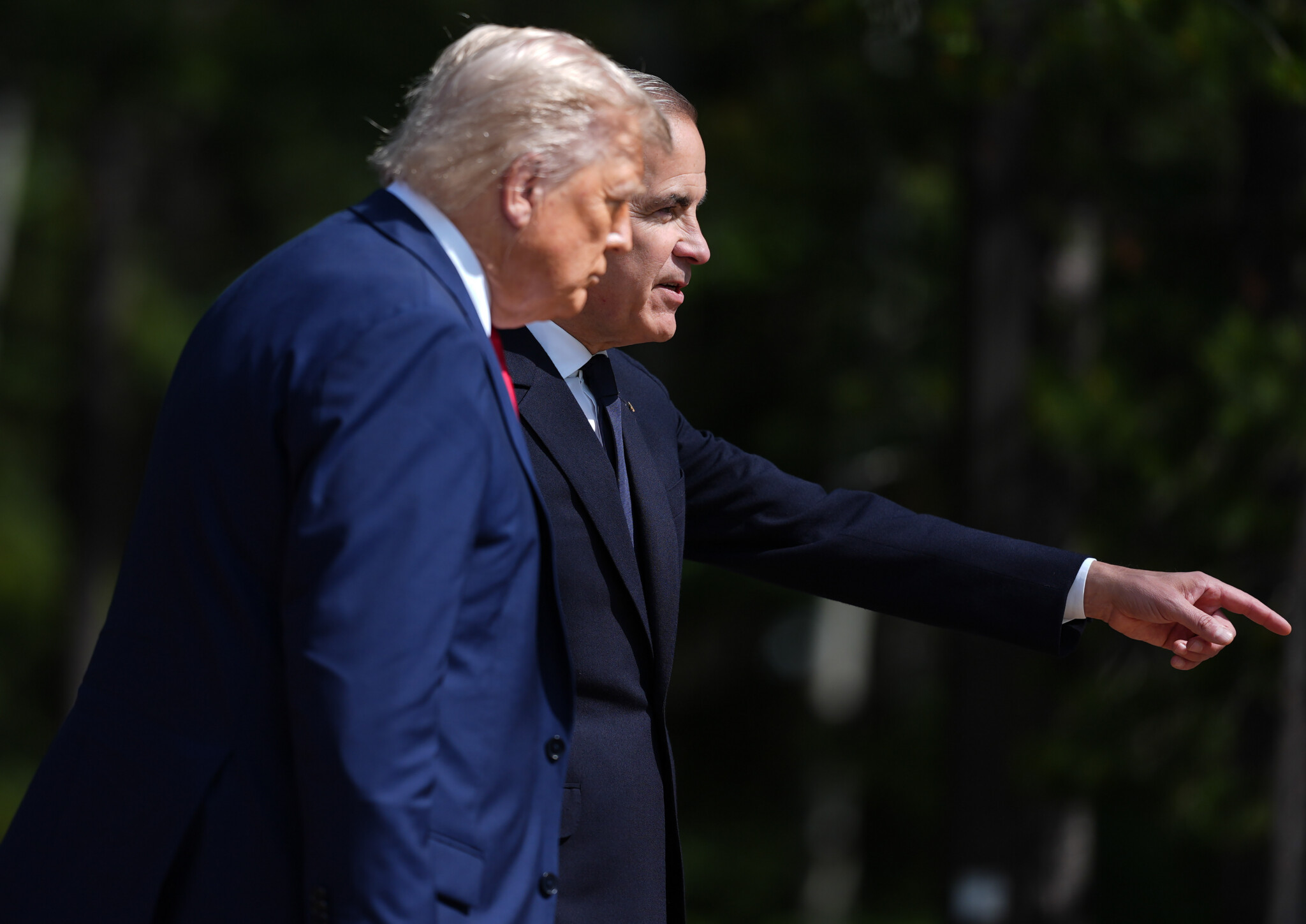

Donald Trump’s sustained political rise over the past decade has been disjunctive. Although he’s neither sufficiently curious nor consistently disciplined to impose a new political paradigm, his presidency has scrambled prevailing assumptions about trade, immigration, globalization, and America’s relationship to the world.
He ended an era without clearly defining what comes next, and Canada is paying a price. We’re now in the early stages of an intellectual and political debate in the U.S. over the ideas that will define the next era.
The outcome of this debate matters a great deal for Canada. As we’ve been reminded in recent months, roughly 74 percent of Canadian exports go to the United States. Those exports represent roughly one-third of our overall economic output. Entire regions, industries, and supply chains are structured around privileged access to the U.S. market. When the terms of that market access change—whether through tariffs, regulatory shifts, or new industrial subsidies—the consequences are immediate and material for Canadian workers and businesses.
We were (somewhat) caught off guard with Trump’s rise back in 2016. To be fair, a lot of people were, including the entire leadership of the Republican Party. His ascendancy was a warning of the political salience of anti-trade and anti-globalization ideas within the U.S. polity. It should have been a wake-up call.

But it wasn’t. We treated Trumpism as aberrational rather than structural. We were slow to recognize this transformation as it challenged comfortable assumptions about the durability of the status quo. We clung to the assumption that the system would revert to form. We were, in turn, reactive when we needed to be anticipatory.
We cannot afford to continue to repeat that error. Managing the immediate risks that the Trump administration poses is, of course, necessary. The economic stakes are too high and the costs of uncertainty too real to do otherwise. But we must also turn our minds to what comes next. And yes, the what will be equally as important as the who.
This means projecting forward to an uncertain future and unconventional voices. This past September, the Liberal caucus disinvited the head of the think tank that wrote the blueprint for Trump’s second term. We may not like what is being said, but ignoring it only makes matters worse. This generational shift is shaping up to be a repeat of the 2016 Republican presidential primary—but also on the Democratic side.
It would be a serious mistake therefore for Canadians to assume that the 2028 presidential election will restore a pre-Trump status quo. There’s ample evidence that these new ideas are ascendant in both major parties. The Biden administration’s own tariffs and industrial policies in favour of domestic production were more of a continuation of Trump’s first term than we wanted to admit. The Trans-Pacific Partnership was politically vulnerable before Trump ever withdrew from it.
And it’s not just the New Right with which Canada has lost touch. One could even say the foundations go as far back as the “Buy American” provisions under the Obama Administration in 2009. Since then, the Democrats and the Left are remaking themselves. Canada may wake up to find yet another shock when the Democrats we thought we knew are no longer there, replaced by something with which we are unfamiliar and once again unprepared.
Identifying the causes is often hard to fully define, but what’s clear is that the messages that resonate with American voters have fundamentally changed.
As former Biden advisor Jake Sullivan recently put it: “…we’ve reached the end of the post-Cold War era, and a new era is coming into view, but the shape of it, I think, is still contested and not entirely clear.”
The debate is now playing out across the United States in think tanks, congressional offices, advocacy networks, and state governments. Individuals and institutions are positioning themselves to define America’s next political economy paradigm.
Some advocate a muscular industrial policy tied to national security. Others favour a labour-inflected economic nationalism. Still others are attempting to reconcile market mechanisms with a more strategic, sector-based approach to trade and investment.
View reader comments (0)
Canadians have a deep interest in understanding the nuances of this debate and its potential outcomes. If the past several decades are any guide, whoever succeeds in defining the U.S. paradigm in structural terms will shape American politics and policy for a generation. The Reagan-era embrace of market liberalization defined both parties in different ways. The post-Cold War globalization consensus did the same. The next framework—whatever its precise contours—will have similarly durable consequences.
The lesson of the past decade is that intellectual shifts often precede political and policy change. The strategic task, therefore, is to understand the ideas, coalitions, and personalities that will shape American political economy over the next five, 10, or 20 years.
That’s the animating premise behind a new series on the future of U.S. political economy that The Hub is proud to produce in partnership with the New North America Initiative at the University of Calgary’s School of Public Policy. The goal isn’t to chase headlines or react to the latest presidential post. It’s to engage directly with the thinkers, policymakers, and emerging leaders on the new Left and the new Right in the U.S. who’re working to define what comes next.
If the United States is entering a new paradigmatic era, Canadians have a profound interest in understanding its intellectual foundations before they harden into policy orthodoxy. The stakes are too large, the relationship too consequential, and the lessons of recent years too clear to do otherwise.
The post-Cold War consensus may be finished. What replaces it will matter enormously. Canada owes it to itself to pay close attention now while the debate is still unfolding.
Canada needs to pay close attention to the evolving political and economic landscape in the United States, driven by shifts on both the Left and Right. Donald Trump’s presidency disrupted established norms, leaving a void that is now being filled by new ideas and policies. Given Canada’s heavy economic reliance on the U.S. market, these changes have significant implications. Canada’must engage with the thinkers and policymakers shaping the future direction of the U.S. to avoid being caught off guard again.
How might new US economic policies impact Canadian businesses and workers, considering Canada's export reliance?
What are some key ideological shifts happening on both the left and right in the US, and why should Canada care?
What specific actions can Canada take to better prepare for potential shifts in US political and economic policy?





Comments (0)