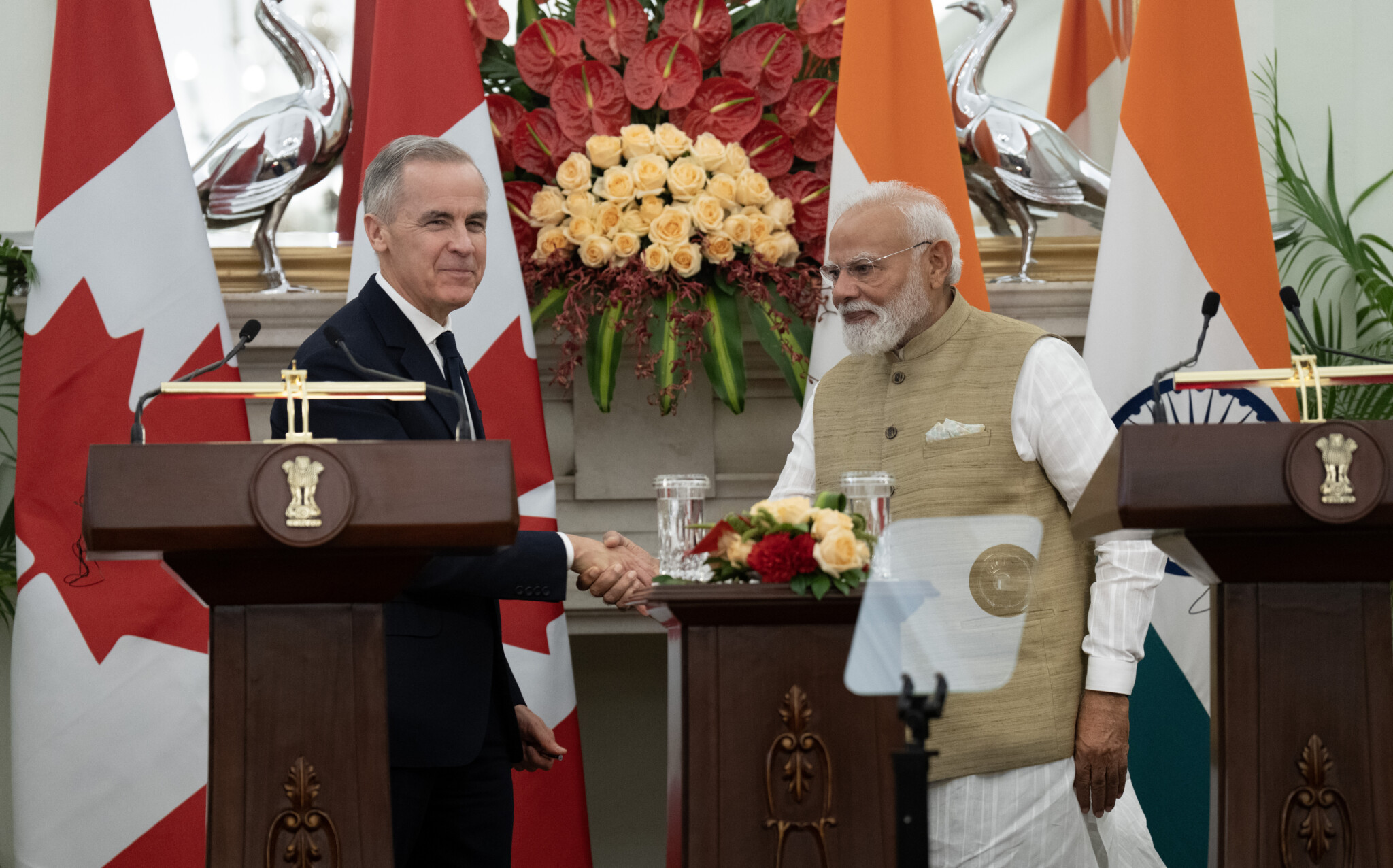
Prime Minister Mark Carney’s government’s apparent willingness to overlook serious violations of Canadian sovereignty by China and India represents a stark departure from the values-based foreign policy that has defined Canada for decades.
But according to journalist and best-selling author David Frum, this controversial shift may reflect a necessary adaptation to a dramatically changed security environment rather than a simple abandonment of principles.
Both China and India have been credibly accused of serious violations of Canadian sovereignty in recent years. China has operated covert “police stations” on Canadian soil, used to monitor, harass, and pressure Chinese diaspora communities, and has conducted interference campaigns targeting Canadian politicians and elections, as documented in the Foreign Interference Commission’s findings.
Beijing also expelled Canadian diplomats and imposed trade restrictions in retaliation for Canada’s detention of Huawei executive Meng Wanzhou, and Chinese state actors have been linked to cyberattacks on Canadian institutions.
India, meanwhile, was directly implicated by then-prime minister Justin Trudeau in the June 2023 murder of Sikh separatist leader Hardeep Singh Nijjar on Canadian soil in Surrey, B.C., an allegation that triggered a major diplomatic crisis, the expulsion of diplomats on both sides, and an RCMP investigation. Canadian security officials subsequently alleged a broader Indian government campaign to intimidate and surveil members of the South Asian diaspora in Canada, including alleged links to organized crime.
Both cases represent what Canadian officials have described as an unprecedented and escalating threat to Canadian sovereignty from foreign state actors.
But with the U.S. appearing less like a reliable ally and more like a potential threat during President Trump’s second term, Canada finds itself in uncharted territory of who to make trade deals and partnerships with for future economic prosperity. The Hub spoke with Frum to better understand how Canada’s strategic calculus has fundamentally changed and what difficult choices lie ahead.
Here are five key takeaways from the conversation.
You are absolutely right, Prime Minister Carney. Your visit has built a strong foundation for a truly renewed partnership.
— Narendra Modi (@narendramodi) March 3, 2026
I look forward to working together with you to build a future defined by trust, growth, innovation and shared prosperity for the people of our nations.… https://t.co/Jyp5s1DK9a
Canada is making calculated trade-offs between sovereignty and economic survival
The Carney government’s approach to China and India represents what Frum describes as a deliberate decision to look past previous transgressions against Canada for the greater interest of the country.
“The Carney government seems to be making a calculated decision to overlook those horrific infractions of Canadian sovereignty in the pursuit of Canadian economic interests and trade interests.”
India’s assassination operation on Canadian soil remains without apology, and Chinese interference and harassment of Canadian citizens continues unabated.
“Now, when I put it that way, it sounds really bad,” Frum acknowledged. “But given Canada’s shrinking options, it may be the least bad choice of a bad bargain.”
This reflects what Frum characterizes as a shift from principles to expedients, where “all the choices are bad, and you have to say which of the bad choices sucks least.”
Canada’s security situation has fundamentally transformed
The foundation of Canada’s post-Second World War prosperity, free security provided by a powerful, friendly neighbour, has crumbled.
“Canada was able to be a values-based power only so long as it could take its security for granted,” Frum explained. “And Canada can’t take its security for granted anymore.”
The transformation is dramatic.
“Suddenly Canada is a lot less like the Canada of the olden days under the American shield and more like Poland, a frontline state with dangerous neighbours nearby.”
“And that means less room for maneuver, and it can’t do everything, and it has to make choices and sacrifices.”
Carney grasps the tragic nature of Canada’s choices in ways Trudeau did not
Frum drew a sharp contrast between the current and former prime ministers’ approaches to Canada’s challenges.
“When you watch Justin Trudeau’s thinking processes, they just seem childish,” he said. “They just seem like someone who didn’t understand what a dangerous and difficult world Canada’s in.”
“Carney seems to have fully grasped the tragic nature of the choices that await a country like Canada,” Frum observed.
This maturity extends to acknowledging uncomfortable realities.
“There are no principles here, they’re only expedients. And you have to measure risk against risk.”
Canada must prepare for a permanent rupture with the U.S., even if it doesn’t materialize
Frum emphasized the distinction between prediction and preparation.
While he doesn’t necessarily expect Trump-style behaviour to continue shaping America’s global posture indefinitely, the risk demands planning.
“Trump won twice, two terms,” he noted. “Both times he carried the House and Senate for at least two years.”
“If you’re a country like Canada, you hope it’s not a rupture, but it would be reckless not to plan as if it were,” Frum said. He then alluded to Dickens’s A Christmas Carol, noting that the Ghost of Christmas Future never answers whether he shows things that will be or things that may be, but either way, “you still have to prepare for the things that may be.”
Canada needs to develop leverage through multiple partnerships
Frum outlined several potential pathways for Canada: Atlantic partnerships with Britain and Europe, Americas bloc cooperation with Latin American countries and Mexico, or Pacific Rim alliances with Japan, Taiwan, and South Korea.
Each presents challenges and uncertain prospects.
“There are real differences in economic interests, differences in values and culture, differences in political traditions, but similarities in geography and economic orientation.”
“I have no idea if any of these things will work. My inclination is to doubt it,” Frum admitted. “But it’s worth a try.”
The priority, he emphasized, is developing leverage.
“That’s going to mean trying a lot of different things because it’s not obvious where you’ll find your leverage.”
This story draws on a Hub video. It was edited using NewsBox AI. Full program here.
David Frum argues that Canada, under Prime Minister Carney, is shifting from a values-based foreign policy to prioritizing economic survival amid a changing global landscape. This shift involves overlooking sovereignty violations by China and India due to a perceived decline in the reliability of the U.S. as an ally. Frum highlights the contrast between Carney’s pragmatic approach and Trudeau’s perceived naivete regarding Canada’s security challenges. He emphasizes the need for Canada to prepare for a potential rupture with the U.S. and to develop leverage through diverse international partnerships, including those with Britain, Europe, Latin America, Mexico, Japan, Taiwan, and South Korea, even if their success is uncertain.
How is Canada adjusting its foreign policy in light of security threats from China and India?
What implications does the potential rupture with the U.S. have for Canada's future?
In what ways might Canada develop leverage through new international partnerships?



Comments (0)