
The sequence of success
For most of Canada’s history there was an understood bargain at the heart of our social contract. If you worked hard, got an education, stayed out of trouble, and did your part, you would get a happy life in return. You could move out, find decent work, buy a home, raise a family if you wanted one, and feel that your life was progressing roughly according to plan. The promise was never that everything would be easy, or even equal. It was that effort would compound into stability, and stability into a future.
For many young Canadians today, that sequence of success has become delayed, distorted, and broken. The country still asks for all the same things it once did: discipline, education, thrift, patience, flexibility, and resilience. But now the rewards arrive later, at a higher price, and with far less certainty.
When the economy contracts in a typical recession, governments act quickly. Rising unemployment and falling production are treated as emergencies. But this challenge is more subtle and serious.
What young Canadians are now living through is a milestone recession: a prolonged breakdown in their ability to reach the normal stages of adulthood at anything resembling a reasonable age.
This should matter to all Canadians because our civilization depends on an unspoken social contract spanning generations. Public services, pensions, and health care are held up by a strong base of working-age Canadians. Today, as Canada has aged, there are fewer than three private sector workers for every senior. If young people are delayed in starting careers and building earnings, the base that sustains our services becomes weaker. If Canadian leaders do not get serious about this challenge, Canada will struggle to sustain the quality of life that the previous ones expected.

Tripped at the gates
Young people face their first hurdle before they even begin working. Education now takes longer and costs more than it used to. The average Canadian graduate leaves school with roughly $29,000 in debt, often after five or six years in higher education or an apprenticeship. They enter a labour market that is punishing for new graduates. Youth unemployment has been above 14 percent for the last year, the highest rate since 2000 outside the pandemic and the 2009 Great Recession.
Meanwhile, more than one in five young people is underemployed. Research shows that young Canadians entering the job market today will simply earn less over their careers than those born before or after them with better timing.
What makes this more disorienting is that young Canadians are not less capable than the generations before them. Yet many are entering an economy that has become less able to convert their skills into opportunity. It is no surprise that many of our top graduates are leaving for the U.S., a brain drain responsible for roughly two-thirds of Canada’s productivity and income gap, according to the Bank of Canada.
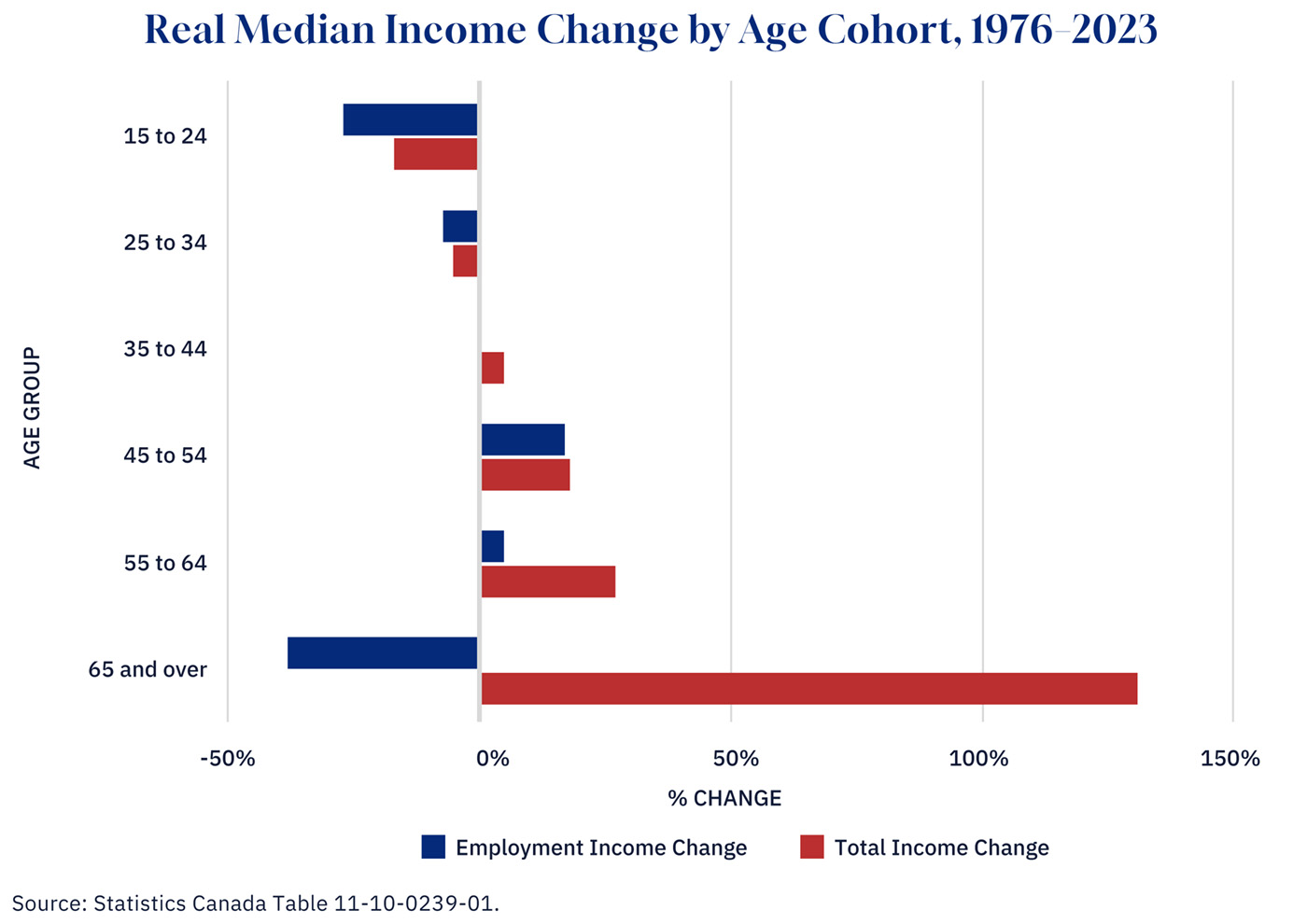
One of the more sobering markers of this shift is that, for the first time in recorded Canadian history, men over 65 now out-earn men aged 25 to 34. Canadians under 45 have barely seen any income growth for decades.
Graphic credit: Janice Nelson
Housing denied, family delayed, dreams deferred
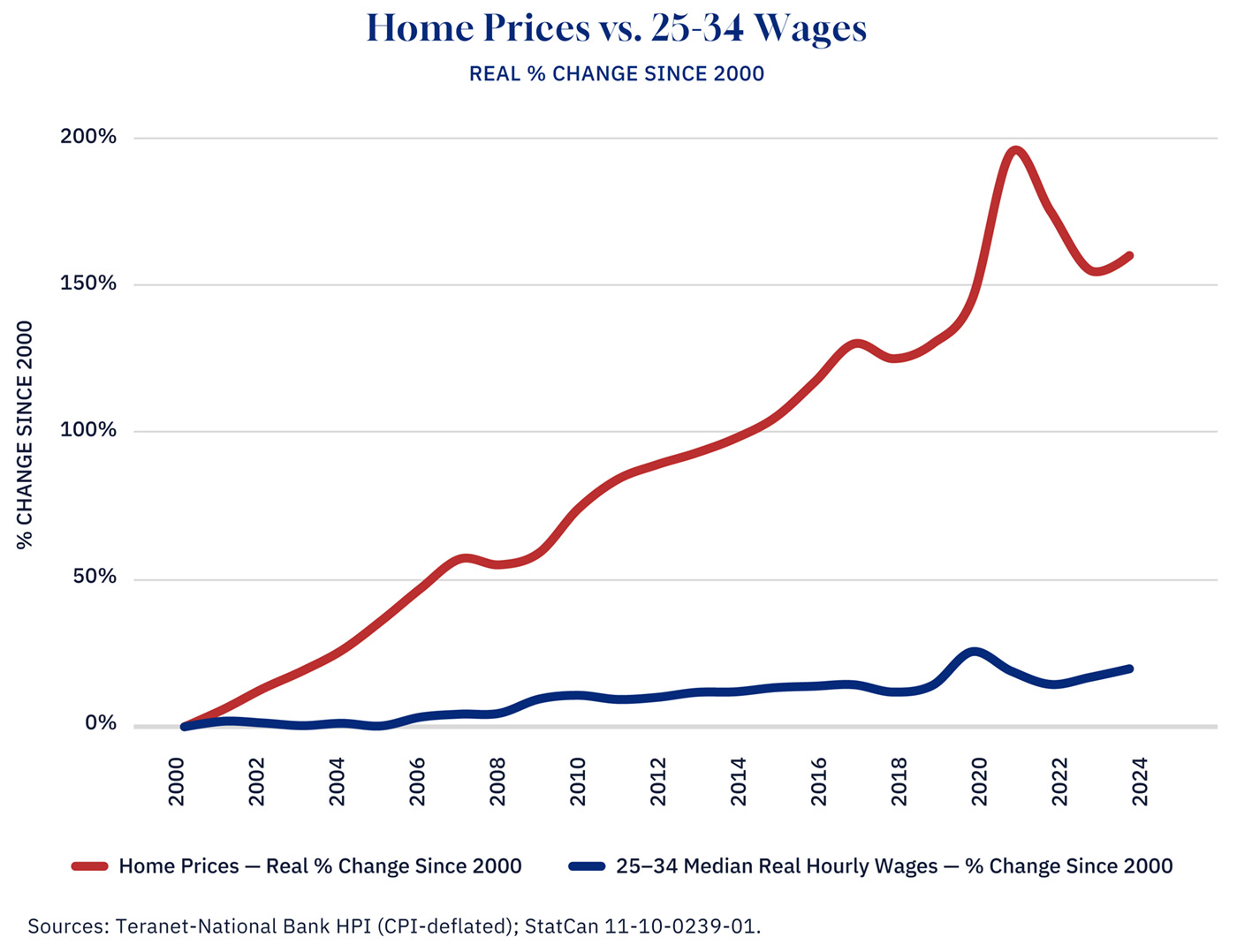
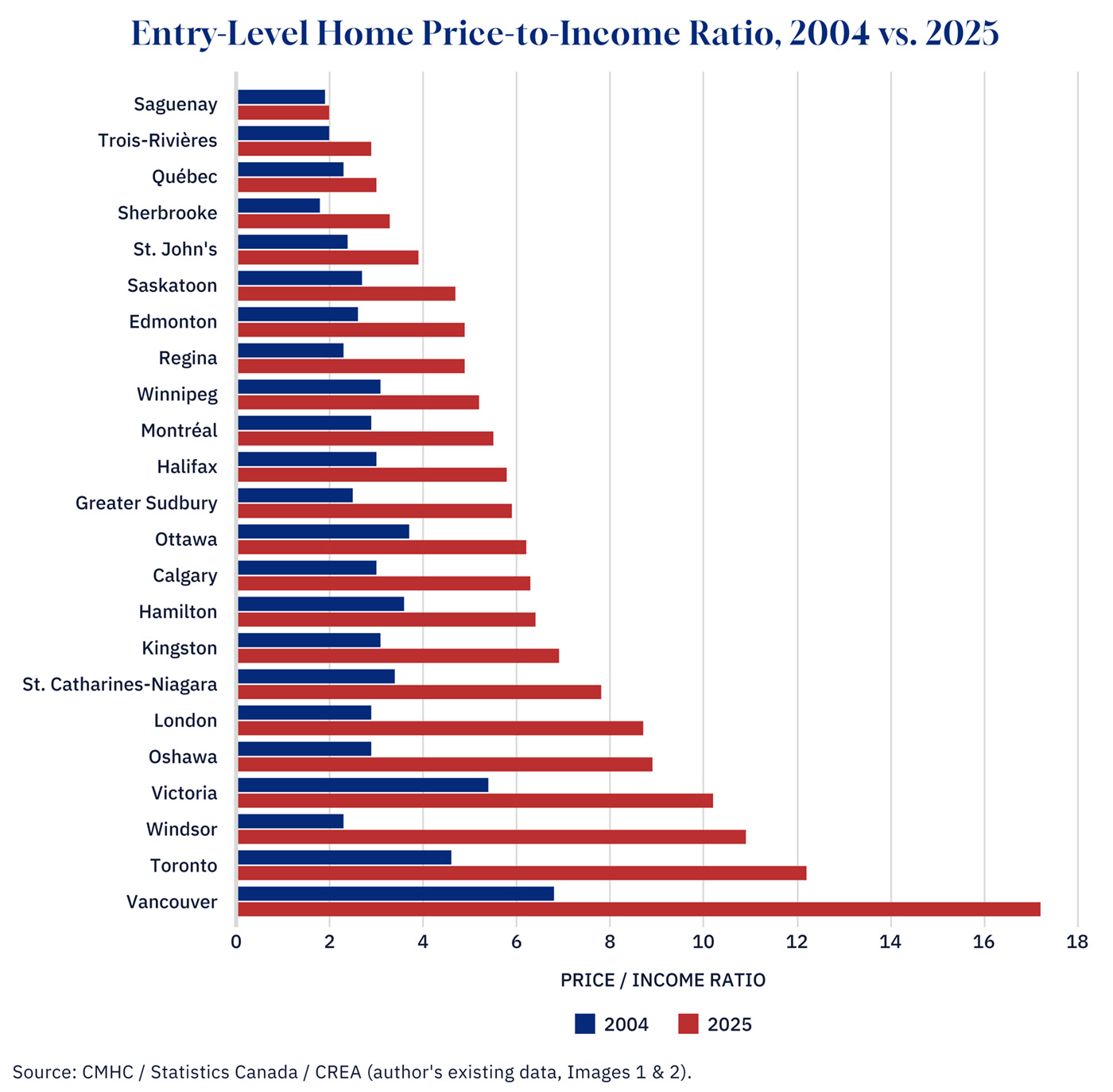
Nowhere does the milestone recession express itself more clearly than in housing, even with recent price declines. In 2000, an entry-level home in many major Canadian cities cost roughly three times what a young couple earned. That ratio has doubled, and now sits above 12 times what a couple earns in Toronto and above 17 times what a couple earns in Vancouver. Those are not just uncomfortable numbers. They describe a society where entry into stability has been fundamentally repriced.
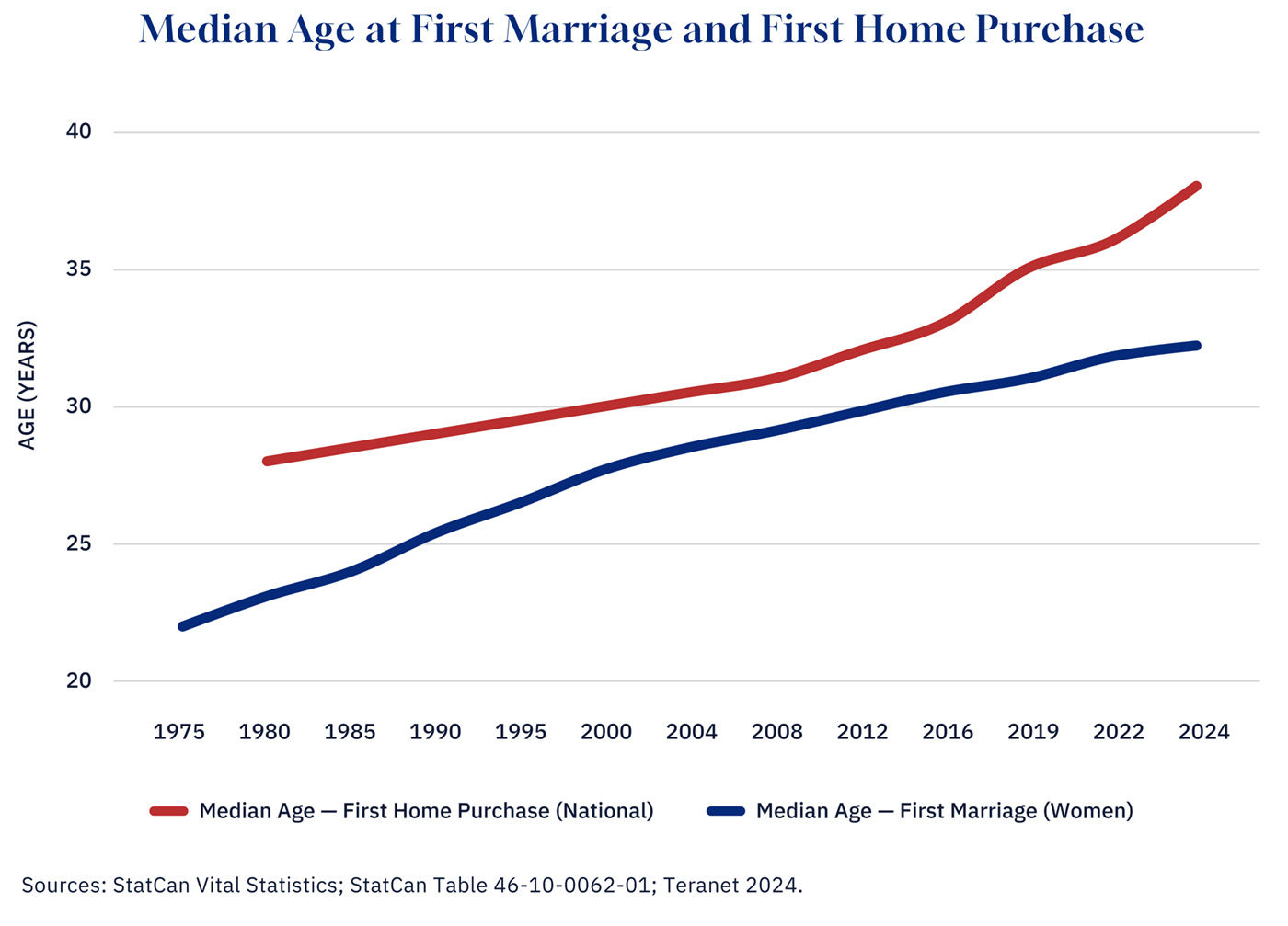
The timeline no longer resembles the one most Canadians still carry in their heads. In Toronto or Vancouver, saving for a down payment can take more than a decade. In Ontario, the average first-time homebuyer is now around 40 years old, when it was once under 30.
Graphic credit: Janice Nelson
For many young buyers, ownership is reached not through earnings alone, but through significant parental help or inherited housing wealth accumulated under very different market conditions. That changes more than the math. It changes the moral texture of our culture, because it erodes the liberal promise that merit and effort are what matter.
Graphic credit: Janice Nelson
What was once possible on one decent income now often requires two strong incomes. Sometimes even that is not enough. Over the last half-century, women’s employment rate between the ages of 25 and 54 rose from roughly 40 percent in the early 1970s to over 80 percent today.
In a healthier and more prosperous economy, that transformation should have expanded freedom within family life. It should have created more flexibility, more female breadwinners, and more choice in how households divide work and home life. Instead, in much of Canada, it has become the minimum ante to remain in contention for a middle-class life.
Graphic credit: Janice Nelson
The psychological impact of delayed financial stability has hit dating markets hard, particularly for young men, with serious impacts on marriage rates and family formation. Women in Canada still report wanting around 2.2 children on average, yet the fertility rate has fallen to roughly 1.2. That gap should not be casually dismissed as a matter of changing preference. In many cases, it reflects that the extra room came too late, the mortgage was too far away, and the period of financial instability stretched on too long.
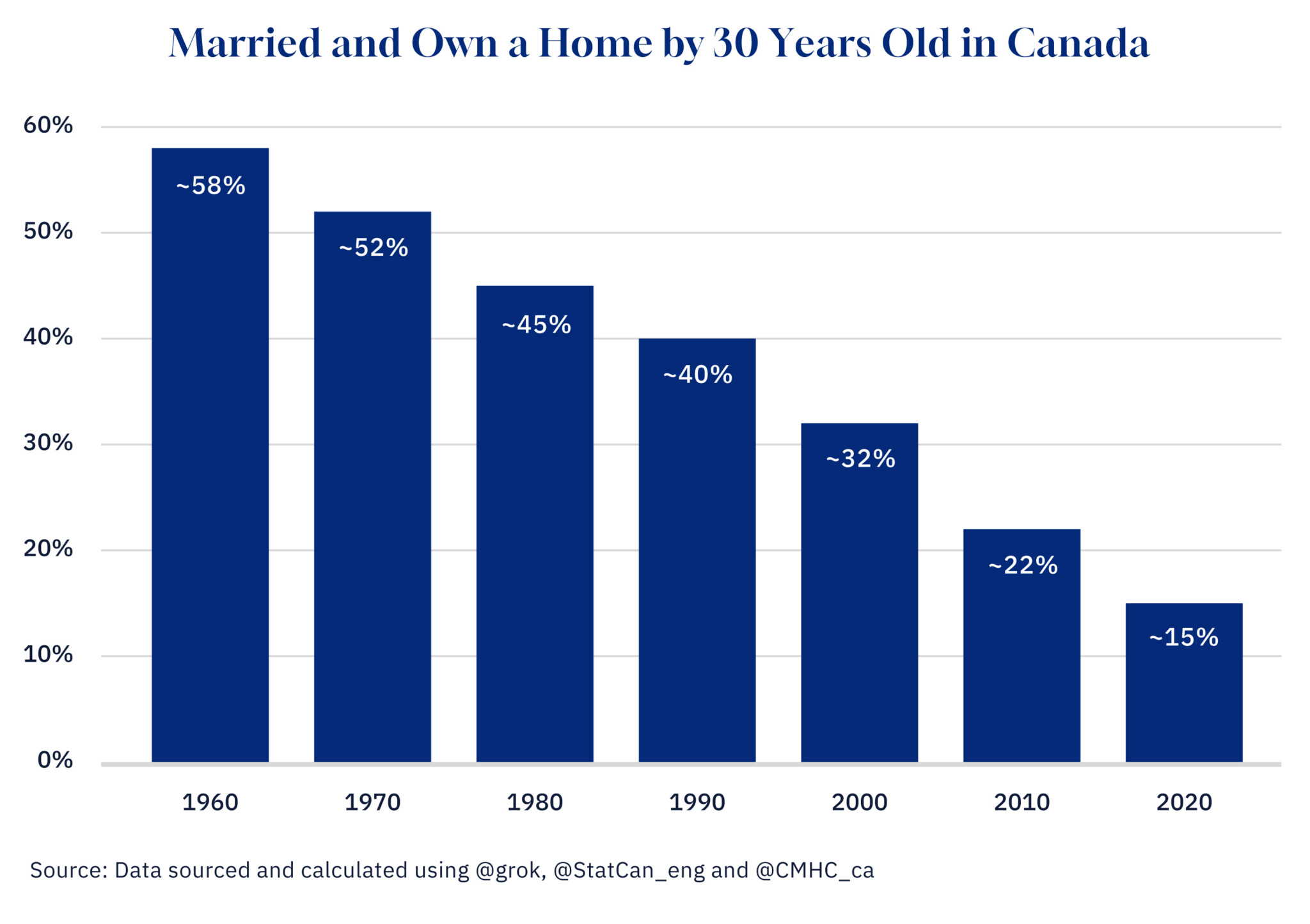
Graphic credit: Janice Nelson.
The economic consequences of Canada’s milestone recession are profound because it shapes behaviour in ways we have overlooked. Those aged between 25 and 40 are supposed to be the driving force in a dynamic economy. It’s the period when people move, experiment, start companies, and make bets on themselves.
But if those years are consumed by exorbitant rent, debt servicing, and housing anxiety, ambition weakens. The number of Canadians building businesses that employ others has fallen roughly 40 percent per capita since 2000, even as the population has grown by more than a third. The explanation is simple: too much economic oxygen has been pulled into rent and mortgage interest, leaving less room for risk, innovation, and growth.
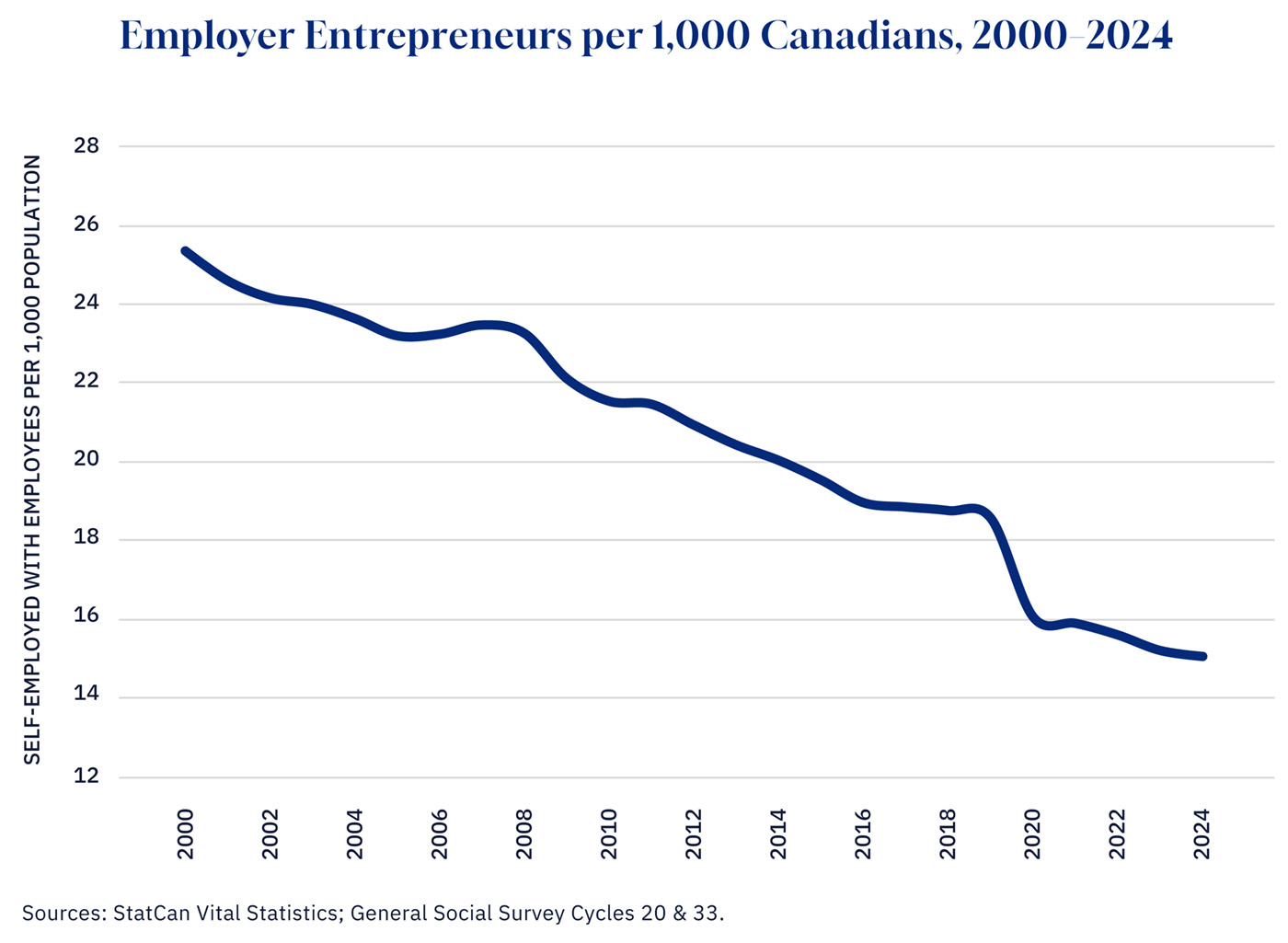
Graphic credit: Janice Nelson
The emotional consequences of all this are not invisible, either. Canada has fallen from sixth in the World Happiness Report in 2015 to 25th in 2026. But the more important story is inside that number. Canadians over 60 still rank in the top 10 in the world for happiness. Canadians under 25 rank 71st. That is an astonishing indictment of the direction of the country.
Make room for the future
None of this is inevitable, and none of it requires resentment between generations. The problem is not that older Canadians conspired against younger ones. It is that we allowed a political economy to emerge in which the costs of drift were diffuse and easy to pass along to the next generation.
The encouraging part is that we know the broad outlines of a remedy. Canada needs to make it easier, faster, and cheaper to build the housing people actually want. That means liberalizing zoning and land use rules, modernizing building codes, making approvals faster, cutting development charges and other taxes on new housing, and investing in the infrastructure needed to support it. Leaders must also be honest that lower housing costs will create losers, and be prepared to support households that are financially exposed to falling values through these changes.
View reader comments (18)
But housing is just the tip of the iceberg. Canada also needs an economy that is more competitive and capable of turning potential into opportunity. That means cheaper and more reliable energy, faster permitting for major projects, stronger competition in concentrated sectors, simplifying bureaucratic public systems, and reducing barriers to starting and scaling businesses. We need governments that focus on delivering core services and infrastructure effectively and at reasonable cost. Otherwise, the country will continue to ask more of its young people while offering them less in return.
A milestone recession can feel like a long delay, but it is not destiny. Canada still has the resources, talent, and civic inheritance to become a country where young people can build early, contribute fully, and live with confidence that adulthood will arrive in time. Their future has not been stolen. But it has been postponed. The work now is to bring it back within reach.

Eric Lombardi stands at the forefront of urban development and advocacy as the founder and president of More Neighbours Toronto, a volunteer…
There is a “milestone recession” affecting young Canadians, delaying their ability to achieve traditional markers of adulthood like homeownership and financial stability. The social contract, where hard work leads to a secure future, is broken for many young people. They face higher education costs, a challenging job market, and unaffordable housing. This situation leads to brain drain, delayed family formation, and weakened economic dynamism. Fixing this requires policy changes, including liberalizing housing regulations and fostering a more competitive economy, to ensure young Canadians can build a future and contribute fully to society.
How does the author define a 'milestone recession,' and why is it more concerning than a typical economic downturn?
What are some key factors contributing to the delayed financial stability of young Canadians, according to the article?
What policy changes does the author suggest to address the challenges faced by young Canadians and restore their economic prospects?







Comments (18)
Everything was fine when I handed it over, then the younger ones started valuing nice hair on the PM more than a masters in economics and experience. And now the government has convinced them that they get more for being a victim than they do if the compete well. Im still doing my part, time for them to figure it out and do theirs. It was never easy, but the government can’t and won’t solve our problems. We need to have a government that sets the conditions to reward success and then get out of the way.