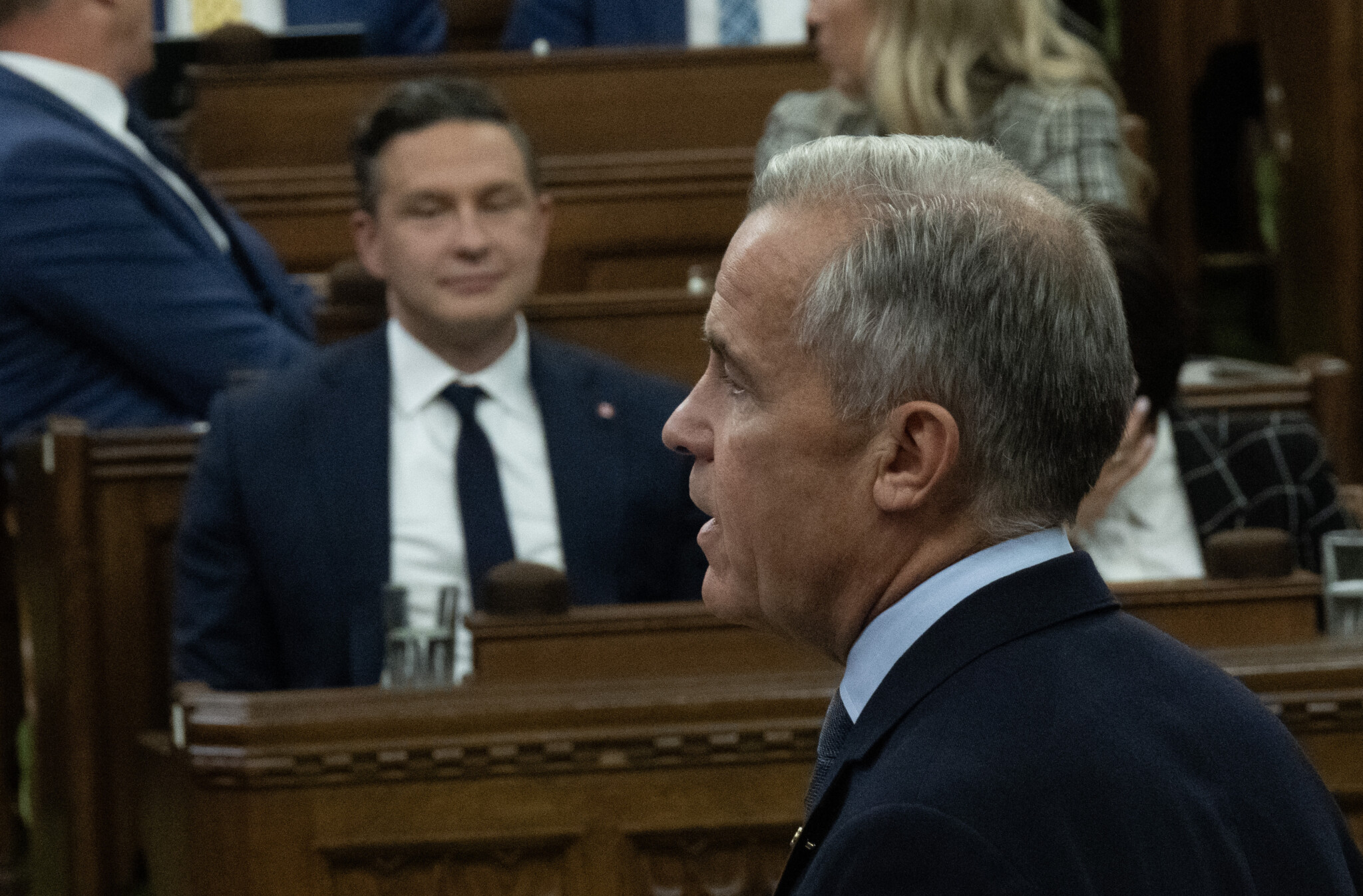
‘There’s still another shoe to drop’: The Roundtable on Carney gunning for a majority and doubts about Poilievre’s leadership
Rudyard Griffiths and Sean Speer discuss a tumultuous week in Canadian politics with the Conservative leader Pierre Poilievre facing scrutiny after a Conservative MP crossed the floor to the Liberals and another one abruptly resigned.
They also cover what it could mean for Prime Minister Mark Carney’s government as well as the potential risks to national unity. In the second half, they shift the discussion to Zohran Mamdani’s landslide victory in New York City’s mayoral race, and how his radical progressive platform represents a potent new political force that conservatives must reckon with. They also examine what lessons Canadian politicians should draw from his success in appealing to educated professionals struggling with cost-of-living pressures.
You can listen to free versions of this episode on Amazon, Apple, and Spotify.
If you liked what you heard in the first half of the program and wish to subscribe to full-length editions of The Roundtable, please consider becoming a Hub Hero. Hub Heroes also get access to all our paid content on TheHub.ca. All these benefits are conferred for one year. Sign up now!

Program Transcript
This is an automated transcript. Please check against delivery.
RUDYARD GRIFFITHS: What a week. Big federal budget, consequential election, New York City, U.S. supreme Court hearing the case against Donald Trump’s tariffs. To help break it all down on today’s Roundtable, I’m joined by Sean Speer, my co founder and editor at large. Hey, Sean.
SEAN SPEER: Yeah, it’s great to be with you, Rudyard. I regretted that I missed last week’s roundtable, one of the first I think we’ve missed in, in years. But as I think you let the audience know, I was rushing to get back home for Halloween. So thanks for standing in. Thanks for standing in for me. But it’s great to be back. And what a week to be back for. Holy smokes. It’s been an extraordinary 72 hours or so, hasn’t it?
RUDYARD GRIFFITHS: It has. Government shutdown also continuing in the United States with flight disruptions reverberating across the continental United States. Let’s dig in though, Sean. Right off the bat into the immediate political news of the last 36 hours or so, this has been the crossing of one Conservative MP to the Liberals, giving Mark Carney just two seats shy of a majority. And then a surprise out of the blue resignation by a Conservative Edmonton ndp. Let me take that again. And then a surprise, and then a surprise resignation by an Edmonton Conservative. And, and then a surprise resignation by a Conservative Edmonton mp. He’s not crossing the floor. He’s not even running again in politics. He’s leaving politics, period. Just what, six months after the general election. Sean, what’s going on here? What do the jungle drums say out there in the, the conservative ethos sphere that you sometimes dabble in?
SEAN SPEER: Yeah, well, think about it this way. We have, we have a budget from the government. The budget is, our astute listeners and viewers know, is the quintessential confidence measure. This is a minority Parliament. So the outstanding question for the past several days is how does Mark Carney cobble together enough votes to, to live another day and get this budget passed? As of right now, 1:40pm on Friday, November 7th, we still don’t have clarity from the NDP on whether they intend to support the budget on the set of confidence votes that will come up when Parliament returns after the upcoming break week. And so, in the absence of NDP support, or at least some vagueness around NDP support, clear opposition from the bloc of Aqua and, and from the Conservatives, Mark Carney has gone about ostensibly trying to solve for this problem by pulling Conservative MPs from the opposition benches into the government.
You mentioned we had one floor crosser already. And then a lot of Speculation in recent days, Rudyard, we were going to get two more. That would give the Carney government the elusive majority that it failed to achieve in April’s election. And then last night, we have Conservative MP from Edmonton announcing abruptly that he’s resigning. I think something’s amiss here, Rudyard. Something is indeed going on. On one hand, I think the story is that the Liberals are reaching out to any Conservative who they think may be disillusioned or dissatisfied with Pierre Poliev’s leadership and trying to get them to cross the floor in the name of giving the government a majority. But that underlying issue around Poliev’s leadership is clearly the unspoken part of this story.
I don’t think there’s reason to think that there is a significant number of MPs who are starting to doubt him, but there’s enough that the Liberals have potential candidates to target. And the announcement that this MP himself is leaving Parliament, in light of the speculation that he was about to cross the floor, and in the face of reports that the Conservatives essentially threatened him, I was reminded of the Eagles song, the Hotel California, you Can Never Leave. One gets a sense that he was faced with a choice. He either dealt with whatever the Conservatives were threatening him with or exit politics altogether. So it’s a long and convoluted way of saying, I think there’s still probably another shoe or two to drop, drop here. And you get the sense that we end the week with Pierre Poliev’s leadership more in doubt than it’s been ever since he took the mantle as party leader.
RUDYARD GRIFFITHS: Yeah, we’ll have to see rumors that there may be some Quebec Conservative MPs who have been playing footsie with Carney and his advisors. Again, tbd. But on two fronts, Sean. One, I think this would be a really lousy way to get a, get a majority. As tempting as it is to, to win a majority through, through floor crossers, I think sets up a, an antagonism in, in the heart of the country, especially in Western Canada, where, you know, Conservatives have a large portion of the popular vote. Yes, elections matter. Yes, they lost. Yes, the Liberals won. But imagine, for instance, it’s Quebec Conservative MPs who cross over to give that majority to Carney. Another three and a half, four years of Liberal rule as a result of that, with the political preferences of Western Canadians, you know, denied.
And the, the sense, Sean, that, you know, this is a minority and that there will be another election sometime and it won’t be four years from now, I think is probably helping the country, to some extent, not paper over, but at least deal with, you know, the sharp cleavages that are happening politically between the west and the rest. Where in the rest, from Ontario east to the Maritimes, you have a Liberal Party who. Who’s. Who’s winning in a very specific geography, and a Conservative Party that’s winning in a very different geography. Alberta, Saskatchewan, parts of British Columbia. I don’t know your thoughts on that. I mean, I know at various times political leaders are asked to weigh these consequences. I know Michael Ignatieff did that in the context of bringing Stephen Harper down. I was involved in some of those discussions at that time. And to his credit, Michael Ignatief thought about the unity implications of kind of usurping Stephen Harper. Do you think Mark Carney is factoring any of that in, or do you think this is just purely political expediency?
SEAN SPEER: Yeah, it’s a great point. It’s one we’ve talked a lot about at the Hub, which is that western Canadians, Albertans in particular, have consistent and overwhelmingly voted Conservative in successive elections and had those preferences essentially vetoed by other parts of the country. And the current construction of Parliament, albeit imperfect, at least reflects the different voices and perspectives across the country. If the government is able to engineer a majority government by targeting particularly central Canadian Conservative MPs, the government would, in effect, be undoing this carefully calibrated representative version of our Parliament. I think you’re right.
We’re living in a moment where we have a high degree of agitation in parts of Alberta, which we’ve seen some polls that show support for, even for separation. And so I think it’s fair to say that the prime minister needs to be mindful of that. The other thing he needs to be mindful of. Rudrand. This is something I spoke to David Coletto about this week on Hub. Politics is a huge part of his superpower, is that a lot of Canadians don’t regard him as a politician. He transcends partisanship. He transcends the way they typically think about politics. And so if he gets into the grubby muck of offering deals and so on in order to essentially manufacture a majority government, the risk for him is it comes at the expense of one of the things that people most like about him.
So there are risks for the government, there are risks for the country. But I think we’d be remiss if we didn’t recognize the risks for Pierre Poilievre. He has had ever since he. He announced his leadership candidacy. He’s had tremendous Support both from elected Conservatives and the broader Conservative Party. I’ve often said this is someone who came of age. His formative years track the Conservative Party itself. He often speaks to Conservative Conservatives in a form of almost muscle memory. I juxtapose that, for instance, with Erin o’, Toole, who at times it felt like there was a bit of disconnect between him and base Conservative voters. So this is someone who, notwithstanding whatever his opponents think of him, has always had extraordinary support from Conservatives. And that you’re starting to see Conservative MPs, either publicly or privately, doubt his leadership, doubt his capacity to get this across the line, doubt his, in a way, his own personality or Persona being the principal impediment. If the Carney government is able to secure a majority between now and parliamentary votes in a couple of weeks through floor crossing, one has to think that that poses a huge threat for Pierre Pauliev as he sets himself up for a leadership review vote in January.
RUDYARD GRIFFITHS: Yeah, one thing. Just to remind listeners and viewers that the Conservative Party, unlike the Liberals, passed and accepted the Reform act by Michael Chong, which in a sense gives the Conservative caucus a tool. It’s there. The rules are clear in terms of how to remove a leader. So that sits there. So let’s go there. Let’s say, hypothetically, worst case scenario happens, Quebec MPs crossover. We get a scenario whereby Mark Carney has three and a half, four years of Runway. I don’t know, I. I start to have a hard time imagining Pierre Poliev as the leader in the next election in that scenario, let alone that a leader that might be sending out Christmas cards come. Come this December, too, as caucus members and their families.
SEAN SPEER: Yeah, there’s something. Well, my inclination for months has been to be generally skeptical to that idea that given Poliev’s support in the party, given the party’s performance in the last election and its continued support, there’s polls this week that has the party at 38 to 40% of the popular vote, numbers that most Conservative leaders would have killed to have for the better part of the past decade. But its handling of these rumors of possible floor crossings are not the behavior of a leader in a leader’s office that feels confident. If the way you’re keeping people in the tent is, if these reports are true, essentially threatening them of God knows what, that is not the way to sustain strong party support and strong caucus discipline.
Members of Parliament want to believe in a leader, believe that he or she has the coattails that get them the next election. They don’t want to be bullied and threatened and blackmailed into supporting the party leader. And so in that sense, for me, if it had been one or two MPs crossing the floor, one could argue, well, listen, we have a big diverse caucus that’s partly a reflection of the success we had in the last election. The vast majority of MPs continue to support my leadership. I have strong support from conservatives. But it almost like, you know, that, you know the old phrase it’s not the crime, it’s the COVID up. The way that they’re going about, at least according to reports, handling these issues for me is as alarming about his own sense of his standing as as the reports of floor crossings themselves, if that makes sense.
RUDYARD GRIFFITHS: Yeah. Just two final observations as we wrap up. One, there used to be a really nice tradition in Canada until the 1930s that when you cross the floor, you had to run in a by election. I think that sounds right to me. You know, you were elected by voters to represent one party. And yes, you as an MP could and should. In fact, maybe it’s one of the few privileges that MPs still have that their leaders haven’t taken away from them. So I’m not against it in principle, but I do like the idea that there would be some kind of democratic mechanism to then ratify the decision by that member of Parliament.
And just finally to say that even if Mark Carney has two more Conservative MPs to cross, that is the barest of bare majorities. It would be an uncomfortable position to him to govern in because then the shoe might be on the other foot. He might have to worry about progressive members in his caucus who don’t like, you know, future tax reform or energy policy.
It would keep him on a razor’s edge for a change. Sean, let’s say goodbye to our complimentary listeners and viewers here. We’re going to join our hub heroes and hub fellows on the other side of this short break. Talk about the wild week in American politics. Where’s this all headed? Supreme Court hearings, big election in New York where Sean’s coming to us from today, airspace getting congested, shutting down, delays as this US Government shutdown drags on. What can we read in the tea leaves here in terms of implications for Canada, for the Canada, U.S. relations, for our own stalled trade talks with the U.S. we’re going to bring that exclusively to our hub heroes and hub fellows after this short intermission.

Comments (3)
When the economy is bad, many jump onto the socialist bandwagon. Socialism is all about giving stuff away even when it doesn’t make economic sense. I was dismayed when polls released prior to the budget suggested Cdns., weren’t prepared to make hard choices. Instead they wanted to keep social programmes intact and raise taxes on corporations and higher income earners. Not the solution we need.
Conservatives here are going to have a difficult time fighting the Mamdami wave that Avi Lewis and Co will doubtless ride. Making things worse, Carney will likely start taking further steps to the left. Be prepared for an avalance of Tic Toc posts promising free money, free rent, free drugs, free lunch…Now, who in their right mind, would turn that down?