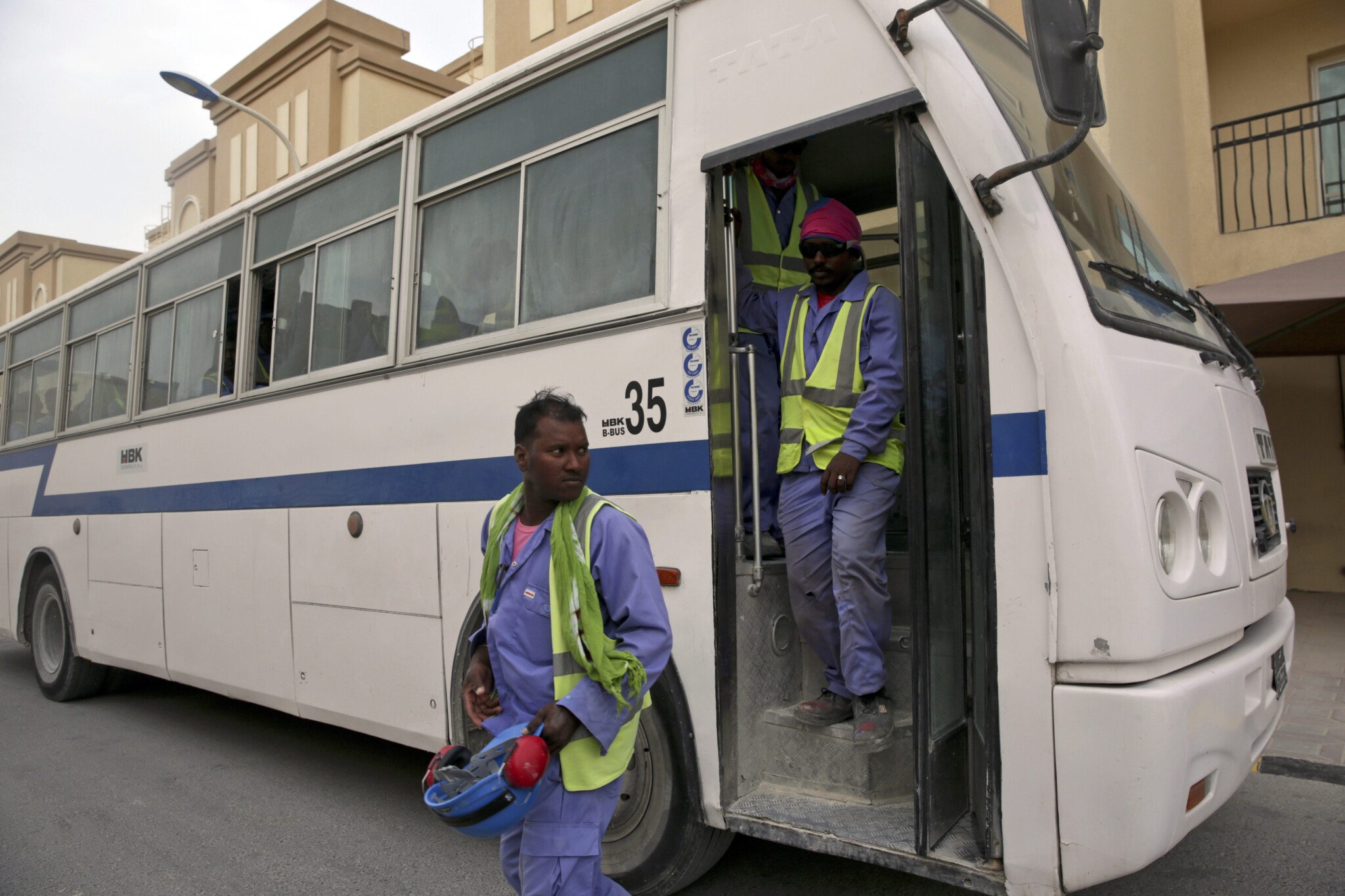
I still remember the day a manila envelope began making the rounds at the office. Inside, there was a condolence card for Ali, along with a request to chip in a few dollars.
Ali’s mother had died back home in India.
To attend her funeral, he’d have to give up several weeks’ pay and get permission from his employer. By raising money, we hoped to help with the first problem. By circulating the card, we hoped to apply enough social pressure to solve the second.
Over coffee breaks, Ali told me about his life: a shared house crammed with bunk beds, monthly trips to the Western Union to wire half his salary to his family.
It would take months to save enough just to leave the country. And if he departed suddenly, there was no guarantee he’d be able to return.
What I’ve just described could take place in Canada today.
But it didn’t.
It happened in Qatar.
From “tea boys” to temporary foreign workers
Back in 2010, Ali earned about $400 a month as the “tea boy” for the 19th floor of our office tower, serving drinks and snacks to staff.
He struggled with reading and writing, but he was sharp, though many treated him as if he wasn’t.
When I tell this story in Canada, half the people react with outrage. The other half smiles and says some version of, “Wow, I wish I had a tea boy.”
Canada doesn’t have tea boys in office towers, but we do have cleaners, dishwashers, farmhands, and nannies flown in from abroad—people who are here to serve.
In the Arab Gulf States, this model is built into the economy. Temporary foreign workers do the jobs locals won’t (or can’t), often for lower pay, lesser rights, and at the mercy of their employers. Even higher-skilled workers like me had to rely on my sponsor for exit permits, which were sometimes dangled as leverage to make me work faster and harder in order to “earn” my weekend getaways. And when I got a competing job offer from another sheikh, I faced roadblock after roadblock trying to secure a “transfer,” ultimately giving up after spending thousands on paperwork for a process that legally existed but never materialized. The conditions have improved since, but that power dynamic between sponsor and employee persists. Canada’s version is more humane. Our laws offer more protections, and the “low” wages are higher. Foreign workers also don’t make up the bulk of our labour force, but the direction of travel is uncomfortably familiar. The Temporary Foreign Worker Program (TFWP) has grown from a seasonal stopgap into a structural pillar for industries from agriculture to warehousing. And, like in Qatar or the UAE, it’s creating a permanent underclass of workers who are essential to our economy but never fully part of our society. By design or not, the program gradually reinforces Canadians to devalue the work itself—treating certain jobs, and the people who do them, as disposable. As Canada tweaks its immigration system, pressure is coming from multiple sides: labour advocates pushing for stronger protections, and a growing anti-immigrant sentiment accusing these workers of “stealing” domestic jobs. The temptation is to abolish the system entirely, a move that would affect some 140,000 foreign workers across Canada. But that would be disastrous for the economy. A program under strain For her book Enduring Work, Catherine Connelly interviewed about 100 people connected to the program in Canada—workers, employers, recruiters, and community organizations. “It’s a very flawed program and the mistreatment that we hear about from time to time—it’s really just the tip of the iceberg,” said Connelly, professor and research chair of organizational behaviour at McMaster University’s DeGroote School of Business. Connelly found that mistreatment of workers in the program was far worse than what she had expected, ranging from unsafe work to what she called “absolute control over the worker by the employer that no Canadian would ever tolerate for a day.” Some housing arrangements involved “hot racking”—beds shared in shifts, like on a submarine, because there weren’t enough for everyone. Connolley found that in some cases, the employer’s control extended beyond the home and workplace. “One restaurant owner, for instance, transported employees to and from work daily, preventing them from engaging in outside activities like religious services or sports, effectively restricting their lives outside work,” Connelly recalled. She said the workers she interviewed were reluctant to speak out for fear of losing their jobs and being sent home. And because most TFW permits are “closed,” they can’t simply leave for a competitor. Their legal right to remain in Canada is tied to one employer—just like Ali in Qatar. Employers see it as a lifeline Business groups argue that the TFWP is already a program of last resort—and arguably one of the most tightly regulated in the country. “There is a very rigorous screening process,” said Christina Santini, director of national affairs at the Canadian Federation of Independent Business (CFIB). “Employers have to demonstrate they’ve done everything to recruit locally.” In agriculture, the need is especially acute. A CFIB report estimates $2.8 billion in lost contracts or sales in 2022 alone due to unfilled jobs. Nearly a third of agri-businesses hired foreign workers in 2023. “If you take those TFWs away, you don’t just lose those jobs, you lose the crops,” Santini said, adding that a farm would have to downsize, resulting in fewer jobs not just for foreigners but Canadians too. By 2030, the CFIB estimates there could be 100,000 vacant jobs in the agriculture sector. Employers must pay prevailing wages, cover housing and transportation in some streams, and comply with inspections. The majority has been compliant, with 94 percent of employers having passed recent reviews. Even among those who were non-compliant, Santini pointed out that most simply did not complete the paperwork. The issue, she added, is less about wanting cheap labour and more that “Canada is not producing enough of those qualified candidates.” Youth unemployment is high, but… Canada’s youth job market remains fragile, leading some critics to claim that foreign workers are hoarding jobs traditionally held by teenagers, especially in fast food. Both Santini and Connelly reject that argument as unfairly demonizing an entire group, though they differ on how much room there is for young people to fill the gap left by the federal government’s recent move to refuse processing certain low-wage TFW applications in metropolitan areas where the overall unemployment rate is 6 percent or higher. The unemployment rate for Canadians aged 15-24 hit 14.6 percent in July, the highest rate in over a decade, excluding the pandemic years. “I think companies realistically would be able to hire [teenagers],” Connelly said. “They might have to pay more. They might have to adjust their hours. They might have to offer more training or more onboarding or different things to make it work.” Santini is less optimistic. She says small businesses often need full-time, year-round staff working shifts that don’t match student availability. “They’re looking to fill—let’s say a position that goes from 6:00 a.m. to 2:00 p.m.—it’s not necessarily what fits a student’s schedule,” Santini said. “They do need a reliable base workforce, and then they can add on part-time work. Those are great jobs for students, but there’s a synergy. If you remove those foreign workers that are full-time, you can’t find full-time staff in the kitchen.” The debate around closed work permits Connelly once thought the program should be abolished. Now, she says that’s naïve. “It will absolutely never happen,” she said. “It’s so embedded in the Canadian employment landscape at this point.” The professor is pushing for “fundamental changes,” specifically around the closed work permit. Most work permits issued in Canada (for foreign students and other types of non-residents) are open and untethered to a specific employer, but the TFWP remains an exception. The vast majority of those permits are employer-specific and closed. Workers can’t change employers without navigating a potentially costly and bureaucratic process. “If people had open work permits, they could vote with their feet,” Connelly said. “As soon as somebody saw, ‘No, this isn’t going to be safe or this isn’t going to work out,’ they could walk across the street and get another job. They’re still helping the economy as a whole, but it’s rewarding the good employers and penalizing the bad ones. That’s just capitalism and market forces being allowed to work in the labour market instead of this overregulation where people are being tied to a single employer.” But there could be other consequences, too. Santini argues that current rules already create strong incentives to treat workers fairly. She warns that scrapping closed permits could create instability for small employers who invest heavily in recruiting and training. Increased turnover, she says, could also push wages sharply higher in some sectors—driving up prices for food, hospitality, and other essentials. “Nothing precludes [TFWs] from applying for another job when they are in Canada and getting that work permit,” she said. “They can end up getting a new work permit working for someone else in a different sector or a different job. They don’t have mobility restrictions.” Still, more than half of agri-businesses surveyed by the CFIB said they would support loosening the rules to create a permit allowing multiple employers to share employees. The harder part to fix Policy tweaks can improve conditions for both employers and employees, but they won’t touch the deeper problem. As long as we see certain work as “someone else’s job”—fit only for people from “somewhere else”—we will keep importing workers to do it. That mindset breeds disposability, the quiet assumption that people doing this work are interchangeable and less deserving of full belonging. “If you have served tables, you’ll be nice to your server later when you have a different job, right?” Connelly explained. “Or if you’ve had a job cleaning up a campground, you’re going to be very tidy next time you camp there as a customer, right? So, yeah, I think there’s value in all this work. I think there’s something to be said for all of us having this type of job.” On this point, the two experts agree. “Fundamentally as a society, when we’re doing our workforce development strategies—whether it be the provincial or federal—consider the fact that we do need individuals in the restaurants…We do need builders as well as engineers as well as IT,” Santini said. “I don’t know where this current government is going with AI and clean technology,” she continued. “But that element still requires the plumbers, still requires the electricians, still requires the machinists and the cleaners.” A little self-awareness is needed In 2022, I returned to Qatar a decade after my stint ended—not as a foreign worker, but as a soccer fan cheering for Canada’s men’s World Cup run. Scanning headlines and social media posts from afar, I couldn’t help but notice the self-righteous tone in how Canadians condemned the Qatari government for its treatment of foreign workers, particularly the predominantly South Asians who built the country’s shiny stadiums. Officially, about 40 workers died, but other estimates range from the hundreds to as high as 6,500. It’s true that Canada’s workplace fatality rates are much lower, regardless of which stat you believe. But they’re not zero. There’s no public tally isolating work-related deaths among TFWs in Canada. Given that these workers are heavily concentrated in agriculture, it’s reasonable to assume that some are among the roughly 62 farm-related fatalities per year recorded nationally. And when I hear the callous way some Canadians talk about TFWs, it’s hard not to think of the attitudes I saw among some Qatari nationals. Connelly pinpointed the sentiment perfectly. “They would have this expectation that these workers should be grateful,” she said. “It wasn’t enough that they just work and be good workers and finish their work and then get a different job. They wanted them to be grateful for this opportunity.” There is a way forward that keeps the TFWP, treats workers with dignity, and meets employers’ needs. But the most urgent reform is in how we value the work itself, and the people who do it.
Falice Chin is The Hub’s Alberta Bureau Chief. She has worked as a reporter, editor, podcast producer, and newsroom leader across Canada and the Middle East, with a focus on economics, public policy, and regional identity. She is based in Calgary.