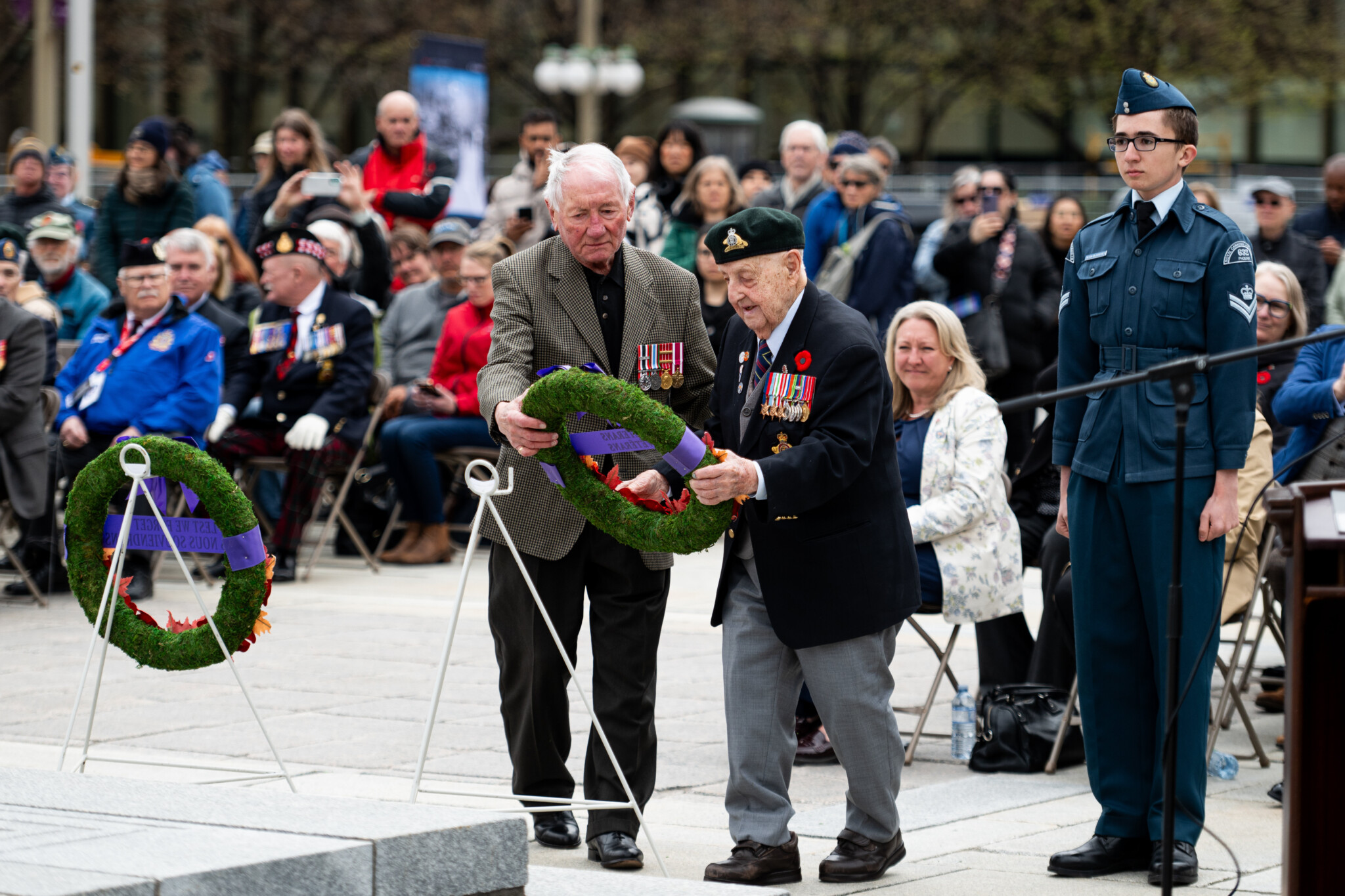
Two Remembrance Days ago, my Cub Scout troop and I had the honour of meeting a 100-year-old man named Merf.
Merfyn David was born in Wales in 1923, moving to Canada when he was a toddler. When he was just 19, he enlisted with the Royal Canadian Corps of Signals, taking up the unenviable task of getting messages across the battlefields of the Second World War.
Merf liberated both France and Holland from Nazi terror, sharing his rations with starving families hiding out in farmhouses. He was part of the first reinforcements following D-Day, which burst open the Western Front, and the botched Dieppe raid that slaughtered 900 of his friends. Merf was shot at by soldiers and strafed by airplanes. But he survived, hanging up his helmet in Germany. On V-E Day, he celebrated by popping the cork off a comically large champagne bottle amongst the rubble.

Members of “O” Section, 2nd Canadian Infantry Division (including Merfyn David) posing with a large bottle of champagne on V-E Day. Oldenburg, Germany, 8 May 1945.
When Merf told these tales to our gaggle of disruptive eight to 10-year-olds, they were unusually quiet. When the Canadian veteran revealed to us that he had also grown up in our Bloor West Village neighbourhood and had also been a member of our Scout troop, you could hear a pin drop. For our boys and girls, the abstract had suddenly become real.
Merf died this February, on the 80th anniversary of the end of his war. He was the last remaining Second World War veteran at his retirement home. He was also one of a few thousand Second World War veterans left across all of Canada. In the next five years, this country will reach an extinction-level event when it comes to those men and women who served. With it will come the loss of tangible human portals that have helped younger generations truly understand their sacrifice. Very soon, we’ll be forced to rely on other methods to get young people to remember. We’ve got work to do to ensure these veterans’ sacrifices do not die with them.

Confronted by history
Young people’s understanding of history today is a field of fog. It is the Frankenstein result of relying on hundreds of disjointed 60-second TikTok videos stitched together to form their perspectives. They lack scaffolding. The names and faces of historic figures are blurry and out of order, untethered to dates or time periods. In 2007, Hub co-founder Rudyard Griffiths revealed polling showing only 26 percent of Canadians aged 18-24 could name the date of Confederation, a 10 percent decline in 10 years. One can only imagine what that number has dropped to today.
While we often talk about those taking sides in the “history wars,” I’m more concerned about the majority of young people who are sitting on the sidelines, the apathetic masses—those entirely disinterested and disengaged with Canada’s past. Those who will meet most history lessons with the response, “Why should I care?”
While schools, museums, books, and impressive new AI history apps will clear some of that historical fog, it is by confronting kids with tangible experiences on a local level that will make the apathetic begin to grasp what young people their age gave up, suffered through, and survived to defend this country’s values.
The Dutch understand this and may be doing a better job of remembering Canadian soldiers than Canadians. Since 1945, school children in the Netherlands have walked to their cemeteries and tenderly cleaned the graves of the Canadian soldiers who liberated their parents and grandparents. They also write letters to the soldiers’ surviving families here in Canada. They’ve learned the lesson that young people must feel history in their everyday lives and in their communities for it to matter.
Canadians are beginning to understand this. In my neighbourhood of West Toronto, a community-based Remembrance Day project called “They Walked These Streets, We Will Remember Them” is now entering its sixth year and is gaining steam. After combing through Canadian service records and newspaper clippings, local teachers Katy Whitfield and Ian Da Silva tracked down the home addresses of more than 1,350 Canadians who enlisted in the army, air force, and navy, and died in the world wars.
Each soldier gets a personal biography on commemorative displays placed around our neighbourhood’s houses, churches, and schools- the same places where these soldiers once lived, prayed, and learned. The biographies tell readers who they were, where they lived and went to school, where they fought, and how they died. After reading, kids have even found out their own houses were once home to soldiers many decades ago. They give thanks by constructing homemade poppies and planting them at the foot of the displays. While the soldiers’ graves are located thousands of miles away, the fallen start to feel much closer, like neighbours.
“That connection to place and street resonates. It makes them human,” Whitfield tells me. “It makes our community feel like a small town.”
Multiply a project like this across the country, and the countless forgotten names etched into cenotaphs in cities, towns, and villages will have life breathed into them once again.
Lest we forget
This Remembrance Day, let us face the fact that Canada is on the verge of losing its living links to the Second World War.
Merfyn David will be remembered by his whopping 21 grandchildren and seven great-grandchildren for being a doting grandfather. But the Canadian veteran’s wartime sacrifices won’t be remembered and passed on unless we have our sons and daughters face them head-on in our communities.
I hope to maybe see Merf’s name on the display currently being erected outside our local church—the very church he met inside 90 years ago as a Cub Scout, and where our Cub Scouts will meet to commemorate Remembrance Day this week.

Harrison Lowman is The Hub's Managing Editor. He has worked for more than a decade in journalism, including at TVO’s The Agenda…





Comments (10)
Thank you Harrison. Your message in this column is important for all of us to remember. I hope there is a way to keep the message of remembrance front and center for cub scouts and teens in the years ahead so that they understand the choices made in WWII and the choices we may be making in the years ahead.