
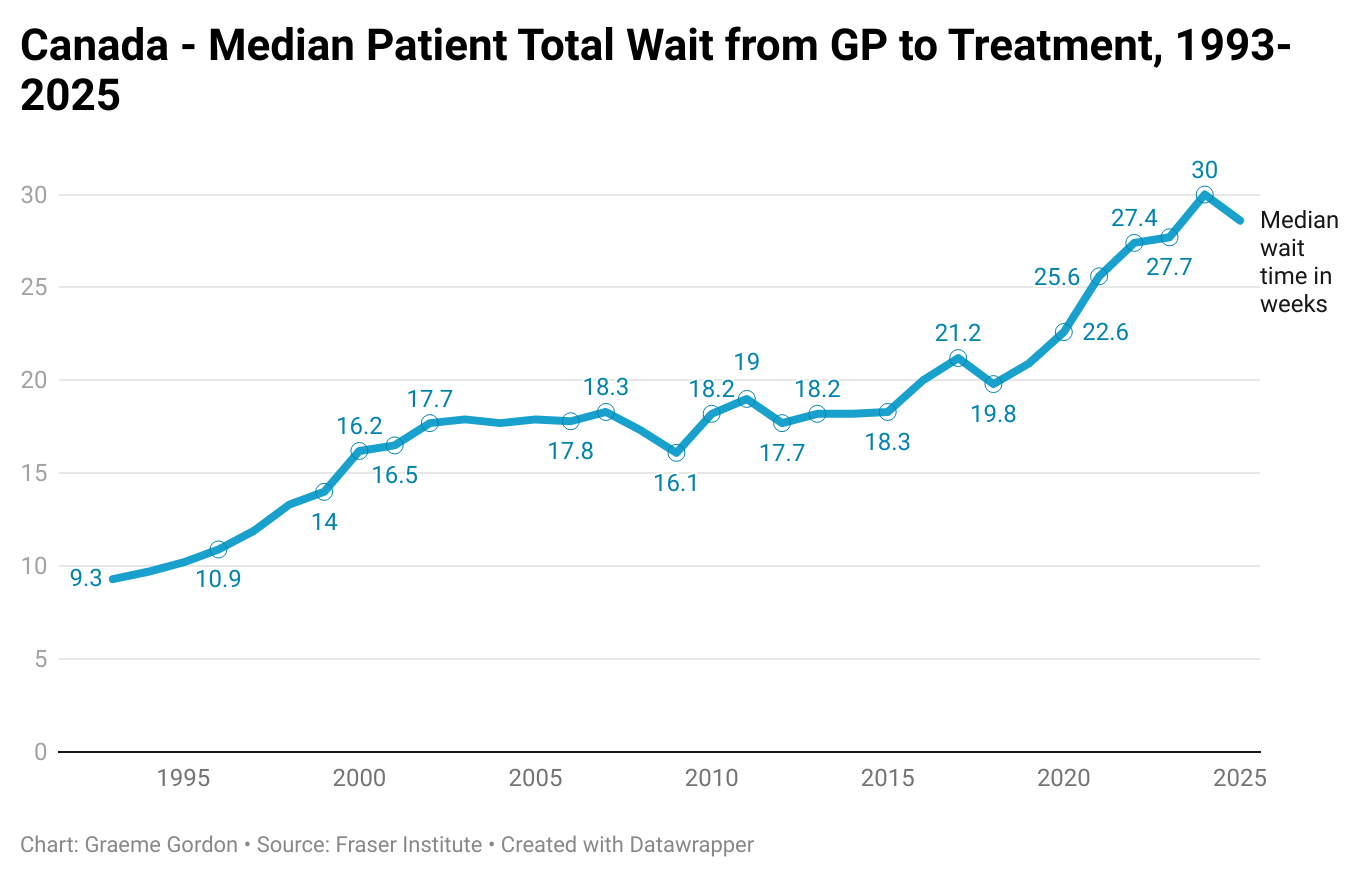
A Canadian patient’s median wait time between a referral from a general practitioner (GP) to end of treatment is now 28.6 weeks, a 208 percent increase from 1993, when it was 9.3 weeks, according to a new research paper released by the Fraser Institute on Tuesday.
However, despite the lengthy wait times in 2025, the median dropped 1.4 weeks from the record median of 30 weeks last year.
“We have a population that has grown and aged, and we have a health-care system that has become less and less efficient as it is expanded in bureaucratic terms. And so, this is just the inevitable outcome of a very poor set of health policy choices…that the provinces have been unwilling to move away from,” Nadeem Esmail, Fraser Institute director of health policy and one of the study’s authors, told The Hub.
The Fraser Institute’s annual study, Waiting Your Turn, calculated “the total waiting time between referral from a general practitioner and delivery of medically necessary elective treatment by a specialist,” surveying 1,577 doctors across Canada.
The study found an estimated 1.4 million medical procedures involved the patient waiting for treatment in 2025, compared to 1.5 million procedures in 2024, which translates to a 10 percent drop.
The estimated percentage of the population of each province waiting for health-care treatments varied from a low of 2.5 percent of Ontarians to a high of 7.8 percent of Newfoundlanders.
The provinces of Ontario (19.2 week wait), Saskatchewan (34.8 weeks), Alberta (36 weeks), P.E.I. (49.7 weeks), and New Brunswick (60.9 weeks) all saw their health-care wait times drop in 2025. Ontario continues to have the shortest median wait time.
Albertan patients’ median wait time dropped 6.3 percent. The median wait time for Ontarians dropped 18.6 percent. Prince Edward Islanders saw wait times fall 35.8 percent.
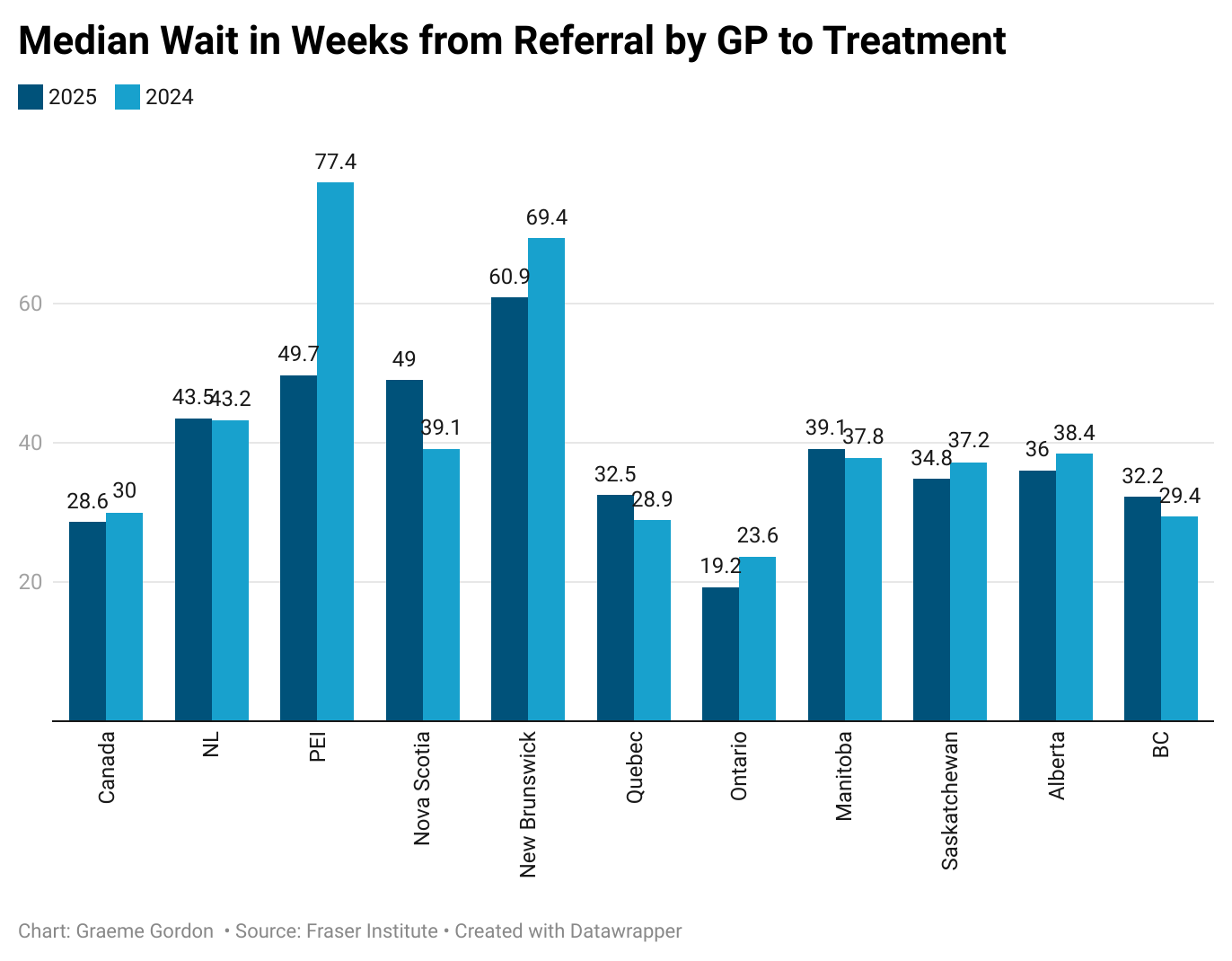
Patients in Newfoundland and Labrador (43.5 weeks) experienced a median wait time virtually unchanged from the previous year. Wait times in the other four provinces all continued to climb.
Quebec patients waited a median of 32.5 weeks, up 3.6 weeks from 28.9 weeks in 2024.
B.C. hit 32.2 weeks, a 2.8-week increase, while Manitoba increased by 1.3 weeks, and Nova Scotia increased by 9.9 weeks.
The median wait times between seeing a general practitioner to consultation with a specialist increased by 313 percent from 3.7 weeks in 1993 to 15.3 weeks in 2025.
Meanwhile, the median wait time between seeing a specialist and receiving treatment (13.3 weeks) was 4.5 weeks longer than what is a “clinically reasonable” time period considered by Canadian doctors.
Neurosurgery and orthopaedic surgery racked up the longest median wait times nationally at 49.9 weeks and 48.6 weeks, respectively. The research paper found wait times for procedures from specialists in head and neck (43.8 weeks), plastic surgery (41.5 weeks), gynaecology (40.6 weeks), and ophthalmology (31.8 weeks) were above the weighted median length of time (28.6 weeks) for patients’ waiting times from referral to the conclusion of treatment.
Excessive wait times for diagnostic technology also added to patients’ afflictions across Canada, with median waiting times of 18.1 weeks for MRI scans, 8.8 weeks for CT scans, and 5.4 weeks for ultrasounds.
Meanwhile, radiation oncology (4.2 weeks) and medical oncology (4.7 weeks) had the shortest wait times.
Doctor availability a major problem in Canada
In October, the Fraser Institute released another health-care study showing Canada now ranks 27th for doctor availability compared to other OECD (Organisation for Economic Co-operation and Development) countries, despite being the third-most expensive.
Esmail believes Canada’s rigid universal health-care system and cap on doctors have led to steadily climbing wait times over the past three decades.
“It’s the predominance of government and the monopolization of health care that has generated this result. And it’s Canada’s unique policy construct that gives us the longest waiting times in the developed world,” Esmail explained.
The health-care expert finds the Alberta government’s recently announced legislation, allowing its doctors the flexibility to work as a private practice after surpassing a threshold of public care hours, is a welcome change, but not enough to fully reverse growing wait times.
“Even after Alberta allows dual practice for non-urgent surgeries, there still is a lack of a vibrant parallel sector in the manner that we see in other countries, where it’s much broader in scope,” said Esmail. “We’re still also not going to have vibrant private hospital competition in Alberta the way we see in very short wait-time countries like the Netherlands, Germany and Switzerland.”
This week, the federal Liberal government announced it was opening a fast-track program for 5,000 foreign doctors working in Canada to gain permanent residency. However, Esmail argues provincial governments and Ottawa need to do more to incentivize medical graduates to come to or stay in Canada, including adding more spaces at Canadian medical schools.
“It’s well time we reviewed the system in its entirety to better understand how we can get more physicians, including Canadian-trained physicians, into practice in Canada.”

Graeme Gordon is The Hub's Senior Editor and Podcast Producer. He has worked as a journalist contributing to a variety of publications, including CBC,…
Given the 28.6-week median wait time in Canada, what policy changes could address this growing issue?
Why does Canada rank low in doctor availability despite high healthcare costs?
How do wait times vary across Canadian provinces, and what might explain these differences?







Comments (1)
Researched MRI diagnostic facilities in the buffalo area and I could have had one the same day. I chose to have one 5 days later. The experience was so unusual for me. The office administration was very organized and the appointment was on time. The MRI staff were very friendly and professional. The appointment concluded with a consultation with the radiologist who shared what he had seen on the MRI. I also have an appointment with an orthopaedic surgeon four days later. And why can we not have this level of quality medical care in Canada?