
Fault Lines examines the pressures pulling Canadian society apart and the principles that can hold it together. We look beyond headlines to understand how institutions, communities, and democratic norms are fraying. Our mission is to show how better choices can repair what is broken.
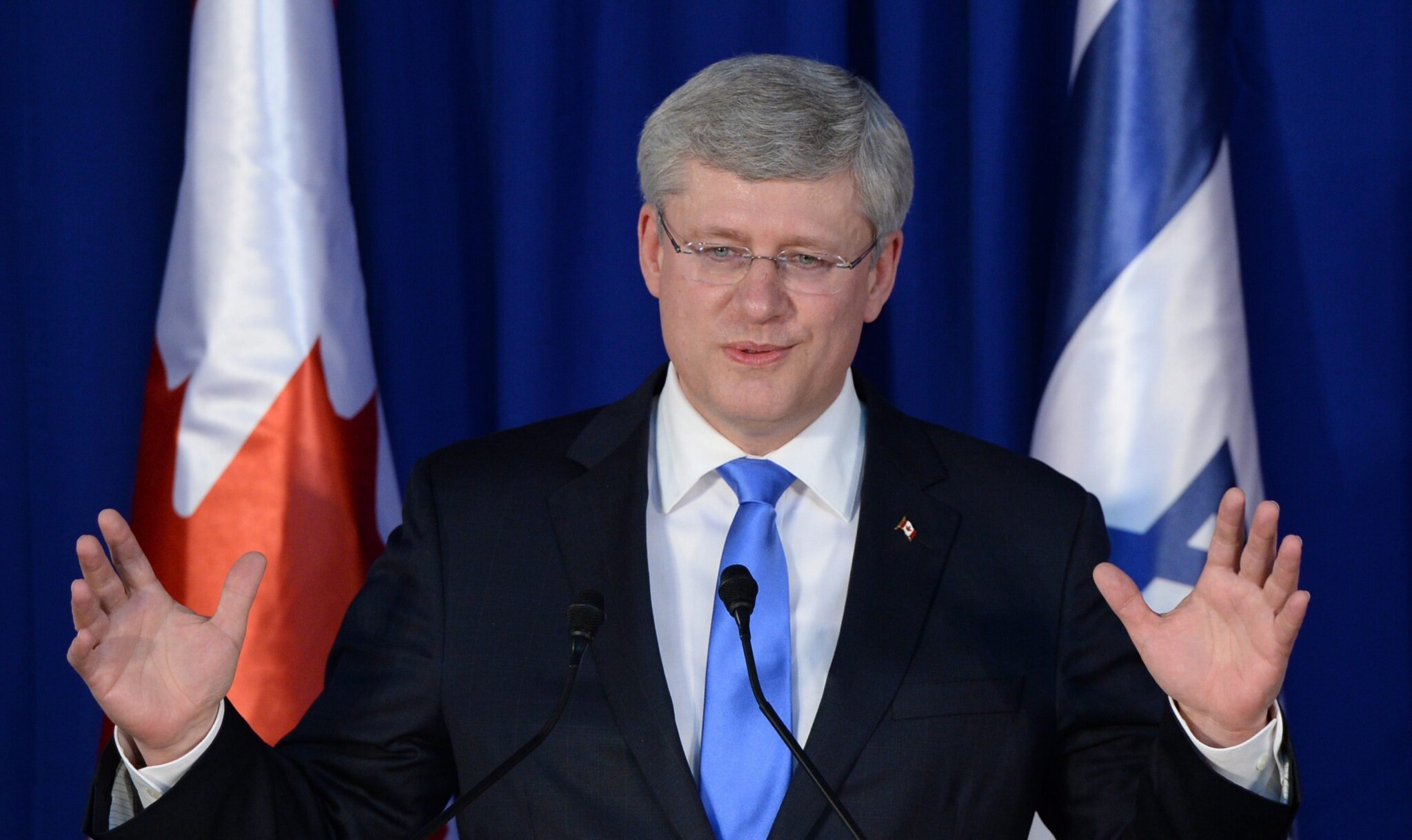
“Through fire and water, Canada will stand with Israel.” – Prime Minister Stephen Harper, address to the Knesset, January 2014.
This week marks 20 years since Stephen Harper first formed government. There will be no shortage of reflections on his domestic achievements, on fiscal discipline, federalism, criminal justice, trade, energy, and the long tail of achievements he left to Canadian conservatism. All of that matters, and others better placed than I will no doubt do it justice.
But as someone who spent most of my formative years working for and travelling with him, at home and abroad, I want to reflect on something more specific: Harper’s principled leadership on the world stage.
It is in foreign policy, particularly in his defence of Israel, that Harper’s character was most clearly revealed. There are many examples of his willingness to puncture diplomatic complacency. I was the only non-world leader in the room when he told Vladimir Putin to “get out of Ukraine,” at a G20 meeting in Australia, puncturing the chummy rituals of the leaders’ lounge. The reaction of his peers made clear how rare such clarity had become.

But it was Harper’s support for Israel where that clarity shone brightest, often in spite of his own political interests. This was not a sentimental attachment, a strategic calculation, nor a performative gesture. It was rooted in a simple conviction that democratic legitimacy and the right to self-defence are not negotiable principles. When asked why he supported Israel so unequivocally, Harper replied with a question of his own. “Why wouldn’t I support Israel?” In a rational moral universe, he argued, the question itself should be unnecessary. Supporting Israel should be as unremarkable as supporting Canada or Australia. The fact that it was not revealed how distorted the moral landscape had become.
Israel occupies a singular place in international politics, not because it behaves uniquely, but because it is judged uniquely. It is the only liberal democracy whose legitimacy is routinely questioned, whose defensive wars are rebranded as aggression, and whose survival is treated as a problem to be managed rather than a fact to be defended. Harper rejected that framing without qualification. As he put it plainly, Israel is not an aggressor state but rather a defensive one. Its military actions, he argued, were aimed at protecting its citizens from existential threats, not projecting power for its own sake.

This was not merely a defence of one country. It was a critique of an international system that had grown comfortable with moral relativism and selective outrage. Harper understood that Israel functioned as a stress test for the moral seriousness of global institutions. If a democratic ally confronting terrorism and regional hostility could be singled out for ritual condemnation while far worse regimes escaped scrutiny, then the problem was not Israel’s conduct but the standards being applied.
In defending Israel, Harper was defending a deeper proposition. Democracies should not be punished for defending themselves simply because doing so is politically inconvenient.
Moral equivocation is often mistaken for sophistication, but it is usually just cowardice in formal dress.
Importantly, this position offered little political upside. Harper stood to lose far more votes than he could ever gain by defending Israel as plainly as he did. That imbalance was not a miscalculation; it was the point. This was not diaspora politics or constituency management. It was a deliberate choice to accept diplomatic friction and domestic criticism in service of a principle he believed mattered. He was willing to be isolated in international forums if the alternative was acquiescing to language and resolutions he believed were dishonest, and that willingness was put to the test far more often than Canadians will ever appreciate.
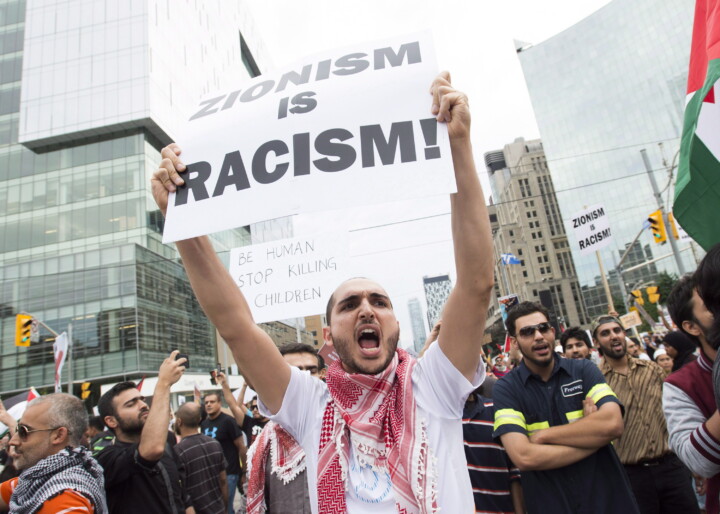
His insistence on clarity was also a direct challenge to the emerging trend of anti-Zionism, which has only metastasized in the years since. Harper observed that it had become the newest, socially acceptable mutation of an ancient hatred.
View reader comments (2)
In his address to the Knesset in 2014, he warned of this shift directly. “We have witnessed in recent years the mutation of the old disease of antisemitism and the emergence of a new strain. People who would never say they hate and blame the Jews for their own failings or the problems of the world instead declare their hatred of Israel and blame the only Jewish state for the problems of the Middle East.”
For Harper, this was not a semantic distinction but an attempt to delegitimize an ally. Its ease of deployment as respectable criticism was precisely what made it dangerous.
What stood out internally was not ideological zeal but discipline. Foreign policy decisions were approached with seriousness and historical awareness, not with a desire to be liked or applauded. Harper believed that history imposed obligations on democratic leaders, and that clarity was not a vice simply because it provoked discomfort. This often placed him in direct tension with the Canadian foreign policy establishment, which had come to confuse even-handedness with virtue and consensus with wisdom.
Harper rejected the idea that “going along to get along” constituted a balanced or sophisticated posture. As he put it plainly, such an approach is not balanced, nor sophisticated. It is, quite simply, weak and wrong. He stood resolutely against that inclination, treating Israel not as a special case, but as the clearest case where principle must prevail over bureaucratic comfort.
Israel was not an exception to Harper’s foreign policy. It was the measure of it.
Today, as Israel once again finds itself pressed to apologize for the act of self-defence, Harper’s record reads less like a historical curiosity than a rebuke. The temptation to blur moral lines in the name of consensus has only grown stronger, and the cost of clarity is now treated as evidence of recklessness rather than seriousness.
Harper understood the opposite. That leadership does not consist in mirroring the anxieties of the moment, but in resisting them. Canada did not lose influence because he spoke plainly. Instead, it retained something rarer: a foreign policy that knew what it stood for, and was willing to say so.

Stephen Staley is the Director of Fault Lines and a longstanding contributor to The Hub on Canadian policy, culture, and civic life. He is…
One of Stephen Harper’s most important legacies was his principled leadership on the world stage, particularly his unwavering support for Israel. Harper rejected the international community’s unique judgment of Israel, viewing it as a stress test for global institutions’ moral seriousness. His stance, often against political expediency, demonstrated a commitment to principles over diplomatic comfort and challenged the rise of anti-Zionism. Harper’s leadership prioritized historical obligations and clarity over appeasement, leaving a legacy of a foreign policy with a clear identity.
How did Stephen Harper's principled leadership on Israel challenge international norms?
What was the 'stress test' Harper saw Israel as for global institutions?
How did Harper's stance on Israel differ from typical diplomatic approaches?






Comments (2)
Well written and to the point. It is a shame that it has taken 10 years of the Trudeau Liberal’s foreign policy to see how good the Harper Government’s foreign policy really was. The same can be said for Canada’s foreign policy under Chretien/Martin.