
Fault Lines examines the pressures pulling Canadian society apart and the principles that can hold it together. We look beyond headlines to understand how institutions, communities, and democratic norms are fraying. Our mission is to show how better choices can repair what is broken.
Professors specializing in the study of free speech believe the mandated free speech policies at publicly-funded Ontario universities and colleges, first introduced by Premier Doug Ford in 2019, have failed in their goal of encouraging academics and students to openly express themselves on campus.
Since the policy was first introduced by the Progressive Conservative government, there have been a total of 97 complaints recorded by the Higher Education Quality Council of Ontario (HEQCO), the body responsible for producing an annual report on the number and nature of complaints. That council files an aggregate report on potential free speech violations, but does not rule on individual cases. Escalated cases, fewer than 10 in the last seven years, get referred to a separate entity, the Ontario Ombudsman, to decide if the policy was followed appropriately.
The somewhat opaque and byzantine Ontario system for monitoring free speech at publicly funded Ontario universities and colleges currently doesn’t have a formal process for deciding if institutions get punished for violating its free speech policy.
So far, it appears no post-secondary institution has been punished with promised curtailed or withdrawn provincial government funding. Free speech experts say that while the government’s intentions may have been noble, it has turned out to be a facade.
“It’s already evident that the Ford government stuff actually didn’t have any real bite to it,” University of Buckingham political science professor Eric Kaufmann told The Hub.
Best laid plans
Shortly after being elected with a large majority in 2018, Premier Ford made good on his campaign promise of making Ontario’s post-secondary institutions adopt official policies to protect free speech.
“Colleges and universities should be places where students exchange different ideas and opinions in open and respectful debate,” Ford said in a press release of the brief policy directive that wasn’t actual legislation.
In doing so, he directed Ontario’s publicly funded colleges and universities to adopt and enforce government-approved free speech policies by January 1, 2019, report annually on compliance, and face potential funding reductions for non-compliance.
Ontario colleges and universities were expected to create policies based on the spirit of the Chicago Principles, a set of 2014 guidelines created at the University of Chicago to reaffirm a commitment to free speech on its campus. The Chicago Principles hold that a university’s role is to provide an open forum for the free expression of all ideas, no matter how offensive or controversial, and that it is never the institution’s place to shield students from viewpoints they find uncomfortable, or to take official stances that limit debate.
Ontario institutions that did not comply were threatened with the potential of “reductions in operating grant funding” from the province. While colleges signed onto a universal free speech policy, each university created or updated its own policies by the deadline.
“Our government made a commitment to the people of Ontario to protect free speech on campuses. Promise made, promise kept,” Premier Ford said at the time.
But Kaufmann believes, nearly a decade later, Ford has merely ordered universities to uphold a policy that has little to no effect in actually protecting free speech on campuses.
“In Ontario, there’s no real mechanism for enforcing if they can just throw those statements under the bus whenever they want. So the universities will capitulate to whoever’s the louder voice, which, of course, is going to be the progressive liberals,” said Kaufmann, a Canadian, in an interview with The Hub.
Kaufmann was a key policy advisor in creating the Higher Education (Freedom of Speech) Act in 2023 under U.K. Prime Minister Boris Johnson’s government. The legislation enforces free speech at post-secondary institutions and has resulted in penalties against offending institutions, including $1.08 million against the University of Sussex for its trans and non-binary equality policy ruled to have a “chilling effect” on free speech for faculty and students.
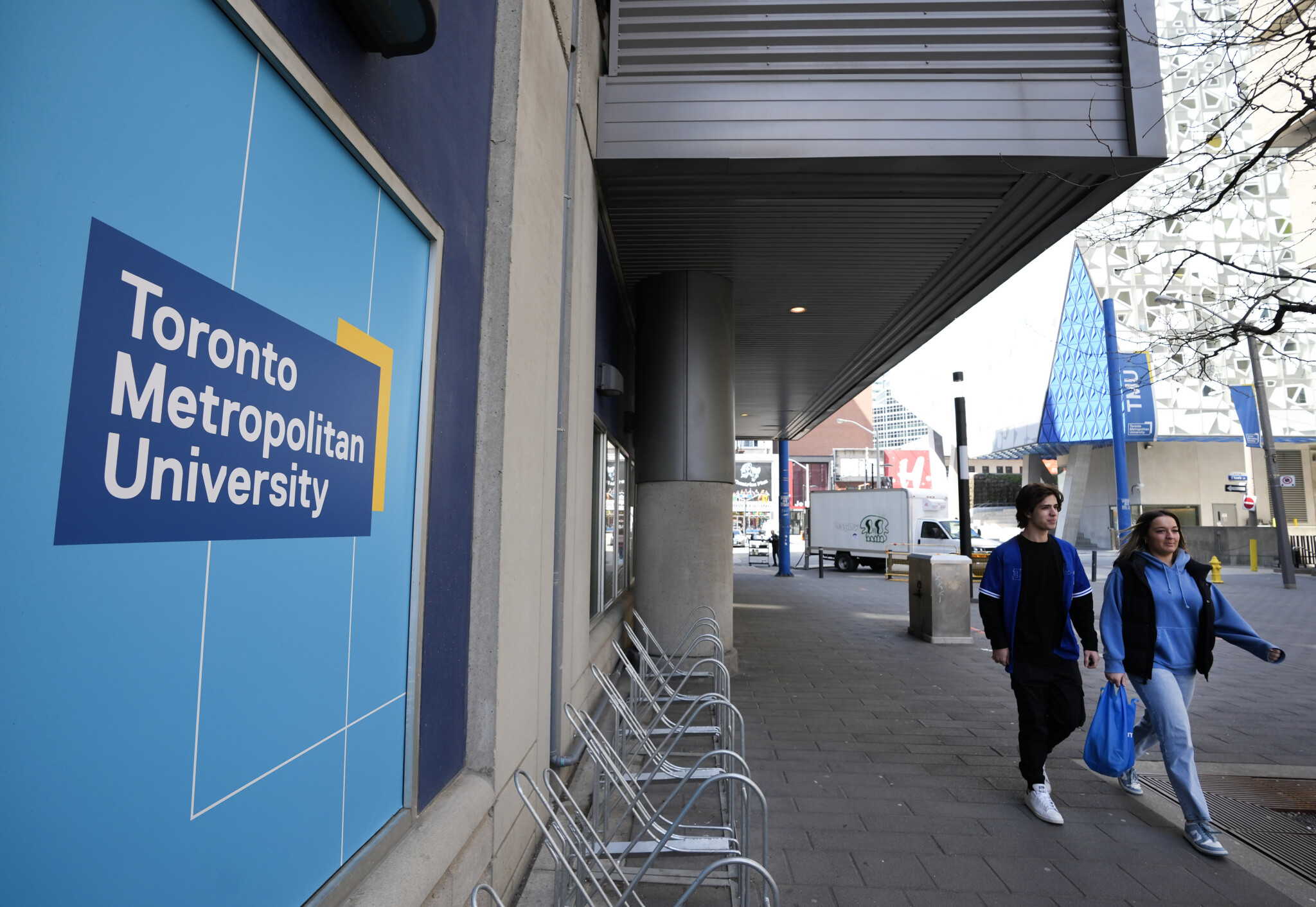
Students make their way around the renamed Toronto Metropolitan University (TMU), formerly known as Ryerson University in Toronto on Wednesday, April 26, 2023. Nathan Denette/The Canadian Press.
Desperate times call for…
Premier Ford’s campaign promise to restore free speech on campuses was a direct response to an intense period of cancel culture and a reaction to two high-profile incidents at Ontario universities a year prior.
The first case involved then-University of Toronto professor of psychology Jordan Peterson. The clinical psychologist became internationally famous in late 2016 for protesting federal legislation amending the Canadian Human Rights Act and the Criminal Code to include “gender identity or expression.” Peterson argued the legislation would force professors and other professionals into “compelled speech” by being legally required to use a person’s preferred pronouns, whether they believed in the gender ideology or not.
Second was the 2017 Lindsey Shepherd affair at Wilfrid Laurier University, which kicked off when Shepherd, a teaching assistant, released recorded audio of a meeting in which she was reprimanded by a university administrator and the professor she worked under. Her transgression had been to play a clip from a debate on public television featuring Peterson criticizing the federal government’s new law.
Peterson and Shepherd both faced fierce censure from their respective institutions.
The newly minted conservative premier, who ended 15 years of Liberal government in Ontario, decided to act.
However, classical liberal academics watched the Ford free speech policy fail, mainly due, they say, to the fact that it asked universities and colleges to self-enforce.

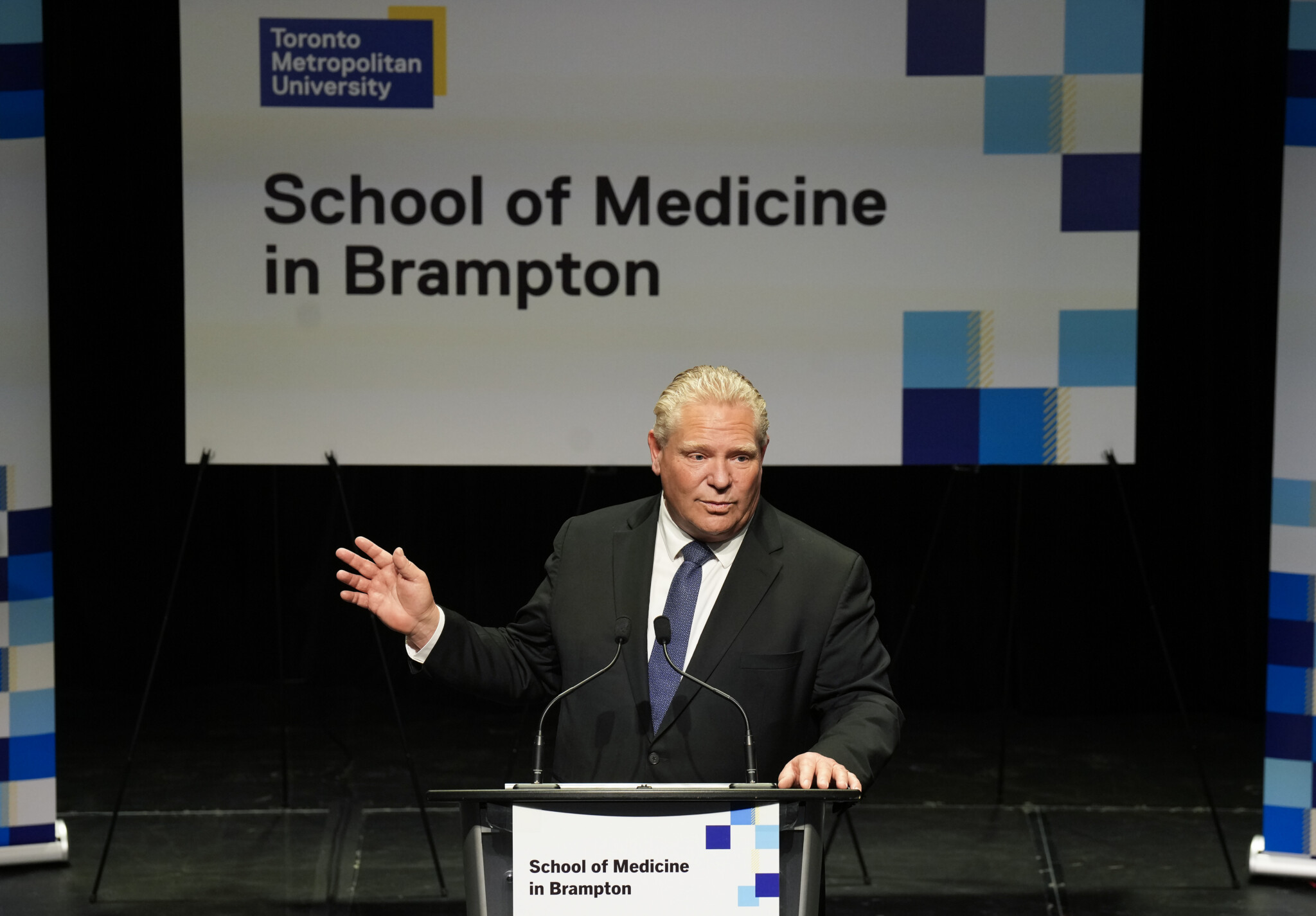
Ontario Premier Doug Ford walks to the podium to make an announcement at Sheridan College on Friday, January 31, 2020. Nathan Denette/The Canadian Press.
A highly complicated system
Currently, post-secondary institutions self-report to a body that does not actually rule on whether or not they have actually protected free speech in the cases provided.
The Ford government tasked the HEQCO to “monitor compliance” of publicly funded universities and colleges that must file the HEQCO annual reports.
“HEQCO’s role is reporting at the aggregate level only. We have no role in any individual complaint,” communications director Matt Ross explained to The Hub.
“Those reports are submitted to HEQCO and posted publicly, and our report summarizes the results from all institutions and includes links to the institutional reports. Over the seven years of reporting so far, 97 total complaints have been tracked,” Ross added.
Ross also explained that generally, reports are resolved at the institution with the complainant. However, if someone is unsatisfied with the resolution, they can appeal to the Ontario Ombudsman.
Ontario Ombudsman director of communications Linda Williamson made it clear that the ombudsman role is to review free speech policies at universities when individuals bring complaints to them and “suggest best practices or improvements to make them more fair and transparent.”
“The Ombudsman does not police free speech at post-secondary institutions,” said Williamson. “Our role is not to redo their work, but to review whether they followed a fair process.”
Williamson said the Ontario Ombudsman has received fewer than 10 complaints in the last seven years, including four in its 2019 annual report that disclosed two cancellations of political discussions and debates at universities related to the 2019 federal election and two where security fees were charged by the institutions for events expected to court controversy and security concerns. No other details were provided in the report.
In the past two annual reports from the Ontario Ombudsman, no complaints have been listed.
There is no Ontario government body or agency in charge of punishing non-compliance. After seven years, no public cases of violations or cuts to funding appear to have been recorded. While the press secretary for Colleges and Universities Minister Nolan Quinn said their office would provide comment for this story, they did not do so by the extended deadline requested by them.
Kaufmann believes “lofty statements” without real consequences for Ontario universities means free speech isn’t actually protected on Ontario campuses.
How conservatives self-censor on campuses
Queen’s University law professor Bruce Pardy published 2020 a paper in the Education and Law Journal looking at free speech on Canadian university campuses. He also finds the Ford government’s free speech policies lacked teeth.
“Government directives that cannot be enforced are of little value…The directive describes a political process, not a legal one,” Pardy explained in his paper. “[It] endorses the use of existing internal university dispute-resolution and disciplinary mechanisms to ‘ensure compliance.’” Aggrieved parties who get no satisfaction from within the university are to refer their complaints to the Ontario Ombudsman, who has no power to compel anyone to do anything.”
Pardy told The Hub that Ontario students now regularly self-censor because they’re aware that criticism around taboo topics like race theory and trans issues cannot be challenged and will not be defended by the administration.
“Students regularly tell me they cannot risk saying what they really think in class, for fear of backlash from teachers or their classmates,” Pardy explained.
Today, all post-secondary institutions in Ontario are required to include EDI-related (Equity, Diversity, and Inclusion) policies on their websites due to a new provincial Strengthening Accountability and Student Supports Act (2024). The new law makes it mandatory for post-secondary institutions to create policies around combatting racism and hate. Pardy believes these policies, along with similar LGBTQ+ and EDI policies adhered to by most of the post-secondary institutions, directly conflict with the free speech policies.
“EDI policies limit speech when they reward some beliefs and not others. Academics and students follow their incentives like everybody else,” Pardy told The Hub.
Despite no high-profile free speech cases at Ontario universities since 2019, Pardy and Kaufmann believe that rather than becoming bastions of free speech, the province’s universities and colleges have become places where conservative students self-censor their true beliefs.
Last year, the Fraser Institute and Leger released a survey of 1,200 Canadian university students showing 83 percent of Right-leaning students found their professors to have left-wing viewpoints. Fifty percent of right-of-centre students said they “sometimes felt uncomfortable expressing their opinions” in classes. Meanwhile, 37 percent of Right-leaning students said “they feared formal consequences for expressing honest thoughts, opinions, or even asking questions in their classes.”
View reader comments (0)
How ideological dogma at universities affects free speech and research
Students aren’t the only ones affected. Faculty and staff at universities know there are certain topics that are sacred cows on campus.
Kaufmann told The Hub that professors will more often than not self-censor when they hold opinions that clash with the political positions universities are increasingly taking, lest they lose their jobs.
“If you have a different view, then you are in conflict with your institution, and therefore you will shut up,” Kaufmann explained.
The political science professor says the informal consequences, which don’t get officially documented in the vast majority of cases, are one of the most powerful ways to flout supposed free speech policies at universities.
“You’re going to have what I think is more insidious, which is the informal political prejudice, peer-to-peer prejudice that punishes you, not by firing you, but just not hiring you, not publishing you, not giving you a grant or promotion, or not even sitting with you,” Kaufmann explained.
He adds that the consequences of free speech being throttled at the social level of institutions will ultimately result in bad policy and governance.
“The ability to speak freely is valued by society. Western society, or societies, fight and die for that. But even beyond that, if you don’t have freedom to speak, to research, then knowledge suffers. You can’t find the truth.”
This is the first of a two-part series looking at free speech on Ontario university campuses since Premier Doug Ford mandated post-secondary institutions enforce free speech policies on campuses nearly a decade ago. Part two will look at the self-censorship and punishments that students and professors who speak against progressive orthodoxy face.

Graeme Gordon is The Hub's Senior Editor and Podcast Producer. He has worked as a journalist contributing to a variety of publications, including CBC,…
Academics are questioning the effectiveness of Premier Doug Ford’s 2019 mandated free speech policies at Ontario universities, arguing they haven’t fostered genuine open expression. Despite the policies, a complex monitoring system lacks enforcement mechanisms, with no institutions penalized for non-compliance. While universities adopted policies based on the Chicago Principles, experts like Eric Kaufmann believe they lack real impact, as institutions often prioritize louder voices, typically from progressive liberals. Concerns are rising about self-censorship among conservative students and faculty, fearing backlash for expressing dissenting views on topics like race theory and trans issues. The absence of robust enforcement and the rise of EDI policies are seen as contributing factors to this chilling effect on free speech, potentially hindering open research and debate.
Has Ford's free speech policy achieved its goals at Ontario universities, according to academics?
What are the potential consequences of self-censorship on university campuses?
How do EDI policies potentially conflict with free speech policies at Ontario universities?






Comments (0)