Canadians generally feel good about their democracy, but don’t necessarily spend a lot of time thinking about its character. An Angus Reid poll from December 2024, for instance, found that Canadians, especially older and wealthier Canadians, are relatively proud of their nation.
But Canadian pride is about more than just economic status and voting every four years. It speaks to the set of institutions and ideas that mark the relationship between individual Canadians and the state. It’s about the status of our democracy.
Writing in 2006, French political philosopher, Pierre Manent, captured this point about the nature of democracy itself:
Thirty years ago our manner of speaking about democracy was different. The substantive “democracy” was usually accompanied by an adjective. One spoke of “liberal” or “bourgeois” democracy, of “socialist” or “popular” democracy. Scholarly opinion very much doubted that there was something called democracy tout court [without qualification].
It makes one wonder what kind of democracy Canada has and how it has evolved according to some of these ideas set out by Manent. What adjectives might help to define our democracy?

The emergence of prosecutorial democracy
As a scholar of history, philosophy and the law, I’m of the view that in recent decades our democracy has taken on two distinct forms. On the one hand is the more traditional notion of democracy that might still be called “liberal.” It’s ostensibly how most Canadians think about democracy. It attaches itself to the nation-state (though not necessarily to nationalism), it values political participation, and actively supports representative government through the role of elected officials making judgements on our collective behalf.
On the other hand is the rise of what I’ve dubbed “prosecutorial democracy.” As the name suggests, it involves the use of prosecutorial mechanisms to enforce and promote a certain conception of democracy. These mechanisms focus on procedures with the authority to compel compliance. They range from administrative tribunals, such as human rights commissions and professional regulators, to criminal prosecution resulting in fines, probation and, ultimately, imprisonment. I should know, I used to lead one.
Years ago, these administrative and criminal sanctions were meant to identify and punish behaviour deemed unacceptable by society at large. While they tended to reflect the values of the ruling classes, they typically enjoyed broad social acceptance.
On the criminal front, murder, theft, and rape are almost universally condemned by all classes. From the standpoint of human rights, refusing service to someone on the basis of race or denying someone the right to publicly express their political opinions is generally frowned upon. And as far as professional regulators go, we usually all agree that lawyers should not steal funds from clients and doctors should demonstrate sufficient competence not to harm their patients.
Today, however, authorities are increasingly using these processes to compel citizens to accept and promote politically and socially acceptable opinions rather than deter actions. These include legislation designed to criminalize online statements such as those leading to Lucy Connolly’s incarceration in the United Kingdomm, the Ontario Human Rights Commission fining the Town of Emo for refusing to celebrate pride, and professional regulators controlling the speech of nurses such as Amy Hamm and Carolyn Strom under the guise of protecting the public and the profession.
Historic roots
This new prosecutorial democracy differs fundamentally from the liberal democracy that Canadians and the West generally have come to respect and admire. Liberal democracy rises and falls on the basis of citizen participation in determining the laws a nation will enact and uphold.
The “liberal” aspect goes back to the 17th century with the creation of a sovereign but representative government that prevents citizens from harming each other but also allows them to interact in civil society without hindrance from government intervention.
The democratic component hails from the 18th century and the idea that the “people” in some sense are the source of the government’s sovereignty (whether republican or constitutional monarchy). It is the people who should participate in the selection of their representatives through open and fair nominations, elections, and judicial procedures. This version of democracy promotes both equality and self-government.
But prosecutorial democracy has little interest in these liberal and democratic niceties. This is largely because of how it sees “democracy.” Unlike liberal democrats who concern themselves with increasing citizen participation through the robust debate of issues, prosecutorial democrats emphasize equality to the detriment of participation. They are perfectly willing to replace the messiness of free expression and open discussion with the conformity of enforced speech about equality, often described today as “equity”, or to produce complete equality of outcomes for those considered “marginalized.” It cloaks itself in the garb of the democrat while dismissing dissent as authoritarian.
The other big difference concerns the social discord prosecutorial democracy supports. Liberal democracy has progressively sought to include greater segments of the population in political self-governance. It serves as a means of social unity. An example here is the inclusion of the working classes into the political mainstream through economic and political measures such as guaranteed pensions, unemployment insurance, health benefits, and collective bargaining.
By contrast, prosecutorial democracy looks at society through the lens of systemic oppression, imposing social division into our political arrangements. Its solution is to control nonconforming citizens through coercive criminal and administrative measures; forcing them to comply with the views of the elite governing class or risk fines and incarceration.
While prosecutorial democracy originated in the 20th century’s progressive movement, with its legitimate demands for equality and tolerance, it reared its uglier head in the 1960s and 1970s fueled by both the bureaucrat’s petty need to manipulate the most mundane speech and the most virulent egalitarian extremism emanating from university campuses. Despite its original benign intent to promote inclusion and equality, it has instead spawned an aggressive intolerance that divides societies and punishes free expression.
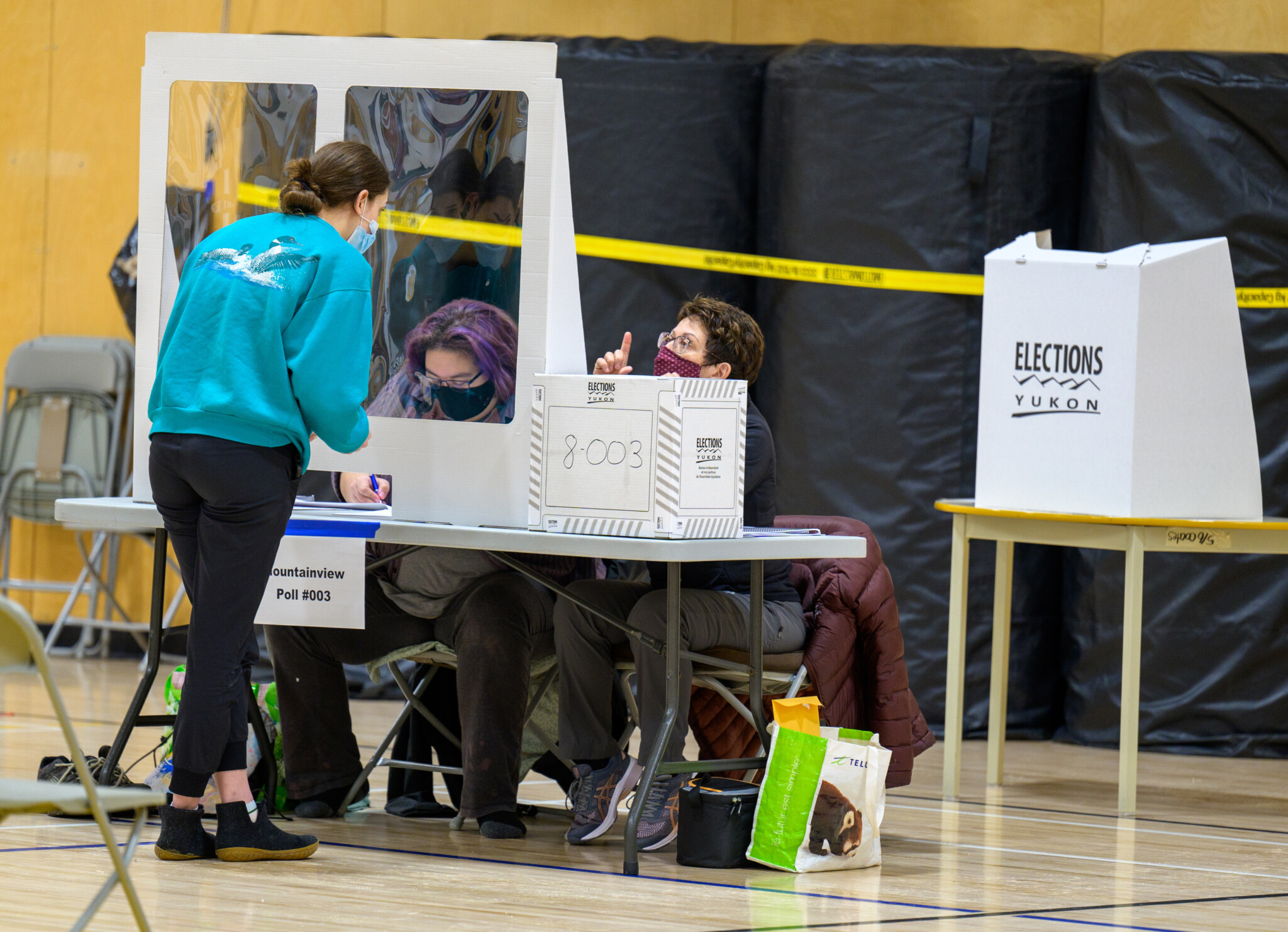
A voter and poll workers are shown at a Whitehorse polling station during the Yukon election on Monday, April 12, 2021. Mark Kelly/The Canadian Press.
Canada in the crosshairs
Canada is particularly susceptible to prosecutorial democracy’s sway. The growth in our disciplinary regimes includes the previous Liberal government’s efforts to impose online harms legislation, something that may return under the Carney administration. Similar efforts by professional regulators to manage members’ speech about gender and public expression suggest troubling trends for Canadians. While Americans can rely on the First Amendment of the Constitution to protect their free speech, Canada seems happy to follow countries like the United Kingdom down the path of enforced compliance with opinions deemed correct by an activist elite dedicated to equality-as-equity over liberal self-government.
On the political level, the social cohesion of our western democracies is fraying as polarization between the governing class and targeted citizens becomes more common. On the personal level, the curse of cancel culture, once initiated by activists outside of institutions, is increasingly led by the institutions.
I view this new “incarceration culture”, where government and administrative tribunals use their coercive powers to fine or even jail citizens who engage in otherwise protected speech and expression, as the future manifestation of cancel culture.
The fight against this creeping conformism begins with recognizing its growing influence. But recognition is not enough. If we hope to preserve some semblance of our liberal principles, civil society actors, including organizations that defend those under attack for exercising free speech, must engage in the legal and legislative battles against prosecutorial democracy.
Canada has a long way to go before we can recover a broader and more inclusive sense of democracy.