
The Munk Debates returned on Wednesday night with a question that has outlived generations of diplomats: Whether it is in Israel’s national interest to support a two-state solution. Four former senior Israeli officials took the stage at Toronto’s Meridian Hall to argue the motion before a sold-out crowd. Outside, the city supplied its own commentary.
The two-state solution was long treated as a political law of gravity, a rule written into the diplomatic heavens. Yet gravity seems to have weakened. There is no evidence that Palestinians or their leaders possess even the slightest willingness to accept Israel’s right to exist, and regional partners have already shown they will normalize relations without waiting for such recognition. Israelis themselves have turned away from a formula that failed to protect them on October 7. A doctrine repeated for half a century now feels like a relic of a world that ended on that day, all of which made for good timing for a frank and open debate on such an important question.

Police formed a strong perimeter around the venue as several hundred protestors, many masked, converged on the entrances. Antisemitic epithets rang out as attendees approached the doors. The scene has become uncomfortably familiar in Toronto, a city that prided itself on civility now requires a police escort for public discussion. It is sad that a public debate of ideas requires courage to stage in our city, but we are fortunate that at least some still have the requisite fortitude.
Comments (8)
Edward Blinick
05 Dec 2025 @ 12:31 pm
What took place in the debate was what takes place in Israeli politics and within the polity. It is a vibrant, heated, open exchange of ideas that define Israel as one of the most real examples of a democracy (however dysfunctional it appears).
However the real debate is not what is happening amog Israelis. The real debate should be: The Palestinians should accept the existence of the State of Israel as part of a Two-state solution (Pro). The presenters should be 4 Palestinians representing their politicians. Or, 4 Canadian Palestinian representatives.
I suspect that there would not be a problem getting people to argue CON. However, I am not sure whether you could get anyone to agrue PRO.
Given the shifting Israeli public opinion post-October 7, what are the core arguments for and against the two-state solution's continued relevance?
How did the protests outside the Munk Debates influence the perception of the two-state solution debate inside?
The Munk Debates saw a significant shift in audience opinion. What does this suggest about the effectiveness of reasoned debate versus entrenched positions on the two-state solution?
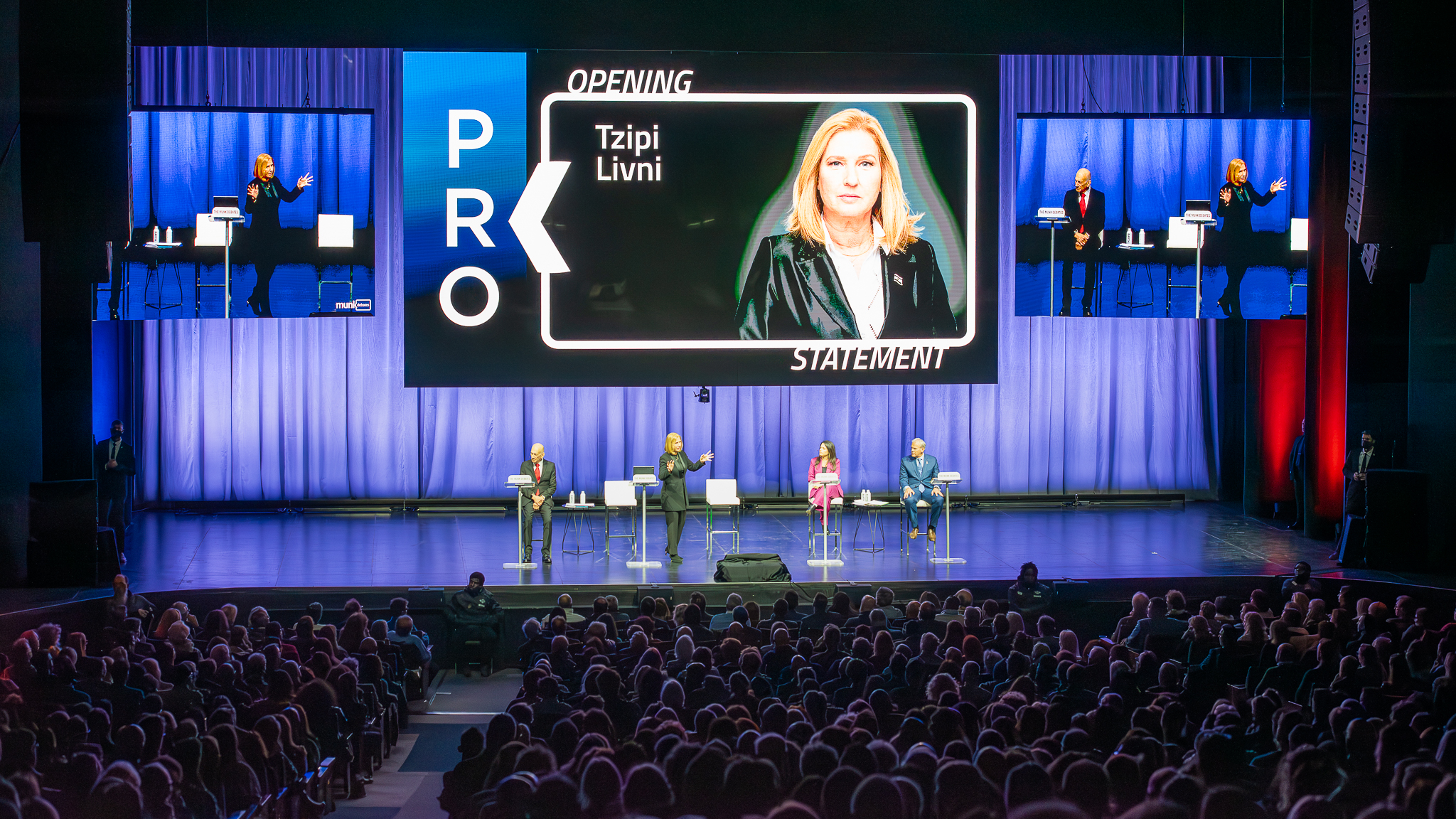
Inside, the atmosphere shifted. All four debaters were Israeli, and they spoke with the urgency of people who debate policy in the morning and live under its shadow by nightfall. Passion filled the hall, though even the most heated moments produced brief interludes of comic relief as moderator (and Hub co-founder) Rudyard Griffiths worked hard to keep time, hold the topic, and preserve the ancient custom of letting one person speak before the next. Time limits wobbled, topics strayed, and speaking turns dissolved into overlapping exchanges, a brief touch of levity within a discussion carried by earnest conviction. Ehud Olmert (mayor of Jerusalem from 1993 to 2003 and prime minister of Israel from 2006 to 2009) and Tzipi Livni (former foreign minister of Israel, vice prime minister, minister of justice, and leader of the Opposition) argued that Israel has no secure future without a negotiated political settlement. Their case rested on the idea that the alternative to a two-state agreement is the status quo, and the status quo cannot hold. Changing demographics, international pressure, and unending cycles of conflict would erode Israel’s position over time. To them, the two-state solution was not a romantic vision but a practical recognition that unmanaged reality is more dangerous than imperfect compromise. Israel cannot live indefinitely by the sword, and statecraft is the art of replacing drift with direction. Michael Oren (former Israeli ambassador to the U.S., member of the Knesset, and deputy minister of diplomacy in the Prime Minister’s Office) and Ayelet Shaked (Israeli politician and activist and former minister of the interior, minister of justice, and member of the security cabinet) took the opposite view and grounded their argument in security, sovereignty, and recent diplomatic history. They noted that the Abraham Accords, along with ongoing discussions with Saudi Arabia and other Sunni states, have already exposed a long-standing misconception: the idea that Palestinian statehood must precede regional normalization. The region has shown otherwise. In their view, Israel’s strategic landscape is improving without concessions that would place hostile forces closer to its population centres. For them, peace cannot be built on the hope of one side alone. No agreement can survive if it rests on promises that collapse the moment they are tested. The pre-debate poll showed a strong majority in favour of the motion. By the end of the evening, that majority had shrunk to a narrow lead. The anti-two-state side had clearly moved the room; 33 percent were in favour of this side to start, yet by the debate’s close, that number had jumped to 46 percent. Polling swings can reflect many things, but it was difficult to ignore the symmetry between the arguments inside and the atmosphere outside. Attendees had just walked past a crowd intent on denying them the simple act of gathering. When a debate in Toronto requires a significant police presence because agitators reject the idea that Israelis should speak at all, it becomes harder to believe that their counterparts in the region will accept Israel’s right to exist as a Jewish state. The implication lingered even when no one said it aloud. This was not the intended message of the protestors, but it was the message many heard. Sometimes the loudest voices strengthen the argument they seek to silence. The debate was thoughtful and substantive, and it succeeded because the organizers, security staff, and police insisted that it would happen in full. They protected the simple but precious space where ideas can contend without fear. Such spaces are disappearing in Canada. Our civic life no longer produces many rooms where strong arguments are met with stronger arguments instead of threats. The Munk Debates remain one of the few. They show that the fight worth having is not the one in the street, but the one on the stage, where conviction meets reason, and the best idea wins.
Stephen Staley is the Director of Fault Lines and a longstanding contributor to The Hub on Canadian policy, culture, and civic life. He is a senior advisor at the Oyster Group, one of Canada’s leading communications and public affairs firms. He formerly served as executive assistant to Prime Minister Stephen Harper and as an executive at one of Canada’s largest banks, where he led strategy and communications for its Canadian business.
Comments (8)
What took place in the debate was what takes place in Israeli politics and within the polity. It is a vibrant, heated, open exchange of ideas that define Israel as one of the most real examples of a democracy (however dysfunctional it appears).
However the real debate is not what is happening amog Israelis. The real debate should be: The Palestinians should accept the existence of the State of Israel as part of a Two-state solution (Pro). The presenters should be 4 Palestinians representing their politicians. Or, 4 Canadian Palestinian representatives.
I suspect that there would not be a problem getting people to argue CON. However, I am not sure whether you could get anyone to agrue PRO.