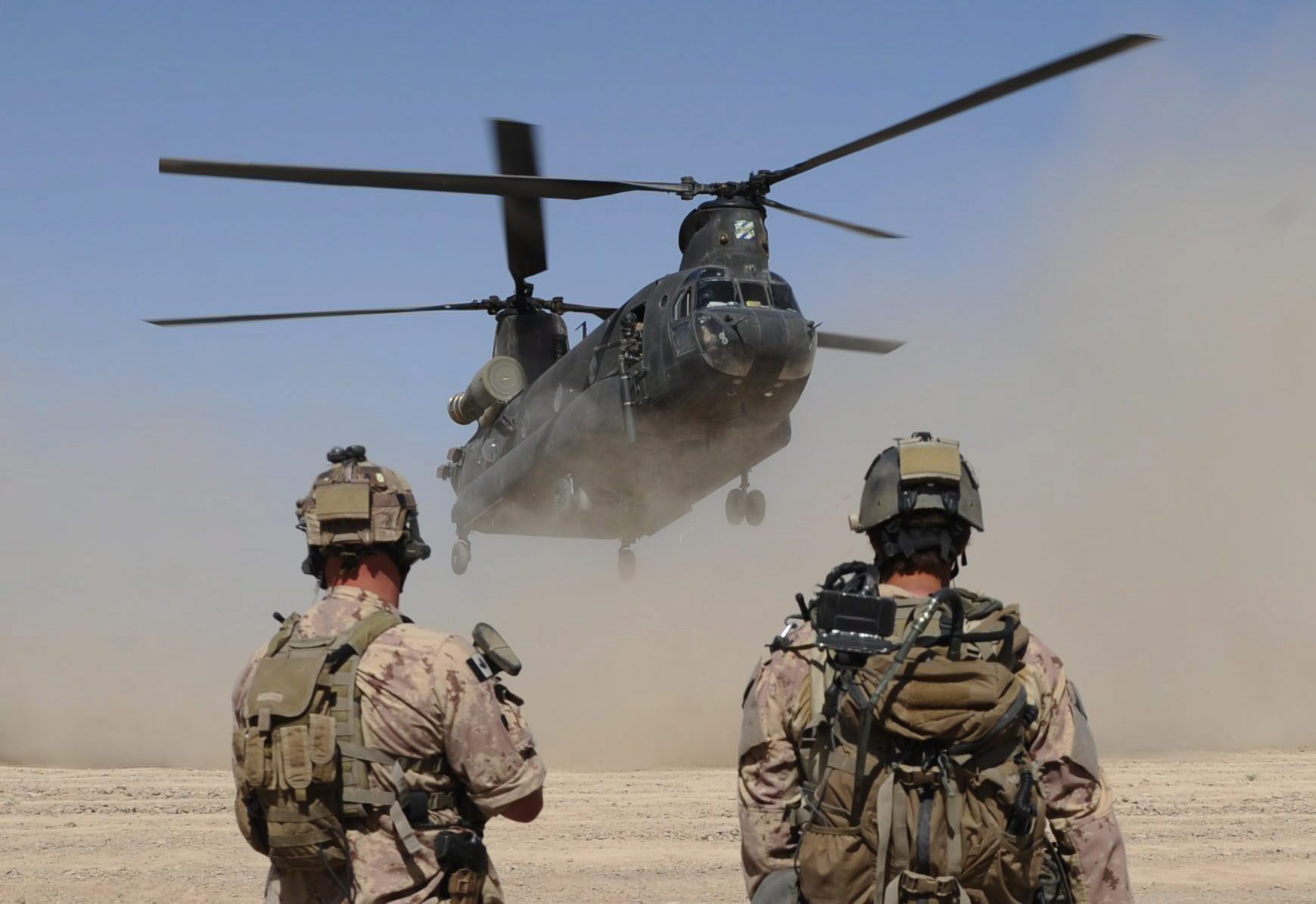
Dear Mr. President,
Your recent comments calling into question the service of Canadians and other allies who put their lives on the line when called upon by your country have received a significant amount of backlash. Rightfully so.
The Canadian and American militaries, in particular, are as integrated on combat operations as any two armed forces in the world. This integration stretches from the First World War through the Second World War, including the Normandy invasion, through Korea, and most recently in Afghanistan.
It is a proud record that deserves honour, respect, and gratitude.
The following story from my own time serving in Afghanistan demonstrates that intimate closeness.
On 3 July 2009, Corporal Nick Bulger, serving in Princess Patricia’s Canadian Light Infantry, was killed in action by an improvised explosive device (IED). The operation that led to this was a combined Canadian and American operation that occurred between Canada Day, 1 July, and American Independence Day, the Fourth of July. The American battalion was under the command of our Canadian Brigade, Task Force Kandahar (TFK).I am willing to bet that the number of times U.S. combat troops have been attached under the command of the forces of another country can be counted on one hand. If this is not what only the closest of allies do, then I don’t know what is. The American battalion had just arrived in theatre and was conducting its first combat operation in Kandahar Province, while the rest of our Canadian Brigade had been in theatre for several months.

Our Canadian brigade commander’s tactical grouping (99 Tac, or just the Tac) was forward for the commencement of the American battalion’s operation. The operation was to seek out the Taliban in tribal territory where their presence was strongest, truly the “Wild West” of Afghanistan. Essentially, the Tac was three LAV III vehicles; in effect, a platoon that provided command and control and included close protection for the commander, other arms advisors (including myself as the combat engineer advisor), numerous specialists, and, crucially, a medic.
It was during this operation that we struck the IED that killed Corporal Bulger. One of our three vehicles, callsign “Whiskey,” the one I was in, was destroyed. Four soldiers in the vehicle broke their backs, and an additional soldier had shrapnel wounds to his legs and perforated eardrums. In my case, I suffered nine breaks to six different vertebrae in my back, and a few other, less serious physical injuries. Beyond those, mental health later became a significant issue for numerous among us in 99 Tac, me included.
Brig.-Gen. Jonathan Vance (commander of the Canadian Task Force Kandahar and later our chief of the defence staff) was in the vehicle in front of ours. I still cannot figure out how Brig.-Gen. Vance’s vehicle missed the IED that we hit while driving directly behind. Lt.-Col. Harjit Sajjan (later our minister of national defence) was in the vehicle behind me. He was one of four who carried me on a stretcher to an American Blackhawk helicopter as I started to go into shock.
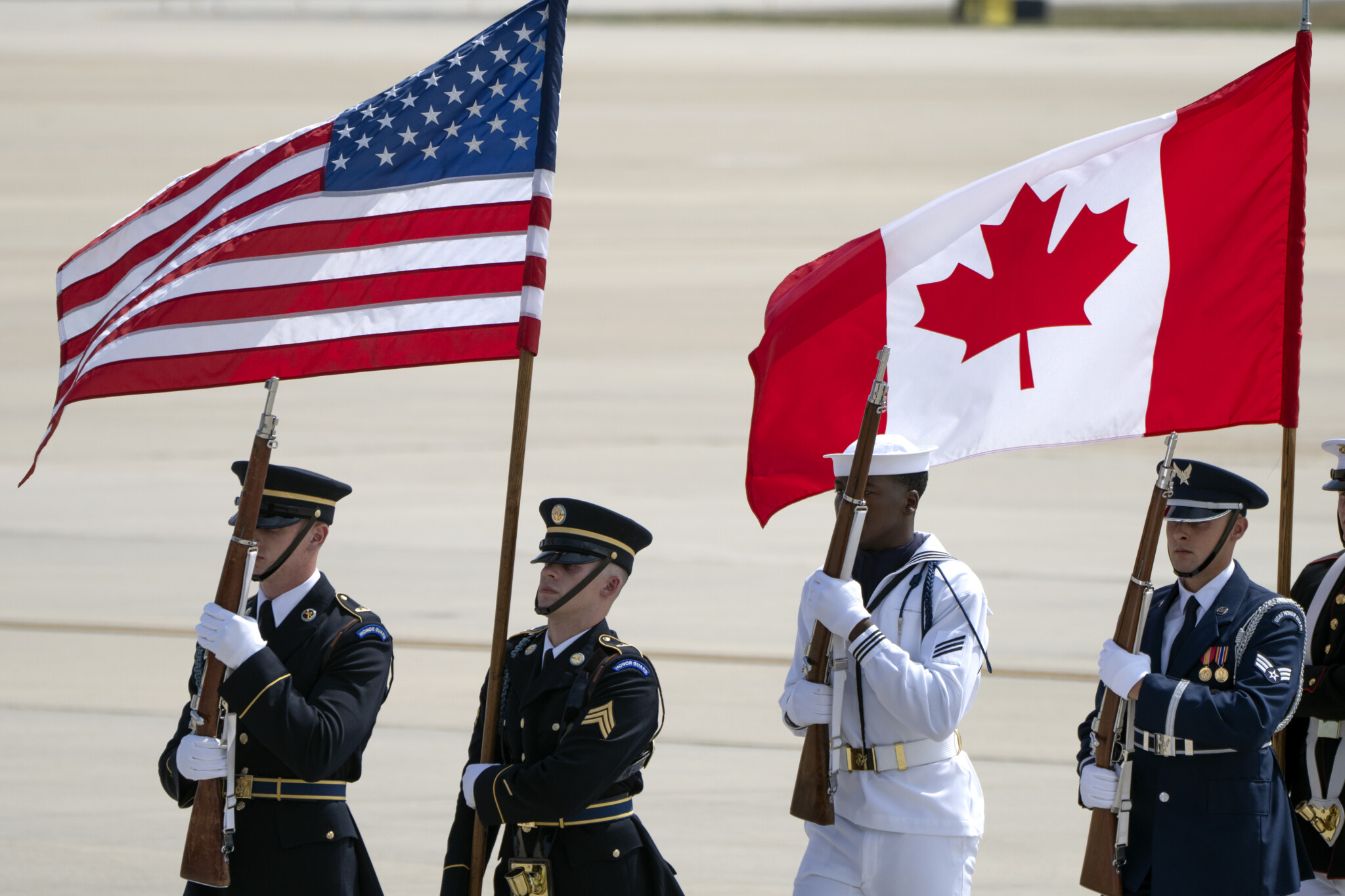
An honour guard marches in formation with U.S. and Canadian flags, July 8, 2024, at Andrews Air Force Base, Md. Mark Schiefelbein/AP Photo.
From the site of the IED, which was about as deep into hostile territory as there was, I was flown back to Kandahar Airfield (KAF). The American combat medics took me directly to the Role 3 hospital—think the modern version of M*A*S*H, some 50 years later. At the Role 3 Hospital, I was treated by Canadian and American doctors and nurses. A grey-haired full-bird American colonel medical officer, think M*A*S*H’s Colonel Potter, told me that there was no spinal damage, but that I would feel it in my back every time the weather changed for the rest of my life. Sixteen years later, he has proven clairvoyant, or at least proven himself a seasoned combat doctor.
While I was seeing “Colonel Potter,” an American Route Clearance Package, with vehicles designed to find and destroy IEDs, arrived at the site where we had hit our IED. While clearing the area, these American IED specialists found a second IED at the same intersection, likely saving further Canadian and/or American casualties. Unfortunately, they found the IED by detonating it. Fortunately, the route clearance vehicles are designed to deflect the blast of explosions, so the American soldiers only had their bells rung, with no further serious injuries.
Also arriving at the scene were Canadian IED specialists. These specialists collected IED materials and studied the tactics used by the Taliban. In doing so, technical analysis of the explosives and components allowed our allied effort to locate and destroy the IED cells and even start tracing where the finances for the Taliban were coming from. This intelligence cooperation undoubtedly saved many Canadian, American, and Allied lives.

Back at KAF, after less than 24 hours at Role 3, myself and two others from our vehicle were strategically evacuated on an American Galaxy aircraft, basically a flying intensive care unit. We were loaded onto the American flying hospital in the middle of the night. The last patient to join us on the flight was an American soldier who had been seriously injured by an IED elsewhere. He had had all four limbs amputated, and it was not certain he would survive the flight to the American military hospital in Bagram near Kabul. With one additional stop in Helmand Province, we also picked up several wounded British soldiers.
After a check-up at Bagram, myself and two others from my vehicle were flown to Landstuhl, Germany. Two of us stayed there for close to a week in the American military hospital there. While at Landstuhl, I missed my first daughter’s first birthday on 7 July. A few days later, I was flown to the University of Alberta Hospital in a Canadian Challenger jet configured for medical evacuation back home.
The threat from the Taliban in Kandahar Province, where Canada’s contributions were most concentrated, was as bad or worse than anywhere in Afghanistan. The day before we detonated an IED, we were rocketed and mortared by the Taliban. The mortar position was destroyed by Canadian artillery. The day before that, Canada Day, we drove through a Taliban ambush and destroyed the ambush position and its occupants. In separate incidents, we also took a detainee who was forcefully extorting locals and searched a compound, i.e., kicked down the door of a bad guy. A couple of days earlier, the Kandahar chief of police had been assassinated.
View reader comments (6)
The events I described cover only five days in Kandahar during the Taliban “fighting season.” My experience, while intense, pales in comparison to the intensity and duration of the experiences of the Canadian infantry battalions, companies, and platoons and the troopers, gunners, and sappers who were with them. It pales in comparison to the Canadian soldiers who deployed on foot with the Afghan National Army. And it contrasts even more greatly still with our special forces, who worked interchangeably with American and Allied special forces.
I do not begrudge the dangers and damage that I, and 40,000 other Canadian soldiers, sailors, aircrew, and special operators faced. We were there with our closest neighbour and ally.
In fact, my motivation for being in Afghanistan traces directly back to watching 9/11 unfold live on television in the midst of a brigade training exercise in Petawawa, Ontario, home of the 2 Canadian Mechanized Brigade Group. Immediately on that day of infamy, all of us wanted to deploy with our brothers in arms. But it took several more years before my unit rotated in amongst the more than 40,000 Canadians who eventually put their lives on the line to stand with our American comrades. Canada was the first to join the United States in Afghanistan, and we were there through thick and thin until 2014, 13 years in total.
Inside North America, at home in Canada, the focus is on contrasting Canadians with Americans. Outside our neighbourhood, however, in the rest of the world, it is amazing how apparent it is that Canadians and Americans share the same fundamental values.
This has been true for more than a century. I hope these values remain the same for another century and beyond.
We are far more alike than different.
With genuine respect,
Chad Rizzato, CD, MBA
Lieutenant-Colonel (Retired)
The service and sacrifices of Canadian soldiers who fought alongside Americans in Afghanistan should not be overlooked. Chad Rizzato recounts a personal experience on July 3, 2009, where a combined Canadian-American operation resulted in the death of Corporal Nick Bulger and severe injuries to himself and others. He highlights the deep integration of Canadian and American forces, the shared risks, and the extensive medical and logistical support provided by both nations. Rizzato emphasizes that Canada was the first to join the U.S. in Afghanistan and remained a steadfast ally for 13 years, underscoring the shared values and mutual respect between the two militaries.
How does the author's personal experience in Afghanistan highlight the deep integration of Canadian and American forces?
What does the article suggest about the long-term impact of shared military sacrifice on international relations?
Beyond combat, what other forms of cooperation between Canadian and American forces are highlighted in the article?




Comments (6)
Thank you for your service Lt Col Rizzato